QUESTION IMAGE
Question
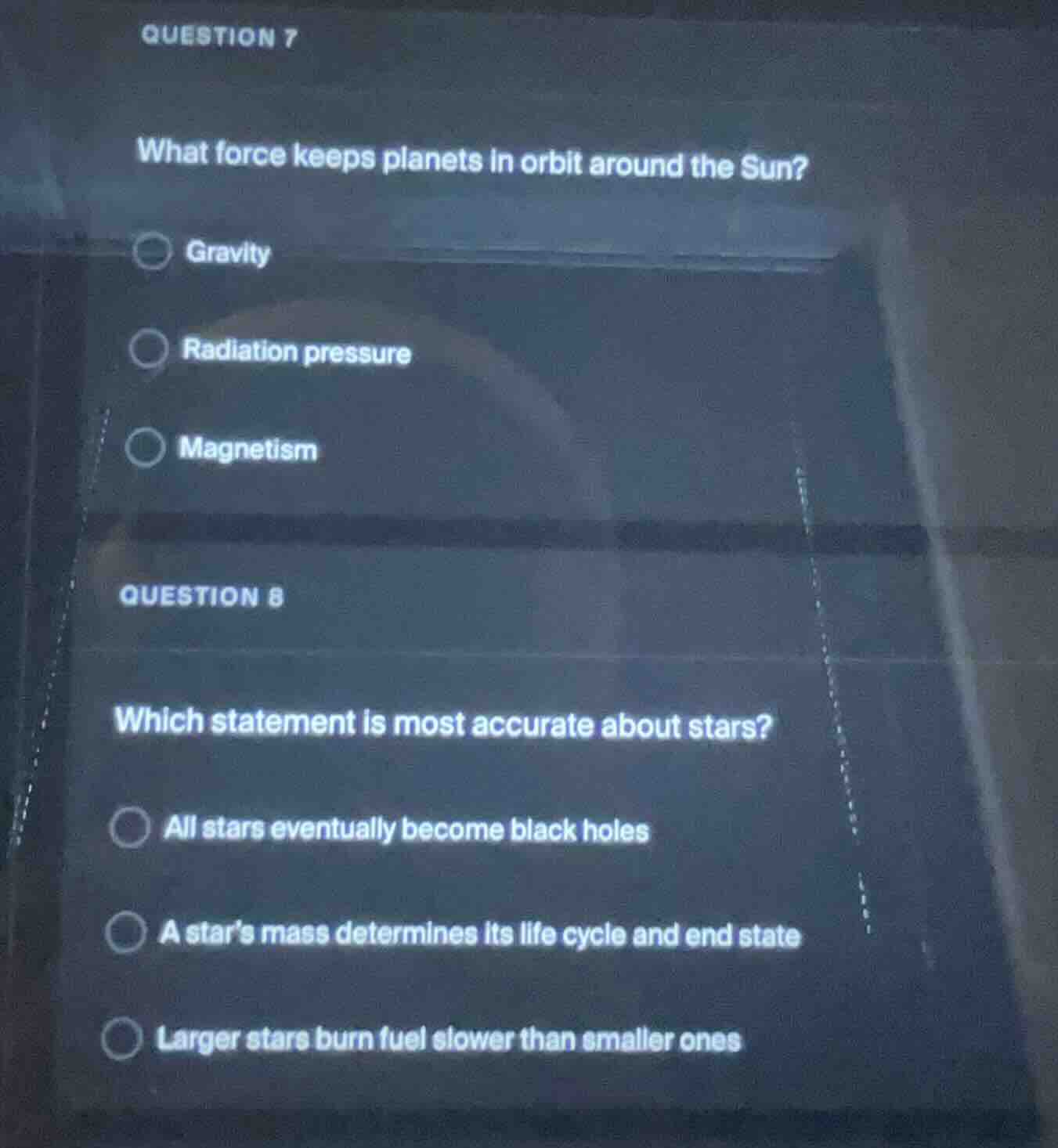
question 7
what force keeps planets in orbit around the sun?
○ gravity
○ radiation pressure
○ magnetism
question 8
which statement is most accurate about stars?
○ all stars eventually become black holes
○ a stars mass determines its life cycle and end state
○ larger stars burn fuel slower than smaller ones
Response
Question 7
Brief Explanations
To determine the force keeping planets in orbit around the Sun, we analyze each option:
- Gravity: The Sun's gravitational pull provides the centripetal force needed for planets to orbit.
- Radiation pressure: Involves pressure from electromagnetic radiation, not orbital motion.
- Magnetism: Relates to magnetic fields, not orbital mechanics.
So Gravity is correct.
Brief Explanations
To find the accurate statement about stars:
- "All stars eventually become black holes": False, only massive stars (typically >20 solar masses) may become black holes; smaller stars have different end states (e.g., white dwarfs, neutron stars).
- "A star's mass determines its life cycle and end state": True, mass dictates fusion processes, lifespan, and final form (e.g., low - mass stars become white dwarfs, high - mass stars can become neutron stars or black holes).
- "Larger stars burn fuel slower than smaller ones": False, larger stars have higher fusion rates and burn fuel faster.
So the second option is correct.

Snap & solve any problem in the app
Get step-by-step solutions on Sovi AI
Photo-based solutions with guided steps
Explore more problems and detailed explanations
A. Gravity