QUESTION IMAGE
Question
question
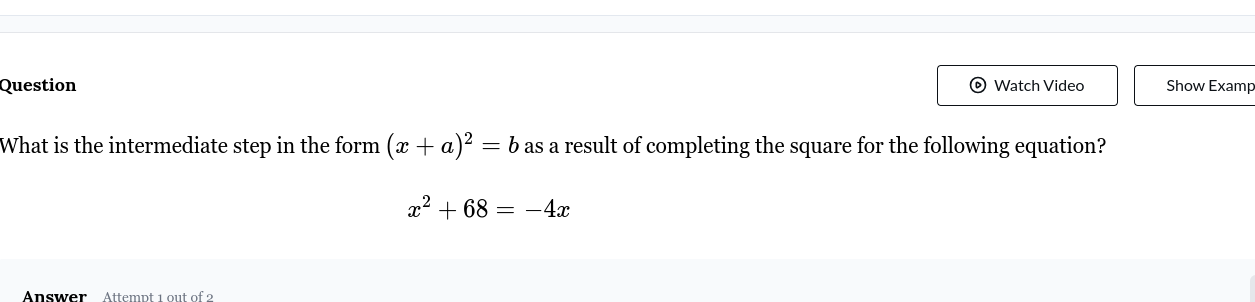
what is the intermediate step in the form ((x + a)^2 = b) as a result of completing the square for the following equation?
(x^2 + 68 = -4x)
answer attempt 1 out of 2
Step1: Rearrange the equation
First, we need to get all the \(x\)-terms on one side. Starting with the equation \(x^{2}+68 = - 4x\), we add \(4x\) to both sides to get \(x^{2}+4x + 68=0\), and then we can rewrite it as \(x^{2}+4x=-68\) (by subtracting 68 from both sides).
Step2: Complete the square
To complete the square for the expression \(x^{2}+4x\), we take half of the coefficient of \(x\), which is \(\frac{4}{2} = 2\), and then square it: \(2^{2}=4\). We add this value to both sides of the equation \(x^{2}+4x=-68\). So we get \(x^{2}+4x + 4=-68 + 4\).
Step3: Write in the form \((x + a)^{2}=b\)
The left - hand side \(x^{2}+4x + 4\) is a perfect square trinomial, which can be written as \((x + 2)^{2}\). The right - hand side is \(-68+4=-64\). So the equation in the form \((x + a)^{2}=b\) is \((x + 2)^{2}=-64\).

Snap & solve any problem in the app
Get step-by-step solutions on Sovi AI
Photo-based solutions with guided steps
Explore more problems and detailed explanations
\((x + 2)^{2}=-64\)