QUESTION IMAGE
Question
question 6
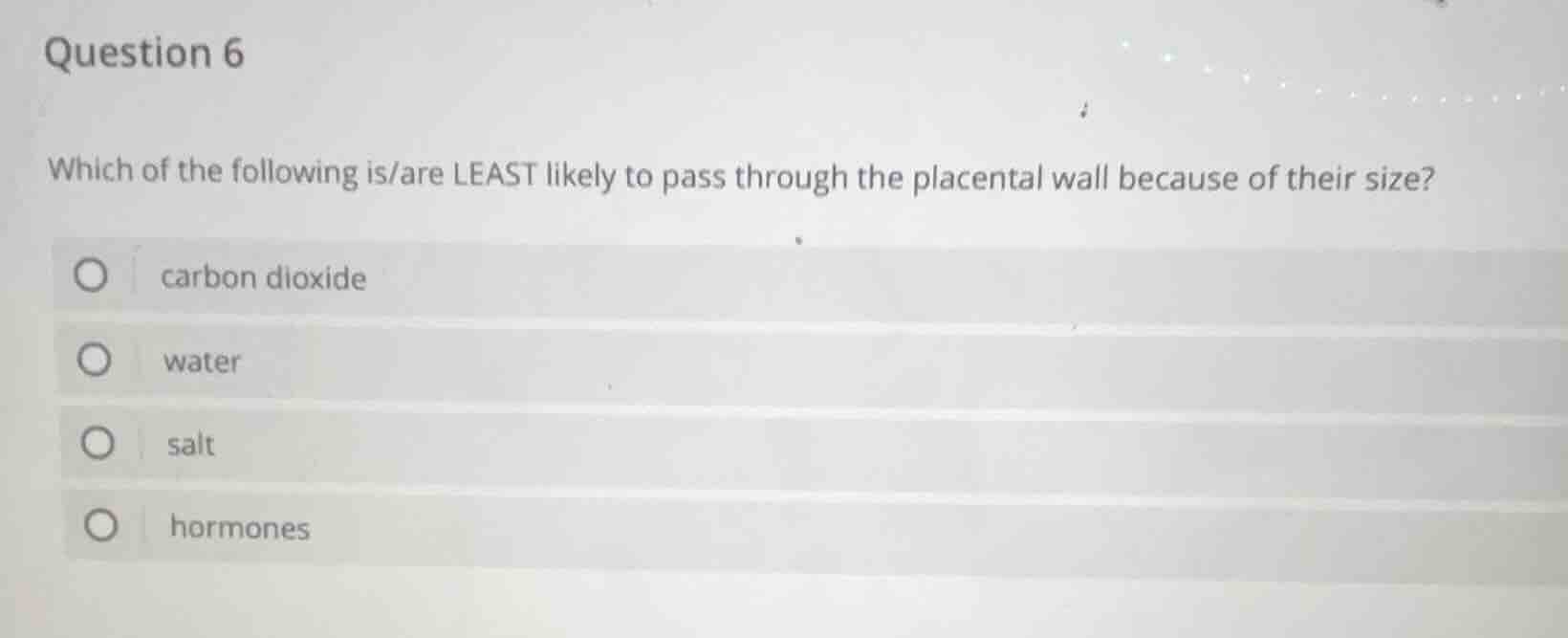
which of the following is/are least likely to pass through the placental wall because of their size?
○ carbon dioxide
○ water
○ salt
○ hormones
Brief Explanations
To determine which substance is least likely to pass through the placental wall due to size, we analyze the molecular/structural size of each option:
- Carbon dioxide ($\ce{CO_2}$) is a small gas molecule (linear, 3 atoms) and can diffuse easily.
- Water ($\ce{H_2O}$) is a small polar molecule and can pass via osmosis or diffusion.
- Salt (e.g., $\ce{NaCl}$) dissociates into ions ($\ce{Na+}$, $\ce{Cl-}$), which are small and can pass through ion channels or via diffusion.
- Hormones are typically larger molecules (e.g., protein - based hormones like insulin, or steroid hormones with more complex structures). Their larger size makes it harder for them to cross the placental wall compared to the other small molecules/ions.

Snap & solve any problem in the app
Get step-by-step solutions on Sovi AI
Photo-based solutions with guided steps
Explore more problems and detailed explanations
D. hormones