QUESTION IMAGE
Question
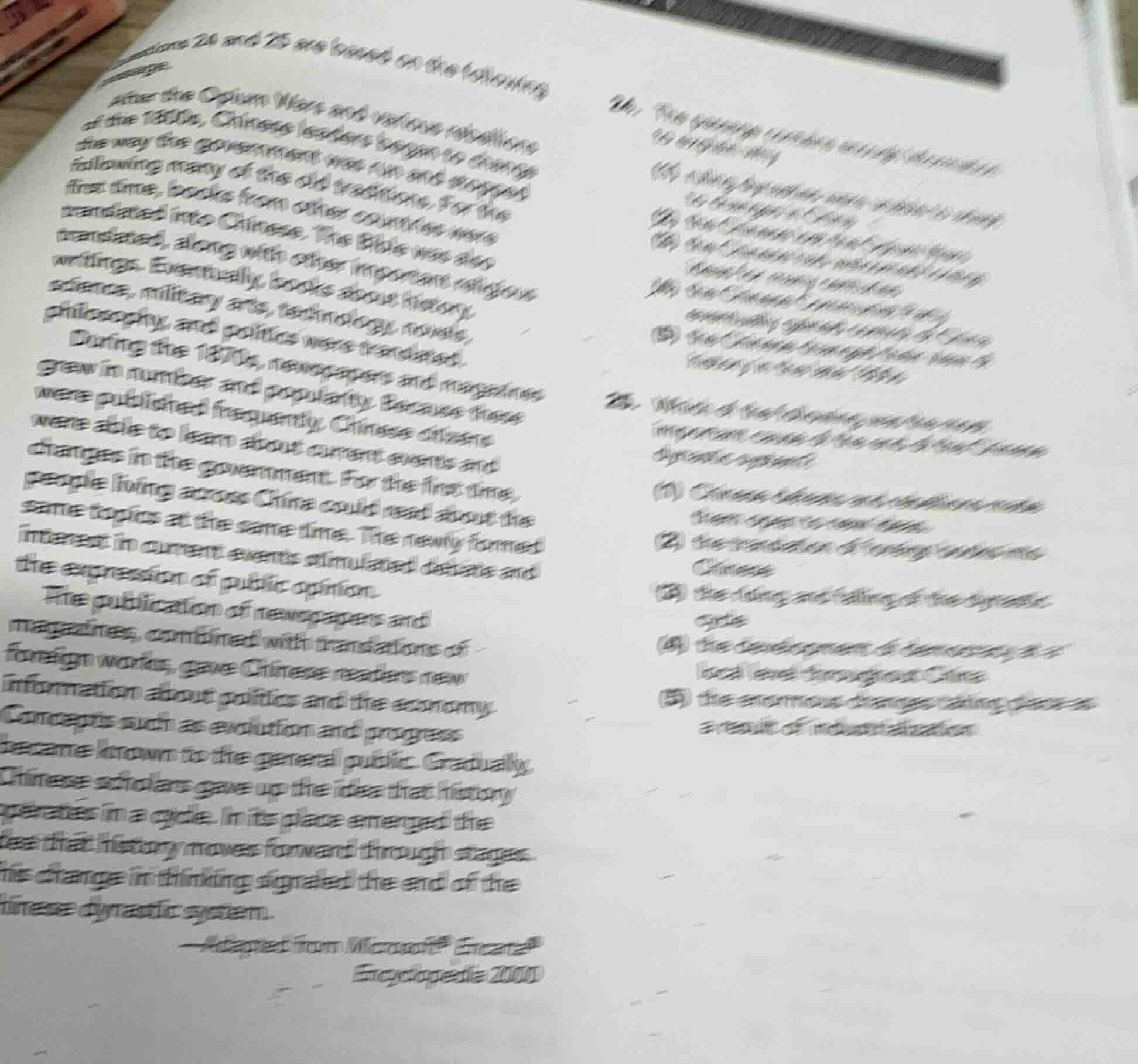
questions 24 and 25 are based on the following passage.
after the opium wars and various rebellions of the 1800s, chinese leaders began to change the way the government was run and stopped following many of the old traditions. for the first time, books from other countries were translated into chinese. the bible was also translated, along with other important religious writings. eventually, books about history, science, military arts, technology, novels, philosophy, and politics were translated.
during the 1870s, newspapers and magazines grew in number and popularity. because these were published frequently, chinese citizens were able to learn about current events and changes in the government. for the first time, people living across china could read about the same topics at the same time. the newly formed interest in current events stimulated debate and the expression of public opinion.
the publication of newspapers and magazines, combined with translations of foreign works, gave chinese readers new information about politics and the economy. concepts such as evolution and progress became known to the general public. gradually, chinese scholars gave up the idea that history operates in a cycle. in its place emerged the idea that history moves forward through stages. this change in thinking signaled the end of the chinese dynastic system.
—adapted from microsoft® encarta® encyclopedia 2000
- the passage contains enough information to explain why
(1) ruling dynasties were unable to adapt to changes in china
(2) the chinese lost the opium wars
(3) the chinese had maintained foreign ideas for many centuries
(4) the chinese communist party eventually gained control of china
(5) the chinese changed their view of history in the late 1800s
- which of the following was the most important cause of the end of the chinese dynastic system?
(1) chinese defeats and rebellions made them open to new ideas
(2) the translation of foreign books into chinese
(3) the rising and falling of the dynastic cycle
(4) the development of democracy at a local level throughout china
(5) the enormous changes taking place as a result of industrialization
For Question 24:
- (1) The passage does not explain why dynasties failed to adapt.
- (2) The passage does not detail why China lost the Opium Wars.
- (3) The passage does not address how long China had unchanged ideas.
- (4) The passage does not mention the Chinese Communist Party.
- (5) The passage states that after Opium Wars/rebellions, foreign books were translated, newspapers spread new ideas, and scholars shifted from cyclical history to linear progress, which explains the change in history views in the late 1800s.
For Question 25:
- (1) The passage opens with Opium Wars and rebellions leading to the end of old traditions, which allowed new ideas (translated books, newspapers) to spread, ultimately shifting historical thought and ending the dynastic system. This is the root cause.
- (2) Translation of foreign books was a result of the initial shocks of defeats/rebellions, not the most important cause.
- (3) The passage notes scholars abandoned the cyclical view, so this is not the cause of the system's end.
- (4) Local democracy is not mentioned in the passage.
- (5) Industrialization is not cited as a cause in the text.

Snap & solve any problem in the app
Get step-by-step solutions on Sovi AI
Photo-based solutions with guided steps
Explore more problems and detailed explanations
- (5) the Chinese changed their view of history in the late 1800s
- (1) Chinese defeats and rebellions made them open to new ideas