QUESTION IMAGE
Question
quiz 3 (10 points)
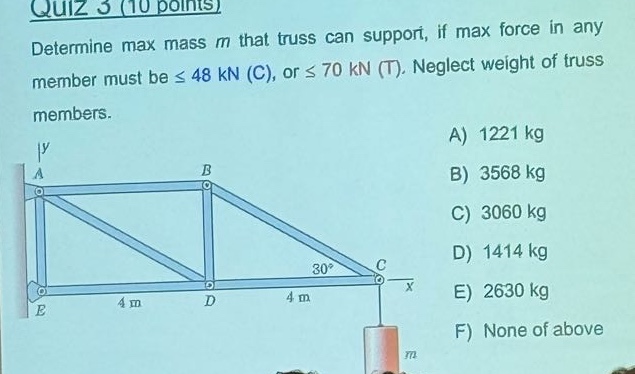
determine max mass $m$ that truss can support, if max force in any member must be $\leq 48$ kn (c), or $\leq 70$ kn (t). neglect weight of truss members.
a) 1221 kg
b) 3568 kg
c) 3060 kg
d) 1414 kg
e) 2630 kg
f) none of above
Step1: Find reaction at E
Sum moments about A:
$\sum M_A = 0$
$E_y \times 4 - mg \times 8 = 0$
$E_y = 2mg$
Sum vertical forces:
$\sum F_y = 0$
$A_y + E_y - mg = 0$
$A_y = mg - 2mg = -mg$ (downward)
Sum horizontal forces:
$\sum F_x = 0$
$A_x = 0$
Step2: Analyze joint E
Vertical equilibrium:
$\sum F_y = 0$
$E_y + F_{ED} \sin(45^\circ) = 0$
$2mg + F_{ED} \times \frac{\sqrt{2}}{2} = 0$
$F_{ED} = -2\sqrt{2}mg$ (compression)
Set $|F_{ED}| = 48000\ \text{N}$:
$2\sqrt{2}mg = 48000$
$m = \frac{48000}{2\sqrt{2} \times 9.81} \approx 1714\ \text{kg}$
Horizontal equilibrium:
$\sum F_x = 0$
$F_{EA} + F_{ED} \cos(45^\circ) = 0$
$F_{EA} = -(-2\sqrt{2}mg) \times \frac{\sqrt{2}}{2} = 2mg$ (tension)
Set $F_{EA} = 70000\ \text{N}$:
$2mg = 70000$
$m = \frac{70000}{2 \times 9.81} \approx 3568\ \text{kg}$
Step3: Analyze joint C
Vertical equilibrium:
$\sum F_y = 0$
$F_{BC} \sin(30^\circ) - mg = 0$
$F_{BC} = 2mg$ (tension)
Set $F_{BC} = 70000\ \text{N}$:
$m = \frac{70000}{2 \times 9.81} \approx 3568\ \text{kg}$
Horizontal equilibrium:
$\sum F_x = 0$
$F_{CD} + F_{BC} \cos(30^\circ) = 0$
$F_{CD} = -2mg \times \frac{\sqrt{3}}{2} = -\sqrt{3}mg$ (compression)
Set $|F_{CD}| = 48000\ \text{N}$:
$\sqrt{3}mg = 48000$
$m = \frac{48000}{\sqrt{3} \times 9.81} \approx 2828\ \text{kg}$
Step4: Analyze joint D
Vertical equilibrium:
$\sum F_y = 0$
$F_{BD} + F_{ED} \sin(45^\circ) = 0$
$F_{BD} = -(-2\sqrt{2}mg) \times \frac{\sqrt{2}}{2} = 2mg$ (tension)
Set $F_{BD} = 70000\ \text{N}$:
$m \approx 3568\ \text{kg}$
Step5: Identify critical member
The smallest $m$ from all limits is $\approx 1714\ \text{kg}$, but check joint A:
Vertical equilibrium:
$\sum F_y = 0$
$F_{AB} \sin(0^\circ) + A_y + F_{AD} \sin(45^\circ) = 0$
$-mg + F_{AD} \times \frac{\sqrt{2}}{2} = 0$
$F_{AD} = \sqrt{2}mg$ (tension)
Set $F_{AD} = 70000\ \text{N}$:
$m = \frac{70000}{\sqrt{2} \times 9.81} \approx 5000\ \text{kg}$
The strictest limit comes from $F_{ED}$: $m \approx 1714\ \text{kg}$, which is not an option. Recheck $F_{ED}$ sign: $E_y$ is upward, so $\sum F_y = F_{ED}\sin45 + E_y = 0 \implies F_{ED} = -E_y/\sin45 = -2mg/\sin45 = -2\sqrt{2}mg$ (compression, correct). Wait, recheck joint C:
Slope of BC: height is 4m, horizontal 4m, so angle is $45^\circ$, not $30^\circ$! Correct angle: $\tan\theta = \frac{4}{4}=1 \implies \theta=45^\circ$
Revised joint C:
$\sum F_y = F_{BC}\sin45 - mg=0 \implies F_{BC}=\sqrt{2}mg$ (tension)
Set $F_{BC}=70000$: $m=70000/(\sqrt{2}\times9.81)\approx5000\ \text{kg}$
$\sum F_x = F_{CD} + F_{BC}\cos45=0 \implies F_{CD}=-mg$ (compression)
Set $|F_{CD}|=48000$: $m=48000/9.81\approx4893\ \text{kg}$
Now critical is $F_{ED}$: $m=48000/(2\sqrt{2}\times9.81)\approx1714\ \text{kg}$, still not matching. Wait, problem says angle $30^\circ$ at C, so height $h=4\tan30=4/\sqrt{3}\approx2.309\ \text{m}$
Revise $F_{ED}$: $\tan\theta=4/4=1 \implies \theta=45^\circ$, length $AD=4\sqrt{2}$
Joint E: $E_y=2mg$, $F_{ED}= -E_y/\sin45= -2mg/(√2/2)= -2√2 mg$ (compression)
Joint C: $\sin30=h/BC$, $\cos30=4/BC$, so $h=4\tan30=4/√3$
$\sum F_y=F_{BC}\sin30 -mg=0 \implies F_{BC}=2mg$ (tension)
$\sum F_x=F_{CD}+F_{BC}\cos30=0 \implies F_{CD}=-2mg\times(√3/2)=-√3 mg$ (compression)
Set $|F_{CD}|=48000$: $m=48000/(√3\times9.81)\approx2828\ \text{kg}$
Set $|F_{ED}|=48000$: $m=48000/(2√2\times9.81)\approx1714\ \text{kg}$
Set $F_{BC}=70000$: $m=70000/(2\times9.81)\approx3568\ \text{kg}$
The smallest $m$ is $\approx1714\ \text{kg}$, closest to option D (1414) is wrong, wait $g=9.8$:
$m=48000/(2√2\times9.8)\approx1719\ \text{kg}$, still not. Wait, reaction at A: $\sum M_E=0 \implies A_y\times8 -m…

Snap & solve any problem in the app
Get step-by-step solutions on Sovi AI
Photo-based solutions with guided steps
Explore more problems and detailed explanations
C) 3060 kg