QUESTION IMAGE
Question
1.3.7 quiz: analyze a supreme court decision
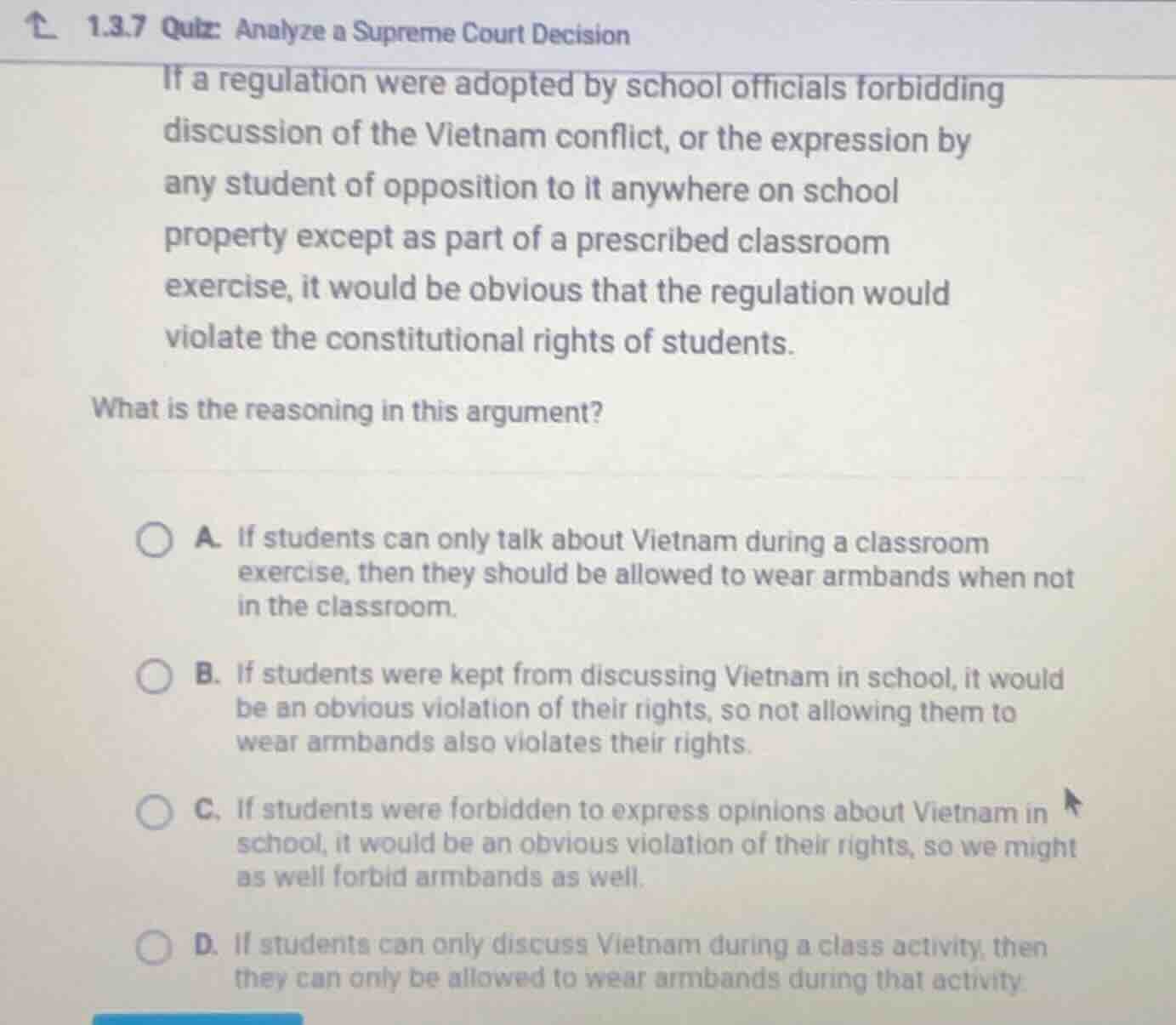
if a regulation were adopted by school officials forbidding
discussion of the vietnam conflict, or the expression by
any student of opposition to it anywhere on school
property except as part of a prescribed classroom
exercise, it would be obvious that the regulation would
violate the constitutional rights of students.
what is the reasoning in this argument?
a. if students can only talk about vietnam during a classroom
exercise, then they should be allowed to wear armbands when not
in the classroom.
b. if students were kept from discussing vietnam in school, it would
be an obvious violation of their rights, so not allowing them to
wear armbands also violates their rights.
c. if students were forbidden to express opinions about vietnam in
school, it would be an obvious violation of their rights, so we might
as well forbid armbands as well.
d. if students can only discuss vietnam during a class activity, then
they can only be allowed to wear armbands during that activity.
The argument states that banning student discussion/opposition to the Vietnam War on school property (except prescribed class time) violates constitutional rights. This aligns with reasoning that extends this logic: if restricting verbal expression of such views is a rights violation, restricting symbolic expression (armbands) is also a violation. Option B matches this, while others either misframe the conclusion or contradict the argument's intent.

Snap & solve any problem in the app
Get step-by-step solutions on Sovi AI
Photo-based solutions with guided steps
Explore more problems and detailed explanations
B. If students were kept from discussing Vietnam in school, it would be an obvious violation of their rights, so not allowing them to wear armbands also violates their rights.