QUESTION IMAGE
Question
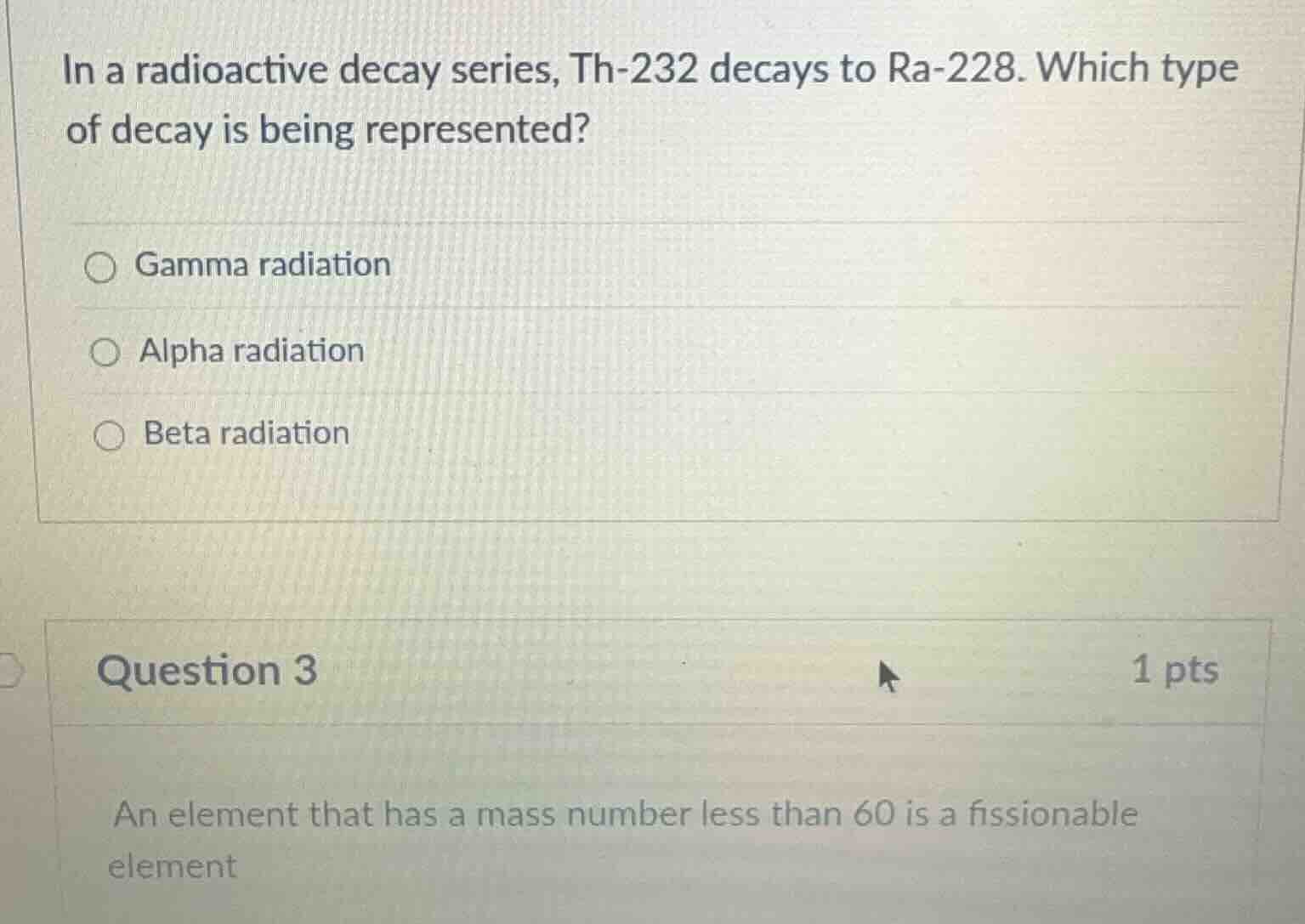
in a radioactive decay series, th-232 decays to ra-228. which type of decay is being represented?
○ gamma radiation
○ alpha radiation
○ beta radiation
question 3
1 pts
an element that has a mass number less than 60 is a fissionable element
For the first question (decay type):
- Recall decay types:
- Alpha decay: Emits a helium nucleus ($\ce{^4_2He}$), so mass number decreases by 4, atomic number by 2.
- Beta decay: Emits an electron ($\ce{^0_{-1}e}$), mass number unchanged, atomic number increases by 1.
- Gamma decay: No change in mass/atomic number (energy release).
- Analyze Th-232 (Th: atomic number 90, mass 232) to Ra-228 (Ra: atomic number 88, mass 228):
- Mass number change: \( 232 - 228 = 4 \).
- Atomic number change: \( 90 - 88 = 2 \).
- Match to decay: This matches alpha decay (mass -4, atomic -2). Gamma and beta do not fit.
Fission involves splitting heavy nuclei. Light elements (mass < 60) lack sufficient nucleons for fission; they are fusion - prone. Thus, the statement is incorrect.

Snap & solve any problem in the app
Get step-by-step solutions on Sovi AI
Photo-based solutions with guided steps
Explore more problems and detailed explanations
B. Alpha radiation
For the second question (fissionable element):
(Note: The statement is false. Fissionable elements typically have high mass numbers (e.g., U-235, Pu-239), while light elements (mass < 60) are more likely to undergo fusion, not fission.)