QUESTION IMAGE
Question
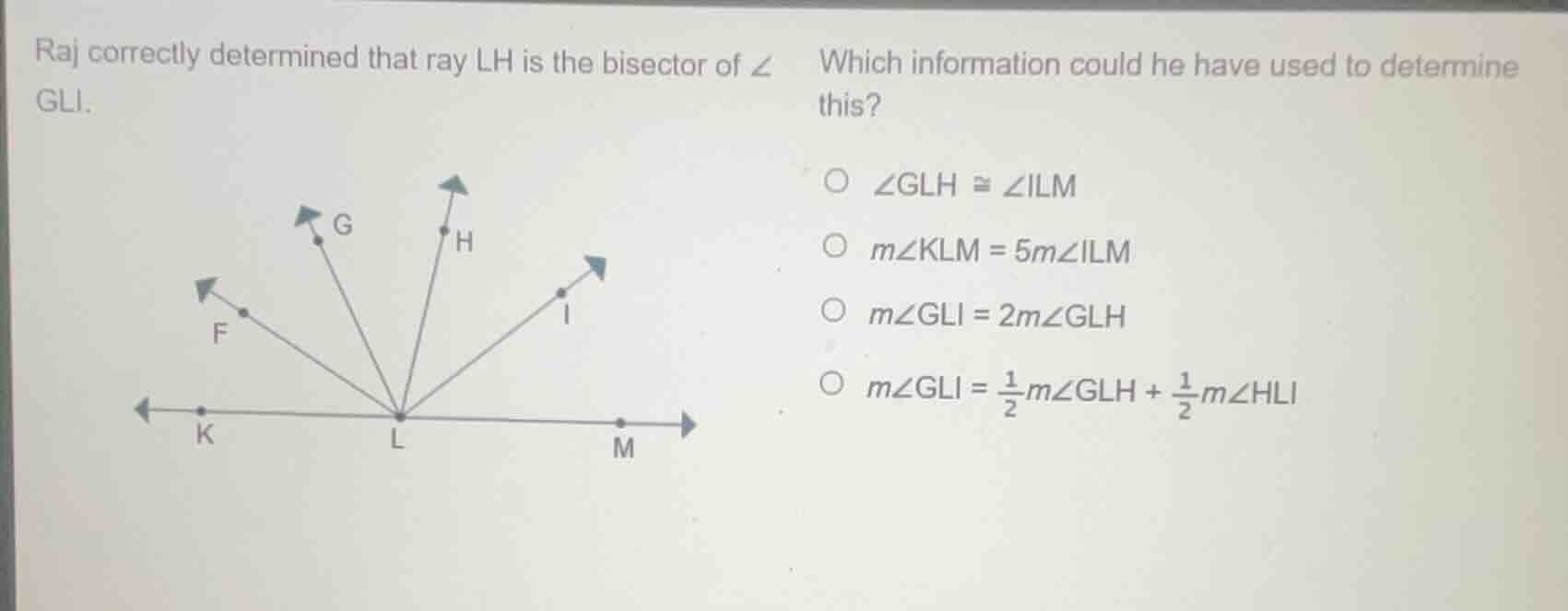
raj correctly determined that ray lh is the bisector of ∠ gli. which information could he have used to determine this? ∠glh ≅ ∠ilm m∠klm = 5m∠ilm m∠gli = 2m∠glh m∠gli = \\(\frac{1}{2}\\)m∠glh + \\(\frac{1}{2}\\)m∠hli
To determine if ray \( LH \) bisects \( \angle GLI \), we need to recall the definition of an angle bisector: a ray that divides an angle into two equal - measure angles. So, if \( LH \) bisects \( \angle GLI \), then \( \angle GLH=\angle HLI \) and \( m\angle GLI = m\angle GLH + m\angle HLI=2m\angle GLH \) (since \( m\angle GLH = m\angle HLI \)).
- For the option \( \angle GLH\cong\angle ILM \): There is no direct relation between \( \angle GLH \) and \( \angle ILM \) to show that \( LH \) bisects \( \angle GLI \).
- For the option \( m\angle KLM = 5m\angle ILM \): This gives information about \( \angle KLM \) and \( \angle ILM \), not related to the bisection of \( \angle GLI \) by \( LH \).
- For the option \( m\angle GLI = 2m\angle GLH \): By the definition of an angle bisector, if a ray divides an angle into two equal - measure angles, then the measure of the original angle is twice the measure of one of the smaller angles. Here, if \( m\angle GLI = 2m\angle GLH \), it implies that \( LH \) divides \( \angle GLI \) into two angles \( \angle GLH \) and \( \angle HLI \) such that \( m\angle GLH=m\angle HLI \) (because \( m\angle GLI=m\angle GLH + m\angle HLI \) and \( m\angle GLI = 2m\angle GLH \), so \( m\angle HLI=m\angle GLH \)).
- For the option \( m\angle GLI=\frac{1}{2}m\angle GLH+\frac{1}{2}m\angle HLI \): Rearranging, we get \( 2m\angle GLI=m\angle GLH + m\angle HLI \), which is not consistent with the angle addition postulate (since \( m\angle GLI=m\angle GLH + m\angle HLI \)) unless \( m\angle GLI = 0 \), which is not possible.

Snap & solve any problem in the app
Get step-by-step solutions on Sovi AI
Photo-based solutions with guided steps
Explore more problems and detailed explanations
\( m\angle GLI = 2m\angle GLH \) (the third option)