QUESTION IMAGE
Question
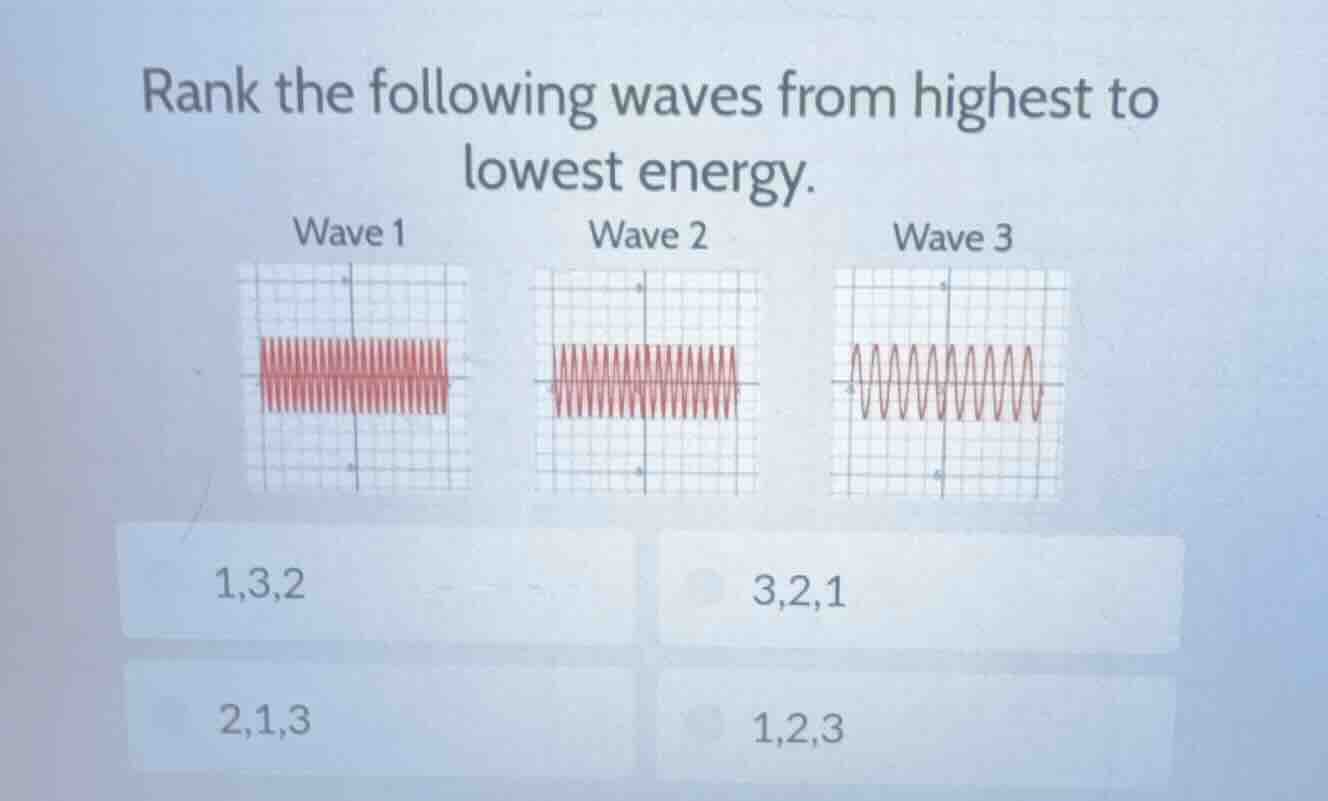
rank the following waves from highest to lowest energy.
wave 1 wave 2 wave 3
1,3,2 3,2,1
2,1,3 1,2,3
Step1: Recall energy - frequency relation
The energy of a wave (for electromagnetic waves, and this concept also applies to other waves in terms of the relationship between energy and frequency) is related to its frequency by the formula \(E = h
u\) (where \(E\) is energy, \(h\) is Planck's constant, and \(
u\) is frequency). Higher frequency means higher energy. Frequency is related to the number of cycles per unit length (in the case of these graphs, we can count the number of cycles in the given grid - like region).
Step2: Count the number of cycles for each wave
- Wave 1: Let's count the number of cycles. Looking at the graph, Wave 1 has the most number of cycles (the most densely packed waves), so it has the highest frequency.
- Wave 3: Wave 3 has fewer cycles than Wave 1 but more than Wave 2? Wait, no, let's re - examine. Wait, actually, when we look at the three waves:
- Wave 1: The number of oscillations (cycles) in the given horizontal length is the highest.
- Wave 2: The number of cycles is less than Wave 1.
- Wave 3: Wait, no, maybe I made a mistake. Wait, actually, the frequency is determined by how many times the wave oscillates in a given period. Let's look at the graphs again. Wave 1 has the most cycles (highest frequency), then Wave 3, then Wave 2? No, wait, maybe the correct way is: the more cycles per unit length, the higher the frequency. Let's count the number of peaks (or troughs) for each wave in the same horizontal span.
- Wave 1: Let's assume the horizontal span is the same for all three waves. Wave 1 has the maximum number of cycles (so highest frequency, hence highest energy).
- Wave 3: Then Wave 3 has more cycles than Wave 2. Wait, no, looking at the options, the options are 1,3,2; 3,2,1; 2,1,3; 1,2,3.
Wait, maybe I messed up. Let's re - think. The energy of a wave is also related to its amplitude, but in the formula \(E=\frac{1}{2}kA^{2}\) for mechanical waves (where \(k\) is a constant related to the medium and \(A\) is amplitude) and for electromagnetic waves, \(E = h
u\) (frequency - based). But in the case of these graphs, if we consider the frequency (number of cycles per unit length):
- Wave 1: Highest frequency (most cycles)
- Wave 3: Next highest
- Wave 2: Lowest frequency
So the order from highest to lowest energy is Wave 1, Wave 3, Wave 2? Wait, no, the options include 1,3,2. Wait, let's check the number of cycles again.
Looking at the three waves:
- Wave 1: The waves are the most closely packed (highest frequency)
- Wave 3: The waves are more spread out than Wave 1 but more packed than Wave 2? No, wait, maybe the correct count is:
- Wave 1: Let's say in the given horizontal length, Wave 1 has, for example, 15 cycles, Wave 3 has 10 cycles, and Wave 2 has 8 cycles. Then the frequency order is Wave 1 > Wave 3 > Wave 2, so energy order is Wave 1 > Wave 3 > Wave 2, which corresponds to the option 1,3,2. Wait, but let's check the options again. The options are:
- 1,3,2
- 3,2,1
- 2,1,3
- 1,2,3
Wait, maybe I made a mistake in the cycle count. Let's look at the graphs again. Wave 1: the waves are very close together (highest frequency), Wave 3: the waves are less close than Wave 1 but more close than Wave 2? No, maybe the correct answer is 1,3,2. Wait, but let's recall that the energy of a wave is proportional to the square of the amplitude and the square of the frequency. But in these graphs, the amplitude (the height of the wave from the mid - line) of Wave 3 is higher than Wave 1 and Wave 2. Wait, maybe I ignored the amplitude. Oh! Right, for…

Snap & solve any problem in the app
Get step-by-step solutions on Sovi AI
Photo-based solutions with guided steps
Explore more problems and detailed explanations
1,3,2