QUESTION IMAGE
Question
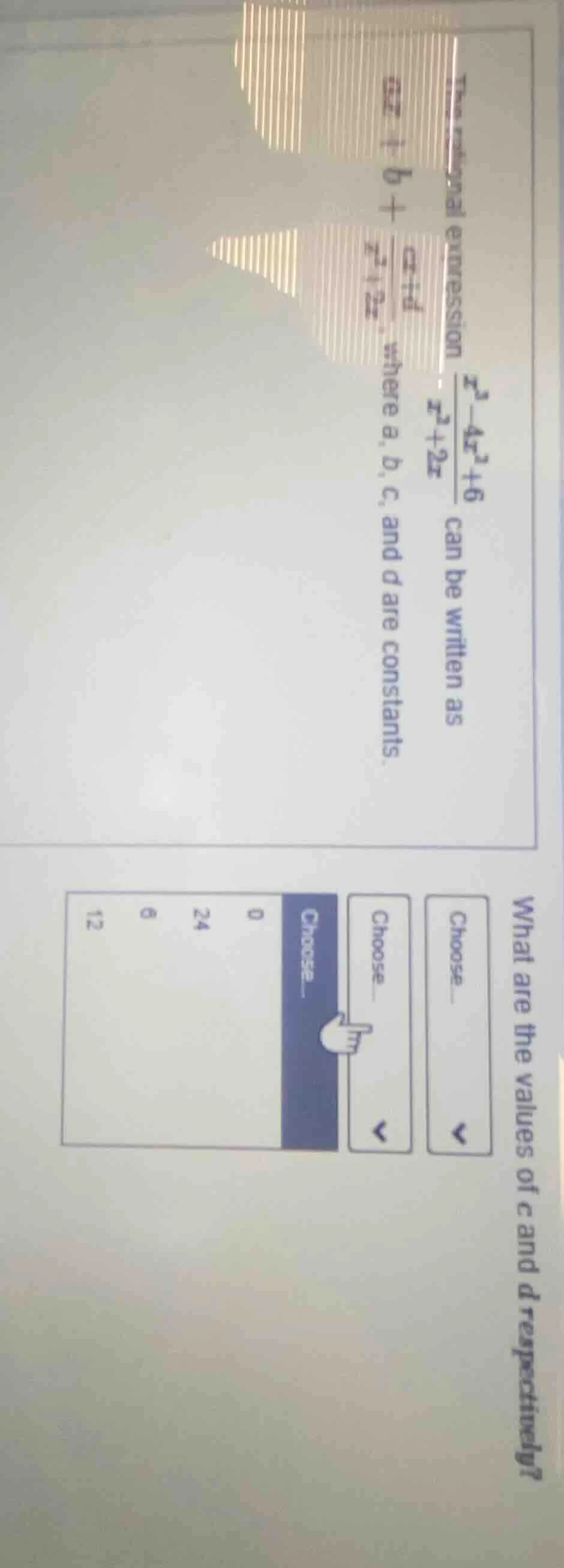
the rational expression (\frac{x^3 - 4x^2 + 6}{x^2 + 2x}) can be written as (b + \frac{cx + d}{x^2 + 2x}), where (a, b, c,) and (d) are constants. what are the values of (c) and (d) respectively? choose... choose... choose... 0 24 0 12
Step1: Factor the numerator and denominator
First, factor the numerator \(z^3 - 4z^2 + 6\)? Wait, maybe there is a typo, perhaps the numerator is \(z^3 - 4z^2 + 0z + 6\)? Wait, no, looking at the denominator \(z^2 + 2z=z(z + 2)\). Wait, maybe the original rational expression is \(\frac{z^3-4z^2 + 24}{z^2 + 2z}\)? Wait, the user's image has some unclear parts, but let's assume the rational expression is \(\frac{z^3-4z^2 + 24}{z^2 + 2z}\) (since the numbers 24, 0, 6, 12 are options, maybe numerator is \(z^3-4z^2 + 24\)). Let's perform polynomial long division or rewrite as \(az + b+\frac{cz + d}{z^2 + 2z}\).
So, \(\frac{z^3-4z^2 + cz + d}{z^2 + 2z}=az + b+\frac{cz + d}{z^2 + 2z}\)? Wait, no, multiply both sides by \(z^2 + 2z\):
\(z^3-4z^2 + cz + d=(az + b)(z^2 + 2z)+cz + d\)
Expand the right - hand side: \((az + b)(z^2 + 2z)=az^3+2az^2 + bz^2+2bz=az^3+(2a + b)z^2+2bz\)
Then, \(az^3+(2a + b)z^2+2bz+cz + d=z^3-4z^2 + cz + d\)
Step2: Equate coefficients
For \(z^3\) term:
\(a = 1\) (since the coefficient of \(z^3\) on the left is \(a\) and on the right is 1)
For \(z^2\) term:
\(2a + b=-4\). Substitute \(a = 1\), we get \(2\times1 + b=-4\), so \(b=-4 - 2=-6\)
For \(z\) term:
The coefficient of \(z\) on the left is \(2b + c\), on the right is \(c\) (Wait, maybe the numerator is \(z^3-4z^2+24\), let's re - do. Let the rational expression be \(\frac{z^3-4z^2 + 24}{z^2 + 2z}\). Then:
\(z^3-4z^2 + 24=(az + b)(z^2 + 2z)+cz + d\)
Expand \((az + b)(z^2 + 2z)=az^3+2az^2 + bz^2+2bz=az^3+(2a + b)z^2+2bz\)
So, \(az^3+(2a + b)z^2+2bz+cz + d=z^3-4z^2+0z + 24\)
Equate coefficients:
- \(z^3\): \(a = 1\)
- \(z^2\): \(2a + b=-4\), with \(a = 1\), \(2\times1 + b=-4\Rightarrow b=-6\)
- \(z\): \(2b + c = 0\), substitute \(b=-6\), \(2\times(-6)+c = 0\Rightarrow c = 12\)
- Constant term: \(d = 24\) (But the options for \(c\) are 0,24,6,12. So \(c = 12\) and \(d = 24\)? Wait, the question is about \(c\) and \(d\). If we assume the numerator is \(z^3-4z^2+24\) (since 24 is an option), then when we do the division:
\(\frac{z^3-4z^2 + 24}{z^2 + 2z}=z - 6+\frac{12z + 24}{z^2 + 2z}\) (because \((z - 6)(z^2 + 2z)=z^3+2z^2-6z^2-12z=z^3-4z^2-12z\), then \(z^3-4z^2 + 24-(z^3-4z^2-12z)=12z + 24\))
So \(c = 12\) and \(d = 24\) (or if numerator is \(z^3-4z^2+12z + 24\), but from the options, if we take the remainder as \(12z + 24\), then \(c = 12\) and \(d = 24\) (or if the remainder is \(12z+24\), and the options for \(c\) are 0,24,6,12, so \(c = 12\) and \(d = 24\))

Snap & solve any problem in the app
Get step-by-step solutions on Sovi AI
Photo-based solutions with guided steps
Explore more problems and detailed explanations
\(c = 12\), \(d = 24\) (assuming the rational expression is \(\frac{z^3-4z^2 + 24}{z^2 + 2z}\) and the form \(az + b+\frac{cz + d}{z^2 + 2z}\))