QUESTION IMAGE
Question
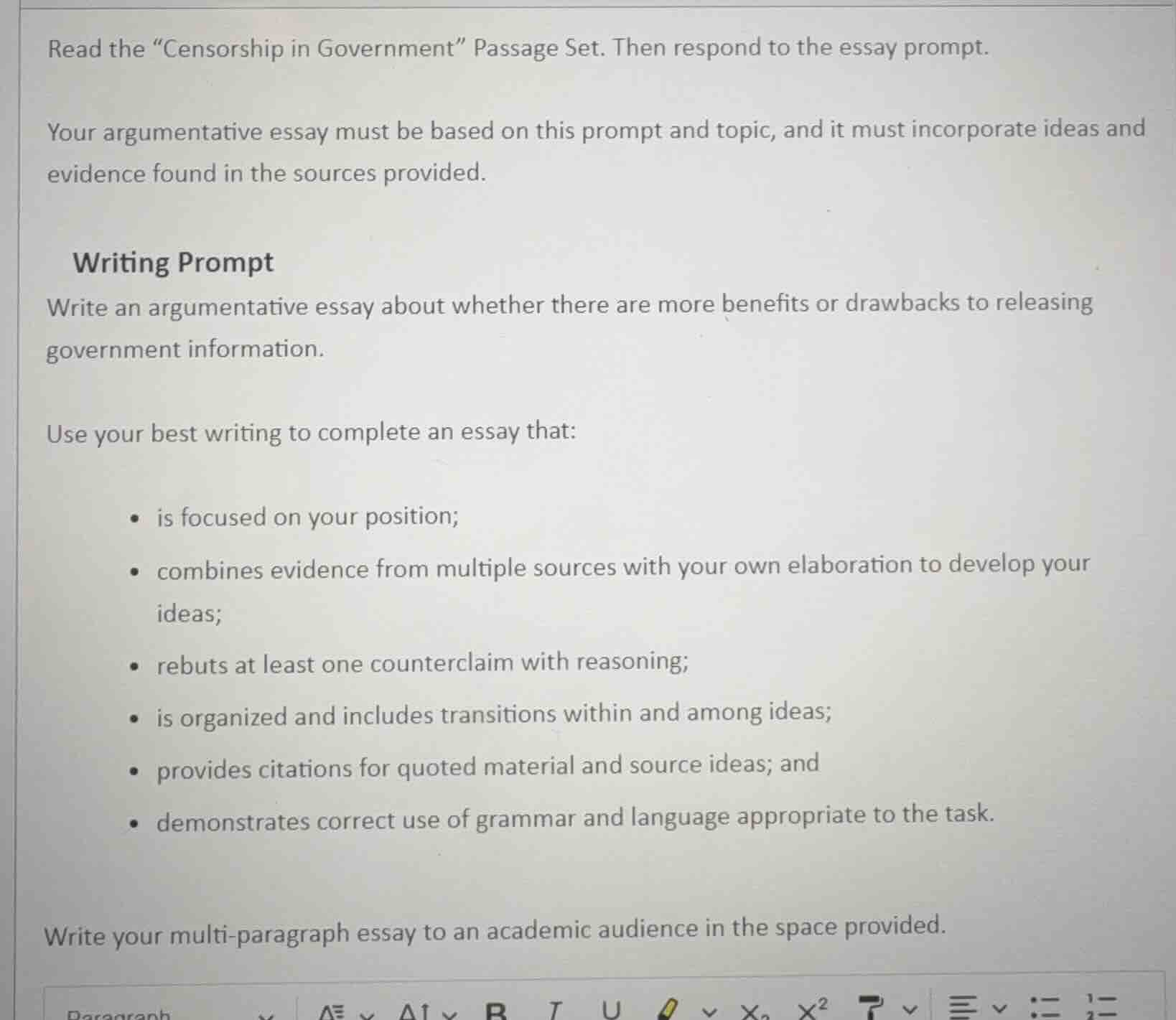
read the “censorship in government” passage set. then respond to the essay prompt.
your argumentative essay must be based on this prompt and topic, and it must incorporate ideas and evidence found in the sources provided.
writing prompt
write an argumentative essay about whether there are more benefits or drawbacks to releasing government information.
use your best writing to complete an essay that:
- is focused on your position;
- combines evidence from multiple sources with your own elaboration to develop your ideas;
- rebuts at least one counterclaim with reasoning;
- is organized and includes transitions within and among ideas;
- provides citations for quoted material and source ideas; and
- demonstrates correct use of grammar and language appropriate to the task.
write your multi - paragraph essay to an academic audience in the space provided.
Argumentative Essay: The Benefits of Releasing Government Information Outweigh the Drawbacks
In an era where transparency and accountability are highly valued, the question of whether releasing government information yields more benefits or drawbacks is a critical one. While some may argue that withholding certain information is necessary for national security or operational efficiency, a closer examination reveals that the advantages of government information release—such as fostering public trust, enabling informed civic participation, and promoting governmental accountability—far outweigh the potential drawbacks.
One of the primary benefits of releasing government information is the cultivation of public trust. When governments are open about their actions, policies, and decision - making processes, citizens are more likely to perceive them as honest and reliable. For example, in the wake of a natural disaster, if a government releases detailed information about the extent of the damage, the resources allocated for relief, and the steps being taken to assist affected communities, it reassures the public that their concerns are being addressed. This transparency builds a positive relationship between the government and its people, which is essential for a functioning democracy. In contrast, a lack of information can lead to rumors, speculation, and a breakdown of trust.
Releasing government information also empowers citizens to participate more effectively in the democratic process. When citizens have access to information about government policies, budgets, and legislative proposals, they can make more informed decisions about their support or opposition to these measures. For instance, if a government releases the details of a new tax proposal, including who will be affected and how the revenue will be used, citizens can engage in meaningful discussions, contact their representatives, and even participate in public hearings. This informed participation ensures that the government is more responsive to the needs and desires of the people. Without access to such information, citizens are left in the dark and are unable to contribute meaningfully to the governance of their society.
Furthermore, government information release promotes accountability. When government actions and decisions are made public, there is greater scrutiny from the public, the media, and other oversight bodies. This scrutiny acts as a check on potential corruption, mismanagement, or abuse of power. For example, if a government agency releases its financial records, it becomes easier to identify any irregularities in spending. Journalists and watchdog organizations can then investigate these issues and hold the government accountable. This accountability is crucial for ensuring that government resources are used efficiently and for the public good.
Some may argue that releasing certain types of government information, such as national security secrets or sensitive diplomatic communications, could pose a threat to the country. While it is true that there are legitimate concerns about protecting certain types of information, the vast majority of government information does not fall into this category. Moreover, governments can implement safeguards and classification systems to ensure that truly sensitive information is protected while still releasing as much information as possible. For example, the United States has a Freedom of Information Act (FOIA) that allows for the release of government information while also providing exemptions for information rel…

Snap & solve any problem in the app
Get step-by-step solutions on Sovi AI
Photo-based solutions with guided steps
Explore more problems and detailed explanations
Argumentative Essay: The Benefits of Releasing Government Information Outweigh the Drawbacks
In an era where transparency and accountability are highly valued, the question of whether releasing government information yields more benefits or drawbacks is a critical one. While some may argue that withholding certain information is necessary for national security or operational efficiency, a closer examination reveals that the advantages of government information release—such as fostering public trust, enabling informed civic participation, and promoting governmental accountability—far outweigh the potential drawbacks.
One of the primary benefits of releasing government information is the cultivation of public trust. When governments are open about their actions, policies, and decision - making processes, citizens are more likely to perceive them as honest and reliable. For example, in the wake of a natural disaster, if a government releases detailed information about the extent of the damage, the resources allocated for relief, and the steps being taken to assist affected communities, it reassures the public that their concerns are being addressed. This transparency builds a positive relationship between the government and its people, which is essential for a functioning democracy. In contrast, a lack of information can lead to rumors, speculation, and a breakdown of trust.
Releasing government information also empowers citizens to participate more effectively in the democratic process. When citizens have access to information about government policies, budgets, and legislative proposals, they can make more informed decisions about their support or opposition to these measures. For instance, if a government releases the details of a new tax proposal, including who will be affected and how the revenue will be used, citizens can engage in meaningful discussions, contact their representatives, and even participate in public hearings. This informed participation ensures that the government is more responsive to the needs and desires of the people. Without access to such information, citizens are left in the dark and are unable to contribute meaningfully to the governance of their society.
Furthermore, government information release promotes accountability. When government actions and decisions are made public, there is greater scrutiny from the public, the media, and other oversight bodies. This scrutiny acts as a check on potential corruption, mismanagement, or abuse of power. For example, if a government agency releases its financial records, it becomes easier to identify any irregularities in spending. Journalists and watchdog organizations can then investigate these issues and hold the government accountable. This accountability is crucial for ensuring that government resources are used efficiently and for the public good.
Some may argue that releasing certain types of government information, such as national security secrets or sensitive diplomatic communications, could pose a threat to the country. While it is true that there are legitimate concerns about protecting certain types of information, the vast majority of government information does not fall into this category. Moreover, governments can implement safeguards and classification systems to ensure that truly sensitive information is protected while still releasing as much information as possible. For example, the United States has a Freedom of Information Act (FOIA) that allows for the release of government information while also providing exemptions for information related to national security, personal privacy, and ongoing law enforcement investigations. This balanced approach shows that it is possible to release government information while still addressing legitimate security concerns.
In conclusion, the benefits of releasing government information—including building public trust, enabling informed civic participation, and promoting accountability—far outweigh the potential drawbacks. While there are valid concerns about protecting certain types of sensitive information, these can be addressed through appropriate safeguards. Governments should strive to be as transparent as possible in their information release to ensure a healthy, functioning democracy.