QUESTION IMAGE
Question
- read: discussion background
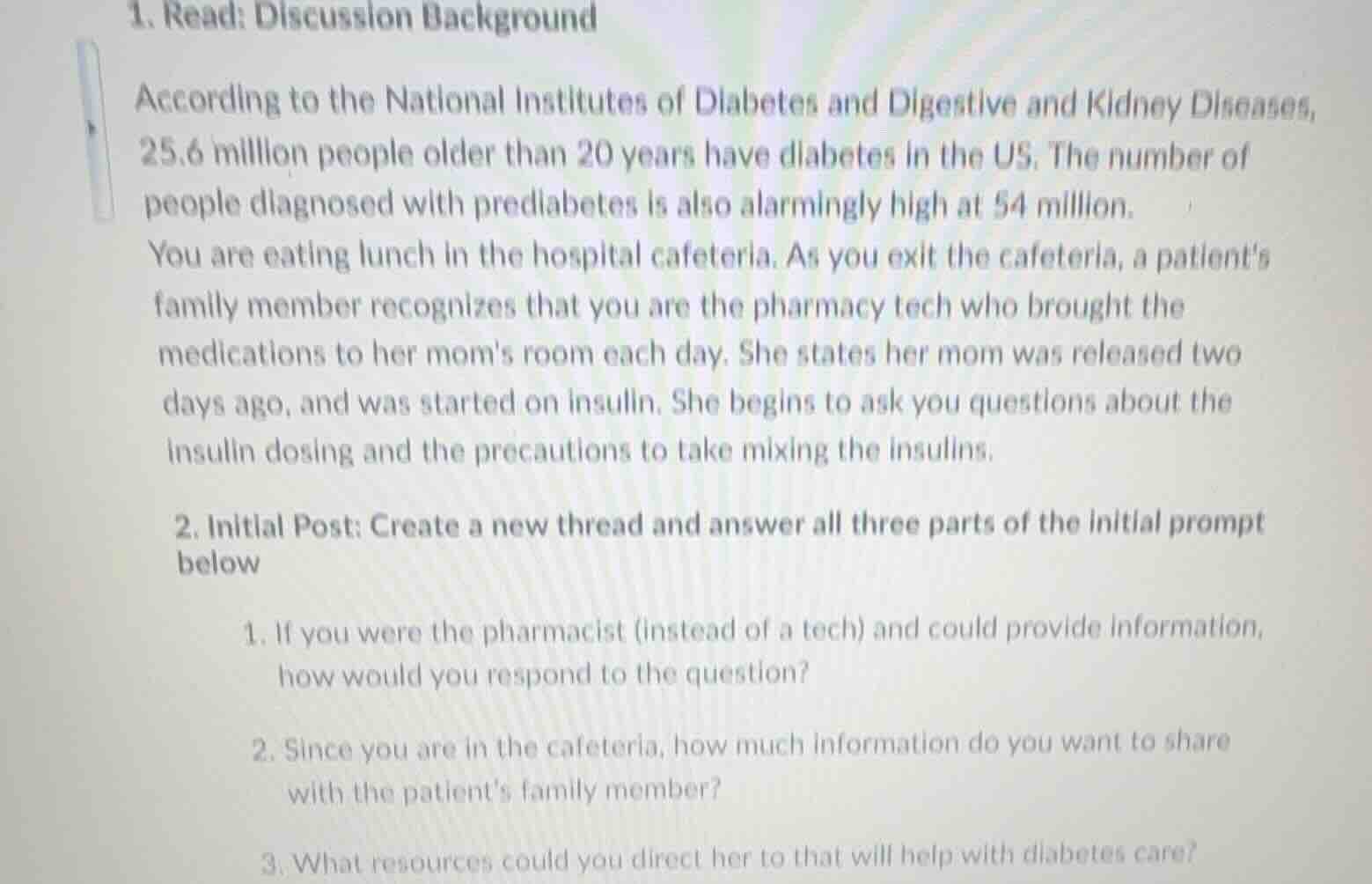
according to the national institutes of diabetes and digestive and kidney diseases, 25.6 million people older than 20 years have diabetes in the us. the number of people diagnosed with prediabetes is also alarmingly high at 54 million.
you are eating lunch in the hospital cafeteria. as you exit the cafeteria, a patients family member recognizes that you are the pharmacy tech who brought the medications to her moms room each day. she states her mom was released two days ago, and was started on insulin. she begins to ask you questions about the insulin dosing and the precautions to take mixing the insulins.
- initial post: create a new thread and answer all three parts of the initial prompt below
- if you were the pharmacist (instead of a tech) and could provide information, how would you respond to the question?
- since you are in the cafeteria, how much information do you want to share with the patients family member?
- what resources could you direct her to that will help with diabetes care?
Part 1: Response as a Pharmacist
As a pharmacist, I'd start by acknowledging her concern. For insulin dosing, I'd explain that dosing is personalized based on factors like blood glucose levels, diet, and activity, so it's crucial to follow the prescriber's instructions. For mixing insulins, I'd mention that rapid - acting or short - acting insulins (like regular insulin) can be mixed with intermediate - acting insulins (like NPH) in the same syringe. The steps are: first, draw up the short - acting insulin, then the intermediate - acting. But I'd also stress that some insulins (like long - acting basal insulins) should not be mixed, and it's best to check the product insert or consult the prescriber.
The cafeteria is a public, non - private setting. So, I should share general, non - patient - specific information about insulin mixing and dosing. I should avoid discussing the patient's specific medical details (since there are other people around) and also not give overly detailed or complex medical advice that might be misinterpreted. The information should be basic, like the general rules for mixing (e.g., which types can be mixed, the order of drawing), and the importance of following the prescriber's dosing instructions.
There are several resources for diabetes care. The American Diabetes Association (ADA) provides a wealth of information on diabetes management, including insulin use. Local hospitals or clinics may have diabetes education programs or support groups. Pharmacies often have pharmacists who specialize in diabetes care and can provide counseling. Online resources like the National Institute of Diabetes and Digestive and Kidney Diseases (NIDDK) website also offer reliable information on diabetes management, including insulin therapy.

Snap & solve any problem in the app
Get step-by-step solutions on Sovi AI
Photo-based solutions with guided steps
Explore more problems and detailed explanations
I would respond: "I understand your concern about your mom's insulin therapy. Insulin dosing is highly individualized, based on her blood sugar levels, diet, and physical activity. So, it's important to follow the dosing instructions provided by her healthcare provider. When it comes to mixing insulins, if she's mixing a short - acting (or rapid - acting) insulin with an intermediate - acting insulin (like NPH), the general rule is to draw up the short - acting insulin first, then the intermediate - acting one into the same syringe. However, long - acting insulins (like glargine or detemir) should not be mixed with other insulins. Also, make sure the syringes and vials are clean, and follow the proper storage instructions for the insulin. If you have the specific insulin types she's using, I can give you more detailed information, or you can also check the insulin's package insert for mixing guidelines."