QUESTION IMAGE
Question
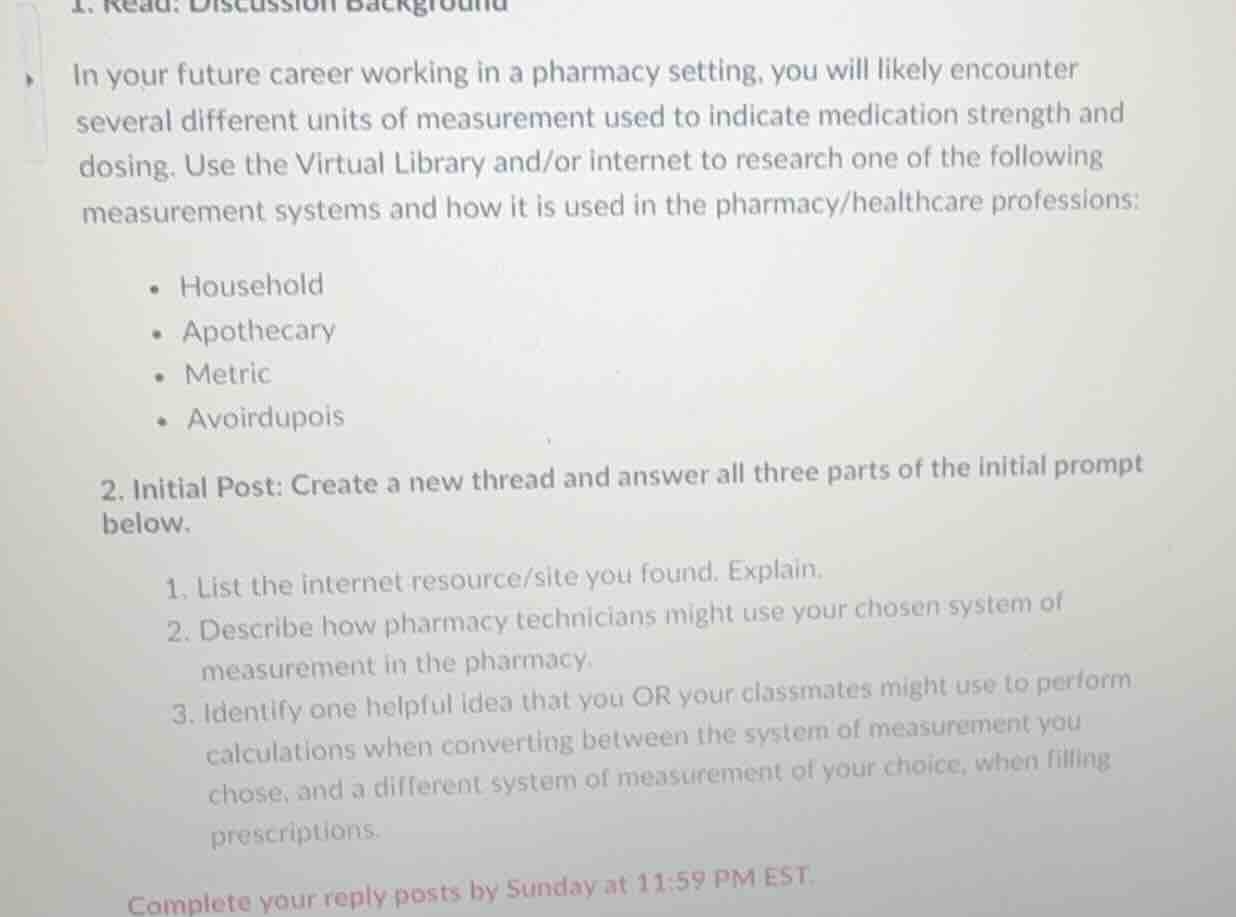
- read: discussion background
in your future career working in a pharmacy setting, you will likely encounter several different units of measurement used to indicate medication strength and dosing. use the virtual library and/or internet to research one of the following measurement systems and how it is used in the pharmacy/healthcare professions:
- household
- apothecary
- metric
- avoirdupois
- initial post: create a new thread and answer all three parts of the initial prompt below.
- list the internet resource/site you found. explain.
- describe how pharmacy technicians might use your chosen system of measurement in the pharmacy.
- identify one helpful idea that you or your classmates might use to perform calculations when converting between the system of measurement you chose, and a different system of measurement of your choice, when filling prescriptions.
complete your reply posts by sunday at 11:59 pm est.
To complete this task, we'll choose the Metric system (a common and precise system in healthcare) and address each part:
1. Internet Resource/Site
A reliable resource is the Pharmacy Times website (https://www.pharmacytimes.com/). It offers articles and guides on pharmacy practice, including measurement systems. For example, their “Pharmacy Calculations” section explains metric units (e.g., grams, milliliters) and their use in dosing, compounding, and prescription filling.
2. How Pharmacy Technicians Use the Metric System
Pharmacy technicians rely on the metric system for:
- Dosing Medications: Calculating drug strengths (e.g., a 500 mg tablet, 10 mL of a 250 mg/5 mL liquid).
- Compounding: Preparing custom medications (e.g., mixing 2 grams of a powder with 100 milliliters of a solvent).
- Inventory Management: Tracking stock (e.g., 500 mL bottles of saline, 1 kg bags of lactose powder).
- Prescription Conversion: Ensuring accuracy when converting between units (e.g., 1 gram = 1000 milligrams) for patient safety.
3. Helpful Idea for Unit Conversion
When converting between the Metric and Household systems (e.g., for patient education), use a standardized conversion chart or formula:
- Example: Convert 5 mL (metric) to teaspoons (household). Since 1 teaspoon ≈ 5 mL, the conversion is direct.
- Technique: Memorize key equivalents (e.g., 1 mL ≈ 1 drop, 1 gram ≈ 15 grains, 1 L = 1 quart) or use a calculator with pre-programmed conversions to avoid errors.
This structure ensures clarity, accuracy, and relevance to pharmacy practice!

Snap & solve any problem in the app
Get step-by-step solutions on Sovi AI
Photo-based solutions with guided steps
Explore more problems and detailed explanations
To complete this task, we'll choose the Metric system (a common and precise system in healthcare) and address each part:
1. Internet Resource/Site
A reliable resource is the Pharmacy Times website (https://www.pharmacytimes.com/). It offers articles and guides on pharmacy practice, including measurement systems. For example, their “Pharmacy Calculations” section explains metric units (e.g., grams, milliliters) and their use in dosing, compounding, and prescription filling.
2. How Pharmacy Technicians Use the Metric System
Pharmacy technicians rely on the metric system for:
- Dosing Medications: Calculating drug strengths (e.g., a 500 mg tablet, 10 mL of a 250 mg/5 mL liquid).
- Compounding: Preparing custom medications (e.g., mixing 2 grams of a powder with 100 milliliters of a solvent).
- Inventory Management: Tracking stock (e.g., 500 mL bottles of saline, 1 kg bags of lactose powder).
- Prescription Conversion: Ensuring accuracy when converting between units (e.g., 1 gram = 1000 milligrams) for patient safety.
3. Helpful Idea for Unit Conversion
When converting between the Metric and Household systems (e.g., for patient education), use a standardized conversion chart or formula:
- Example: Convert 5 mL (metric) to teaspoons (household). Since 1 teaspoon ≈ 5 mL, the conversion is direct.
- Technique: Memorize key equivalents (e.g., 1 mL ≈ 1 drop, 1 gram ≈ 15 grains, 1 L = 1 quart) or use a calculator with pre-programmed conversions to avoid errors.
This structure ensures clarity, accuracy, and relevance to pharmacy practice!