QUESTION IMAGE
Question
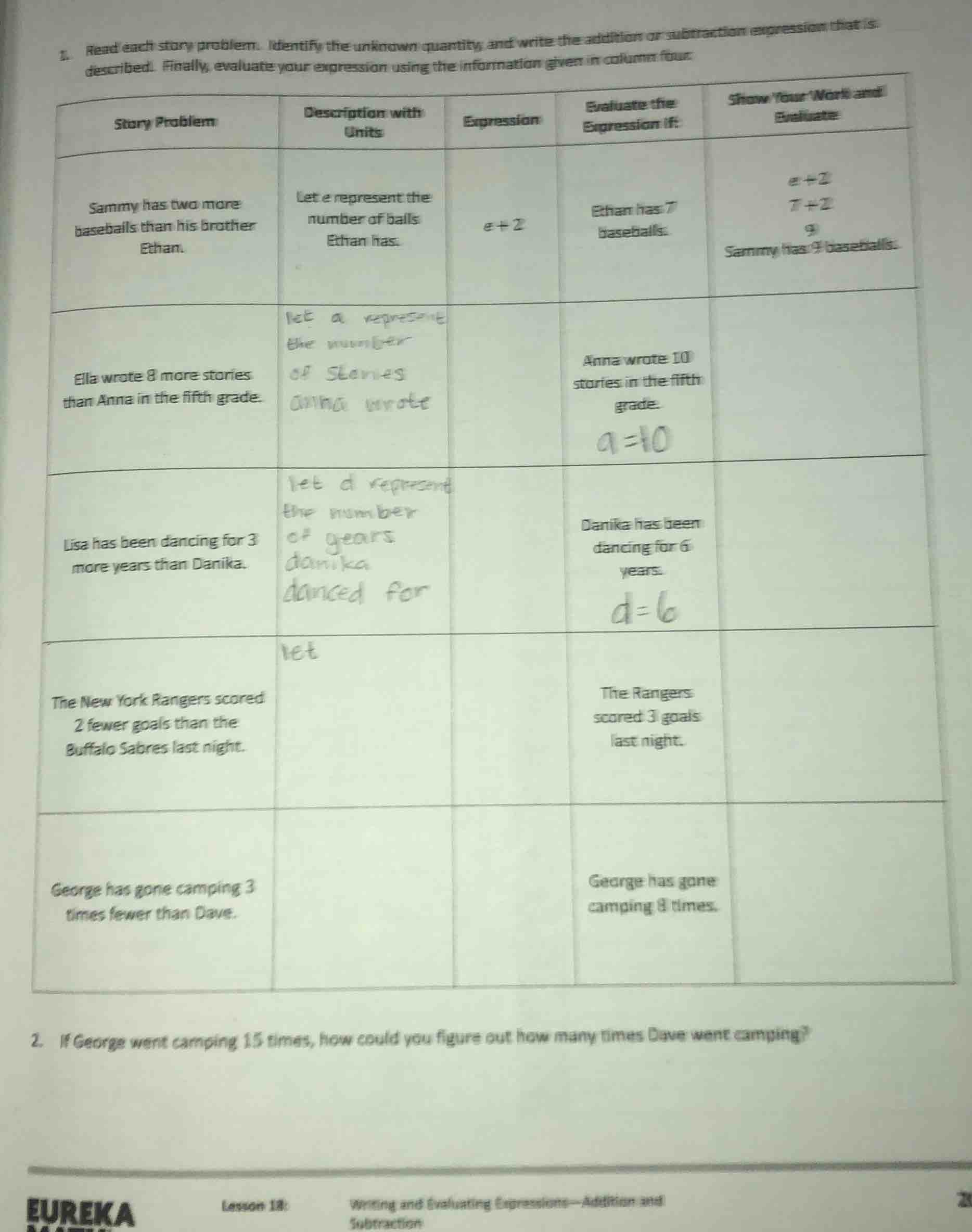
- read each story problem. identify the unknown quantity, and write the addition or subtraction expression that is described. finally, evaluate your expression using the information given in column four.
| story problem | description with units | expression | evaluate the expression if: | show your work and evaluate |
|---|
( 7 + 2 )
9
sammy has 9 baseballs. |
| ella wrote 8 more stories than anna in the fifth grade. | let ( a ) represent the number of stories anna wrote | anna wrote 10 stories in the fifth grade. |
( a = 10 ) | |
| lisa has been dancing for 3 more years than danika. | let ( d ) represent the number of years danika danced for | danika has been dancing for 6 years. |
( d = 6 ) | |
| the new york rangers scored 2 fewer goals than the buffalo sabres last night. | let | the rangers scored 3 goals last night. | ||
| george has gone camping 3 times fewer than dave. | let | george has gone camping 8 times. |
- if george went camping 15 times, how could you figure out how many times dave went camping?
eureka math
lesson 18: writing and evaluating expressions—addition and subtraction
Response
Problem 1 (Ella wrote 8 more stories than Anna...)
Step1: Define the unknown and expression
Let \( a \) be Anna's stories. Ella's stories: \( a + 8 \).
Step2: Substitute \( a = 10 \)
\( 10 + 8 = 18 \)
Step1: Define unknown and expression
Let \( d \) be Danika's years. Lisa's years: \( d + 3 \).
Step2: Substitute \( d = 6 \)
\( 6 + 3 = 9 \)
Step1: Define unknown and expression
Let \( s \) be Sabres' goals. Rangers' goals: \( s - 2 \).
Step2: Substitute \( s = 3 + 2 = 5 \)? Wait, no—Rangers scored 3, so Sabres: \( 3 + 2 = 5 \), Rangers: \( 5 - 2 = 3 \). Wait, expression: Let \( s \) = Sabres’ goals, Rangers: \( s - 2 \). Given Rangers = 3, so \( s - 2 = 3 \Rightarrow s = 5 \), but evaluation of Rangers’ goals is 3. Wait, the problem says "evaluate the expression if: The Rangers scored 3 goals". Wait, maybe expression for Rangers: \( s - 2 \), and we need to find Sabres? No, the story is Rangers scored 2 fewer than Sabres. So Rangers’ goals: \( s - 2 \), where \( s \) is Sabres’ goals. If Rangers scored 3, then \( s - 2 = 3 \Rightarrow s = 5 \), but the expression for Rangers is \( s - 2 \), evaluation: 3 (matches). Wait, maybe the expression is for Rangers: let \( s \) = Sabres’ goals, Rangers: \( s - 2 \). So expression: \( s - 2 \), evaluate when Rangers = 3? Wait, no, the table column: "Evaluate the Expression if: The Rangers scored 3 goals". So the expression is for Rangers’ goals: \( s - 2 \), but we need to define \( s \) as Sabres’ goals. Wait, maybe I misread. Let's re-express: Let \( s \) = Sabres’ goals. Rangers’ goals: \( s - 2 \). Given Rangers scored 3, so \( s - 2 = 3 \Rightarrow s = 5 \), but the evaluation is for Rangers’ goals, which is 3. So expression: \( s - 2 \), evaluation: 3 (since Rangers scored 3). Wait, maybe the unknown is Sabres’ goals, but the story is about Rangers. Let's correct: Let \( r \) = Rangers’ goals, \( s \) = Sabres’ goals. Then \( r = s - 2 \). Given \( r = 3 \), so \( 3 = s - 2 \Rightarrow s = 5 \). But the expression should be for Rangers: \( s - 2 \), so when evaluating, we know \( r = 3 \), so the expression \( s - 2 = 3 \), but maybe the expression is \( s - 2 \) with \( s = 5 \), so \( 5 - 2 = 3 \). So steps:
Step1: Define \( s \) = Sabres’ goals, Rangers: \( s - 2 \).
Step2: Since Rangers = 3, \( s = 3 + 2 = 5 \). Substitute into expression: \( 5 - 2 = 3 \).

Snap & solve any problem in the app
Get step-by-step solutions on Sovi AI
Photo-based solutions with guided steps
Explore more problems and detailed explanations
Expression: \( a + 8 \), Evaluation: 18 (Ella wrote 18 stories)