QUESTION IMAGE
Question
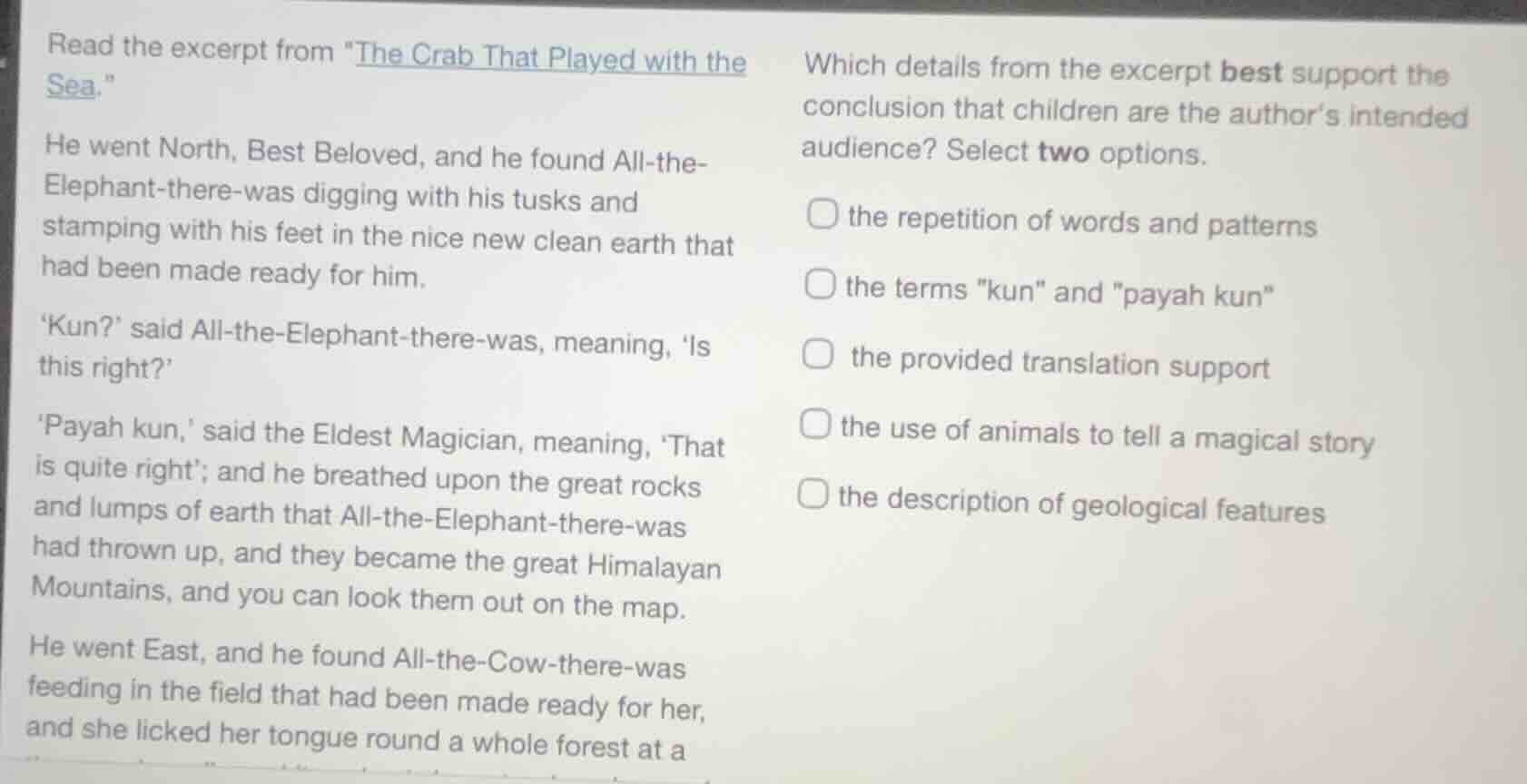
read the excerpt from \the crab that played with the sea.\he went north, best beloved, and he found all-the-elephant-there-was digging with his tusks and stamping with his feet in the nice new clean earth that had been made ready for him.kun? said all-the-elephant-there-was, meaning, is this right?payah kun, said the eldest magician, meaning, that is quite right; and he breathed upon the great rocks and lumps of earth that all-the-elephant-there-was had thrown up, and they became the great himalayan mountains, and you can look them out on the map.he went east, and he found all-the-cow-there-was feeding in the field that had been made ready for her, and she licked her tongue round a whole forest at awhich details from the excerpt best support the conclusion that children are the authors intended audience? select two options.the repetition of words and patternsthe terms \kun\ and \payah kun\the provided translation supportthe use of animals to tell a magical storythe description of geological features
- The repetition of words and patterns (like the structure "He went [direction], and he found All-the-[Animal]-there-was...") is a common storytelling technique for children, as it creates rhythm and predictability that young audiences engage with.
- The use of talking animals in a magical, whimsical story is a classic trope in children's literature, as it makes fantastical concepts accessible and entertaining for young readers.
- While the translation support exists, it is more about clarity for any audience rather than targeting children specifically. The terms "kun" and "payah kun" themselves are not inherently child-focused, and geological feature descriptions are neutral in audience targeting.

Snap & solve any problem in the app
Get step-by-step solutions on Sovi AI
Photo-based solutions with guided steps
Explore more problems and detailed explanations
- the repetition of words and patterns
- the use of animals to tell a magical story