QUESTION IMAGE
Question
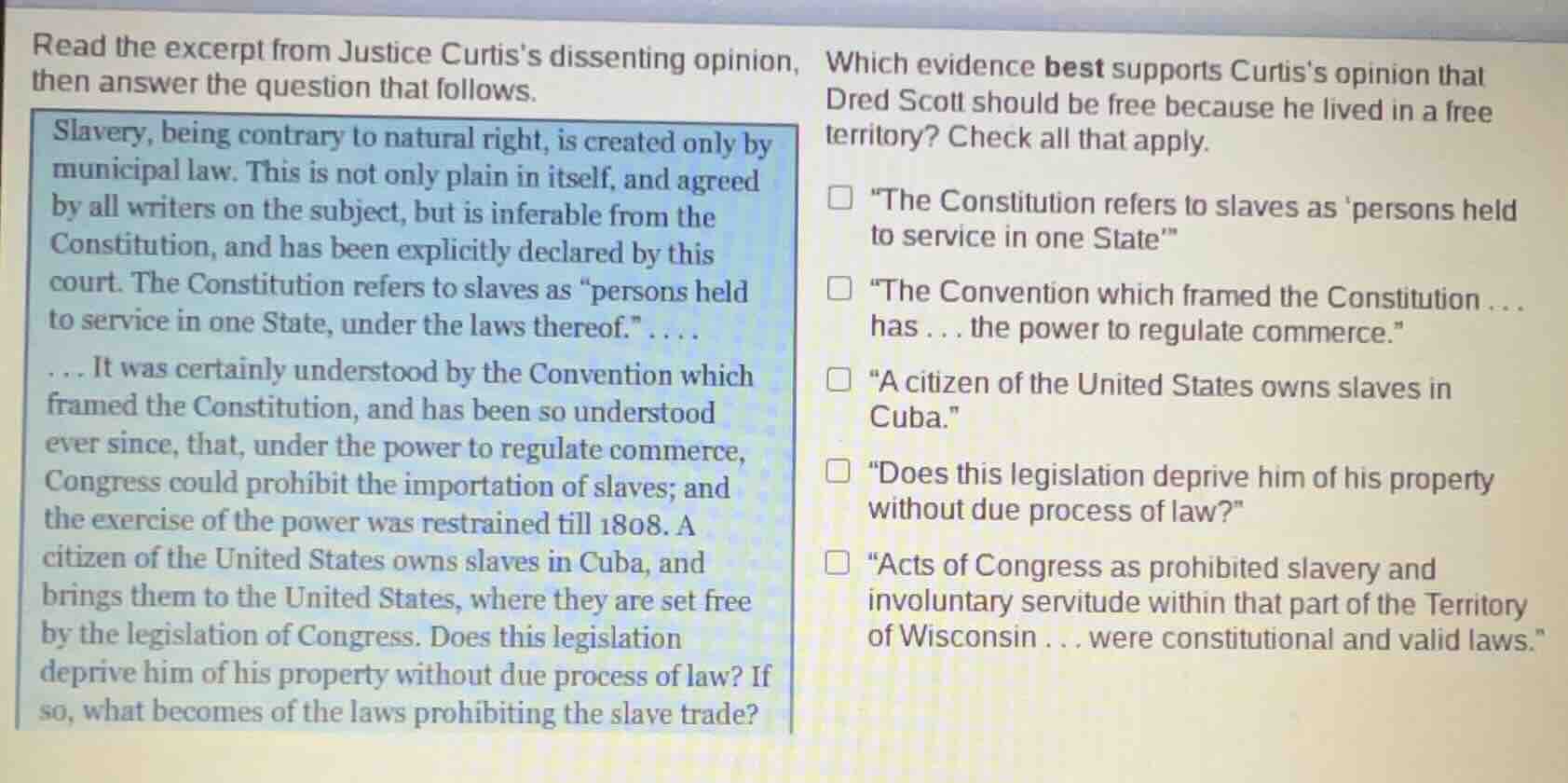
read the excerpt from justice curtiss dissenting opinion, then answer the question that follows.
slavery, being contrary to natural right, is created only by municipal law. this is not only plain in itself, and agreed by all writers on the subject, but is inferable from the constitution, and has been explicitly declared by this court. the constitution refers to slaves as \persons held to service in one state, under the laws thereof.\ . . . .
. . . it was certainly understood by the convention which framed the constitution, and has been so understood ever since, that, under the power to regulate commerce, congress could prohibit the importation of slaves; and the exercise of the power was restrained till 1808. a citizen of the united states owns slaves in cuba, and brings them to the united states, where they are set free by the legislation of congress. does this legislation deprive him of his property without due process of law? if so, what becomes of the laws prohibiting the slave trade?
which evidence best supports curtiss opinion that dred scott should be free because he lived in a free territory? check all that apply.
- \the constitution refers to slaves as persons held to service in one state\
- \the convention which framed the constitution . . . has . . . the power to regulate commerce.\
- \a citizen of the united states owns slaves in cuba.\
- \does this legislation deprive him of his property without due process of law?\
- \acts of congress as prohibited slavery and involuntary servitude within that part of the territory of wisconsin . . . were constitutional and valid laws.\
- For the option "The Constitution refers to slaves as 'persons held to service in one State'": The excerpt mentions the Constitution's reference to slaves in this way, and Curtis's argument about slavery being created by municipal law ties to the legal status of slaves. This shows a legal recognition of slaves as persons under state law, supporting the idea that in a free territory (where municipal law is different), Dred Scott should be free.
- For the option "Acts of Congress as prohibited slavery and involuntary servitude within that part of the Territory of Wisconsin... were constitutional and valid laws": Curtis's opinion is about Dred Scott being free because he lived in a free territory. If Congress's acts prohibiting slavery in Wisconsin Territory were constitutional, it supports that living in a free territory (like where such laws apply) would make Dred Scott free.
- The other options: "The Convention which framed the Constitution... has... the power to regulate commerce" is about the convention's power, not directly about Dred Scott's freedom in a free territory. "A citizen of the United States owns slaves in Cuba" is an example about Cuba, not relevant to Dred Scott's situation in a US free territory. "Does this legislation deprive him of his property without due process of law?" is a question, not evidence supporting the opinion.

Snap & solve any problem in the app
Get step-by-step solutions on Sovi AI
Photo-based solutions with guided steps
Explore more problems and detailed explanations
- The Constitution refers to slaves as "persons held to service in one State"
- Acts of Congress as prohibited slavery and involuntary servitude within that part of the Territory of Wisconsin... were constitutional and valid laws