QUESTION IMAGE
Question
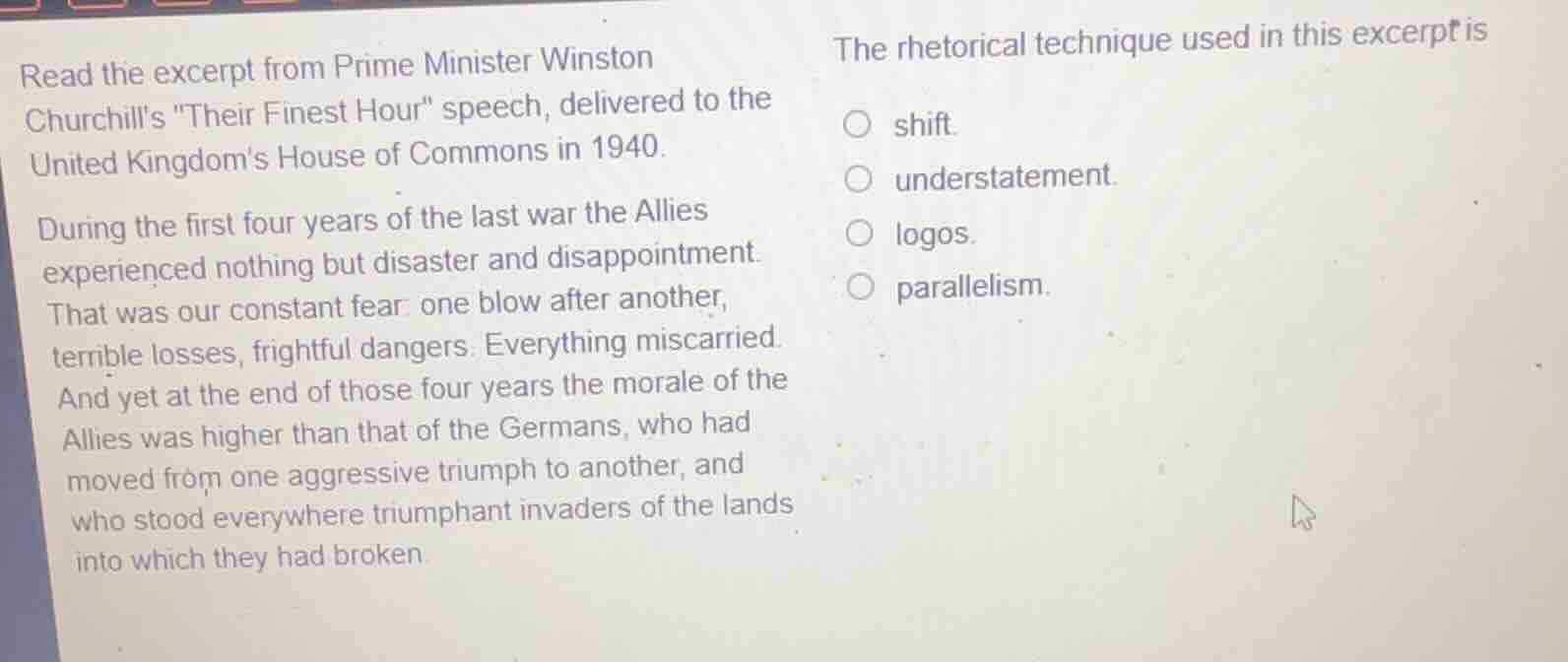
read the excerpt from prime minister winston churchills \their finest hour\ speech, delivered to the united kingdoms house of commons in 1940.
during the first four years of the last war the allies experienced nothing but disaster and disappointment. that was our constant fear: one blow after another, terrible losses, frightful dangers. everything miscarried. and yet at the end of those four years the morale of the allies was higher than that of the germans, who had moved from one aggressive triumph to another, and who stood everywhere triumphant invaders of the lands into which they had broken.
the rhetorical technique used in this excerpt is
○ shift.
○ understatement.
○ logos.
○ parallelism.
To determine the rhetorical technique, we analyze each option:
- "Shift" is not a standard rhetorical technique in this context.
- "Understatement" involves downplaying, but the excerpt contrasts the Allies' struggles with their higher morale vs. Germans' triumphs, not understating.
- "Logos" is logical appeal, but the excerpt uses contrast, not logical reasoning structure.
- "Parallelism" involves contrasting or comparing ideas in parallel structure. Here, the excerpt contrasts the Allies' disasters with the Germans' triumphs, and the Allies' higher morale with Germans' triumphant invader status, using parallel contrasting ideas. Wait, no—actually, the key is the contrast between the Allies' situation (disaster but high morale) and Germans' (triumph but... well, the contrast in outcomes and morale). Wait, no, the correct technique here is actually contrast but among the options, "parallelism" in the sense of parallel contrasting structures? Wait, no, let's re-express: the excerpt presents the Allies' experience (disaster, disappointment, losses, dangers, miscarry) and then their morale, versus Germans' (triumph, aggressive triumph, triumphant invaders). The structure of contrasting two groups' experiences in parallel is parallelism? Wait, no, maybe I made a mistake. Wait, the correct answer is actually contrast but since "parallelism" can involve parallel contrasting ideas, and the other options are incorrect: "shift" is not rhetorical, "understatement" is wrong, "logos" is about logic. Wait, no, the correct technique here is parallelism? Wait, no, let's check again. The excerpt uses a contrast between the Allies' four years of disaster and the Germans' four years of triumph, and then the Allies' morale vs. Germans'. The structure of presenting two parallel scenarios (Allies' struggles vs. Germans' success) is parallelism. Alternatively, maybe it's "contrast" but since "parallelism" is an option and the others are wrong, the answer is parallelism. Wait, no, let's re-express: the key is that the excerpt contrasts the Allies' situation (disaster but high morale) with the Germans' (triumph but... the contrast in their experiences and outcomes). The rhetorical technique here is parallelism in the sense of contrasting two parallel narratives. So the correct option is parallelism.

Snap & solve any problem in the app
Get step-by-step solutions on Sovi AI
Photo-based solutions with guided steps
Explore more problems and detailed explanations
D. parallelism (Note: Assuming the options are labeled as A. shift, B. understatement, C. logos, D. parallelism)