QUESTION IMAGE
Question
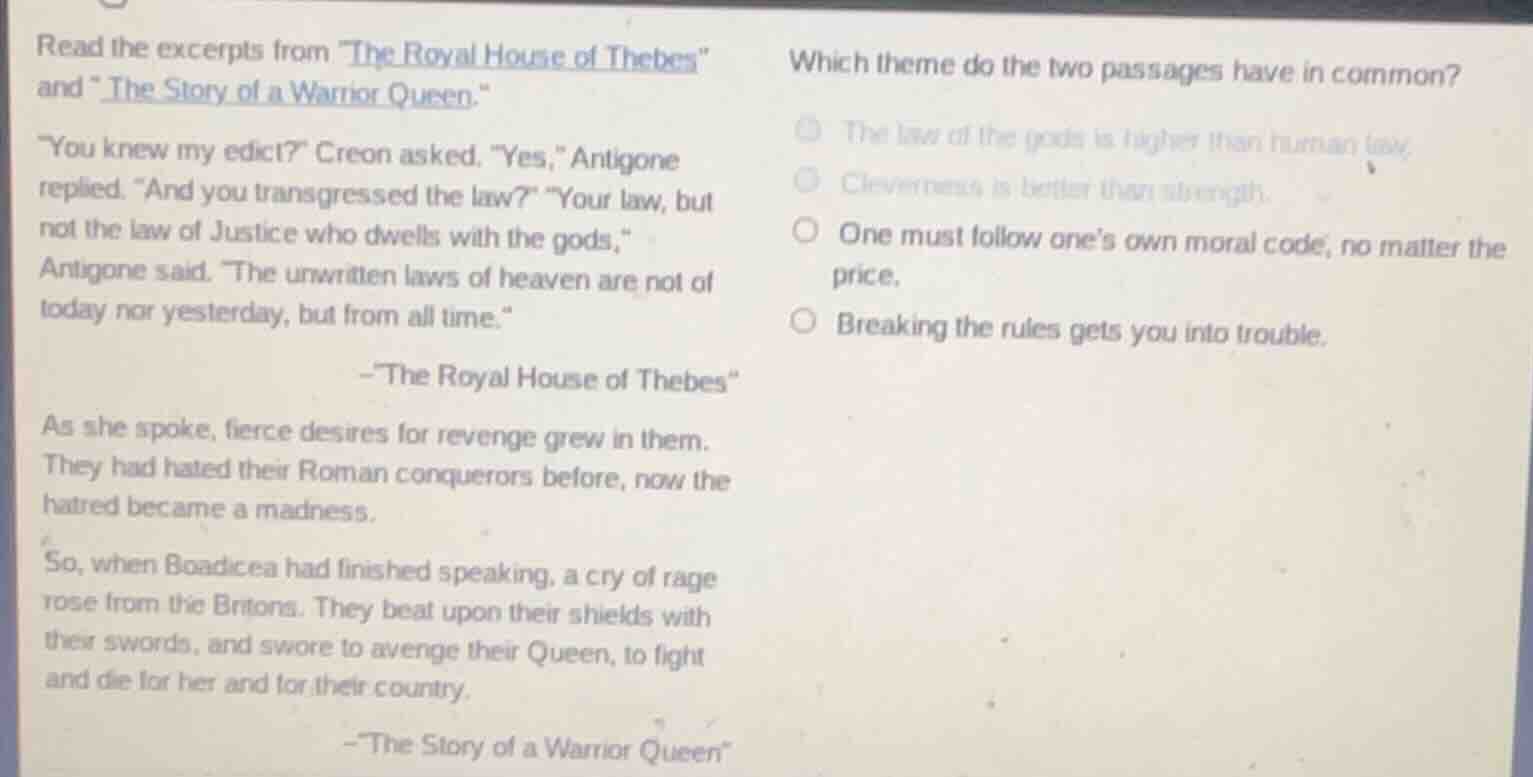
read the excerpts from \the royal house of thebes\ and \the story of a warrior queen.\you knew my edict?\ creon asked. \yes,\ antigone replied. \and you transgressed the law?\ \your law, but not the law of justice who dwells with the gods,\ antigone said. \the unwritten laws of heaven are not of today nor yesterday, but from all time.\—\the royal house of thebes\as she spoke, fierce desires for revenge grew in them. they had hated their roman conquerors before, now the hatred became a madness.so, when boadicea had finished speaking, a cry of rage rose from the britons. they beat upon their shields with their swords, and swore to avenge their queen, to fight and die for her and for their country.—\the story of a warrior queen\which theme do the two passages have in common?the law of the gods is higher than human law.cleverness is better than strength.one must follow ones own moral code, no matter the price.breaking the rules gets you into trouble.
- Analyze "The Royal House of Thebes": Antigone follows her moral code (law of gods) against Creon's law, even if it means transgressing his edict.
- Analyze "The Story of a Warrior Queen": The Britons follow their moral code of loyalty to their queen and country, driven by hatred for Roman conquerors, and are willing to fight and die.
- Evaluate options:
- "The law of the gods is higher than human law": Only applies to the first passage, not the second (which is about loyalty to queen/country, not gods' law).
- "Cleverness is better than strength": Not supported by either passage.
- "One must follow one's own moral code, no matter the price": Applies to both—Antigone follows her moral code (despite consequences), and the Britons follow theirs (willing to fight/die).
- "Breaking the rules gets you into trouble": The first passage shows Antigone breaking Creon's rule but standing by her moral code; the second is about following a moral code (not breaking rules to get in trouble).

Snap & solve any problem in the app
Get step-by-step solutions on Sovi AI
Photo-based solutions with guided steps
Explore more problems and detailed explanations
One must follow one's own moral code, no matter the price.