QUESTION IMAGE
Question
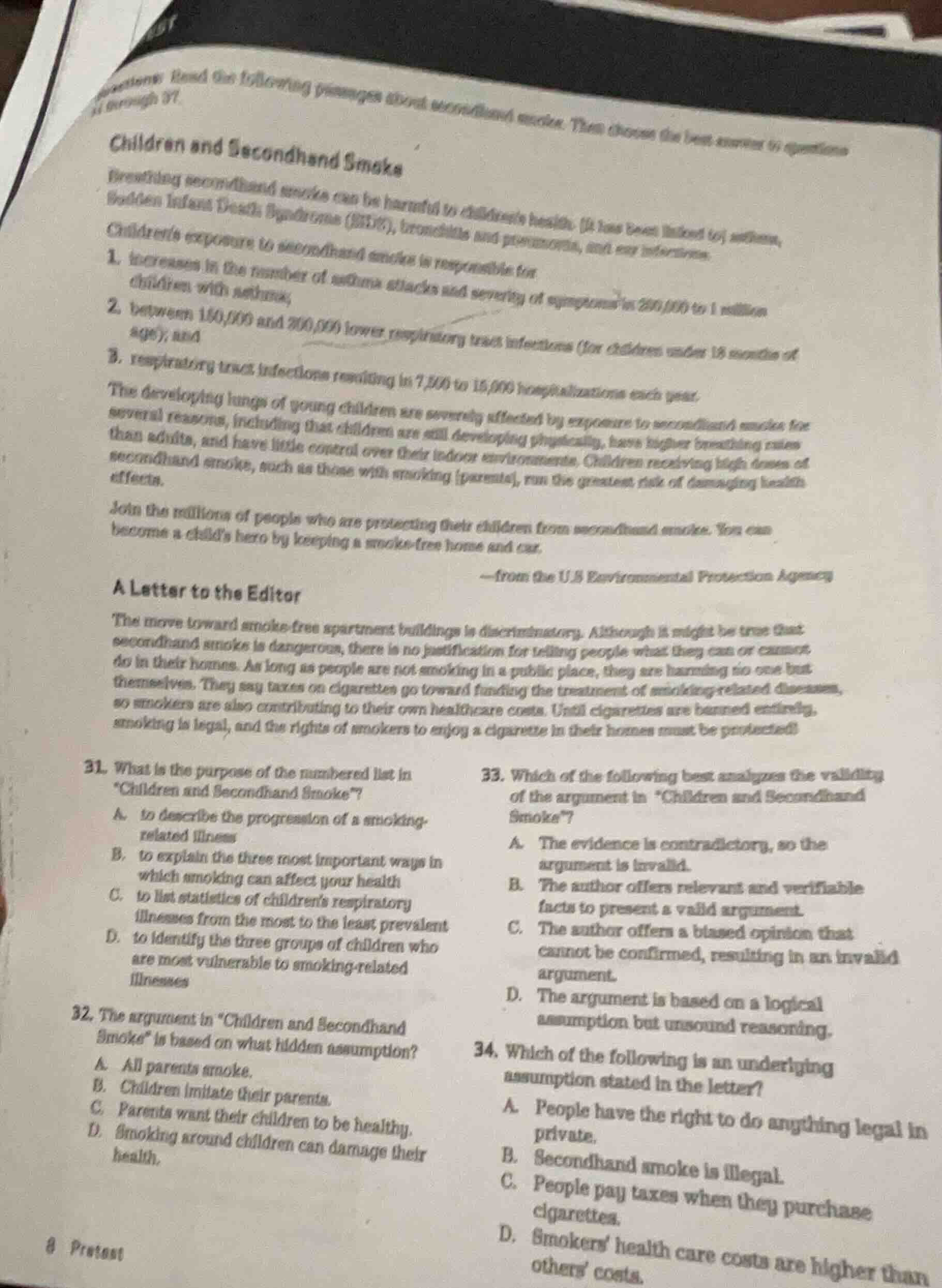
read the following passages about secondhand smoke. then choose the best answer to questions 31 through 37.
children and secondhand smoke
breathing secondhand smoke can be harmful to childrens health. it has been linked to asthma, sudden infant death syndrome (sids), bronchitis and pneumonia, and ear infections.
children’s exposure to secondhand smoke is responsible for
- increases in the number of asthma attacks and severity of symptoms in 200,000 to 1 million children with asthma;
- between 150,000 and 300,000 lower respiratory tract infections (for children under 18 months of age); and
- respiratory tract infections resulting in 7,500 to 15,000 hospitalizations each year.
the developing lungs of young children are severely affected by exposure to secondhand smoke for several reasons, including that children are still developing physically, have higher breathing rates than adults, and have little control over their indoor environments. children receiving high doses of secondhand smoke, such as those with smoking parents, run the greatest risk of damaging health effects.
join the millions of people who are protecting their children from secondhand smoke. you can become a child’s hero by keeping a smoke - free home and car.
—from the u.s environmental protection agency
a letter to the editor
the move toward smoke - free apartment buildings is discriminatory. although it might be true that secondhand smoke is dangerous, there is no justification for telling people what they can or cannot do in their homes. as long as people are not smoking in a public place, they are harming no one but themselves. they say taxes on cigarettes go toward funding the treatment of smoking - related diseases, so smokers are also contributing to their own healthcare costs. until cigarettes are banned entirely, smoking is legal, and the rights of smokers to enjoy a cigarette in their homes must be protected!
- what is the purpose of the numbered list in “children and secondhand smoke”?
a. to describe the progression of a smoking - related illness
b. to explain the three most important ways in which smoking can affect your health
c. to list statistics of children’s respiratory illnesses from the most to the least prevalent
d. to identify the three groups of children who are most vulnerable to smoking - related illnesses
- the argument in “children and secondhand smoke” is based on what hidden assumption?
a. all parents smoke.
b. children imitate their parents.
c. parents want their children to be healthy.
d. smoking around children can damage their health.
- which of the following best analyzes the validity of the argument in “children and secondhand smoke”?
a. the evidence is contradictory, so the argument is invalid.
b. the author offers relevant and verifiable facts to present a valid argument.
c. the author offers a biased opinion that cannot be confirmed, resulting in an invalid argument.
d. the argument is based on a logical assumption but unsound reasoning.
- which of the following is an underlying assumption stated in the letter?
a. people have the right to do anything legal in private.
b. secondhand smoke is illegal.
c. people pay taxes when they purchase cigarettes.
d. smokers’ health care costs are higher than others’ costs.
Question 31
- Option A: The numbered list is about children's exposure to secondhand smoke and its effects, not the progression of a smoking - related illness. Eliminate A.
- Option B: The list is specifically about how secondhand smoke affects children's health, not general ways smoking affects health. Eliminate B.
- Option C: The numbered list provides statistics (e.g., 200,000 to 1 million children with asthma, 150,000 and 300,000 lower respiratory tract infections, 7,500 to 15,000 hospitalizations) related to children's respiratory illnesses due to secondhand smoke. This option fits.
- Option D: The list is about the effects of secondhand smoke on children, not identifying vulnerable groups. Eliminate D.
- Option A: The passage does not assume all parents smoke. Eliminate A.
- Option B: The passage is about the harm of secondhand smoke to children, not about children imitating parents. Eliminate B.
- Option C: The passage's main point is about protecting children from secondhand smoke, not about parents' desire for their children's health. Eliminate C.
- Option D: The passage presents the harm of secondhand smoke to children (like asthma, respiratory infections) and then asks people to protect children from it. The hidden assumption is that smoking around children can damage their health.
- Option A: The evidence in "Children and Secondhand Smoke" (statistics about the harm of secondhand smoke to children) is not contradictory. Eliminate A.
- Option B: The author provides relevant (related to children's health and secondhand smoke) and verifiable (statistics) facts to support the argument that secondhand smoke is harmful to children. This makes the argument valid.
- Option C: The author's argument is based on facts, not a biased opinion. Eliminate C.
- Option D: The argument is based on sound reasoning with factual evidence. Eliminate D.

Snap & solve any problem in the app
Get step-by-step solutions on Sovi AI
Photo-based solutions with guided steps
Explore more problems and detailed explanations
C. to list statistics of children's respiratory illnesses from the most to the least prevalent