QUESTION IMAGE
Question
read this passage about two inherited traits in pond snails.
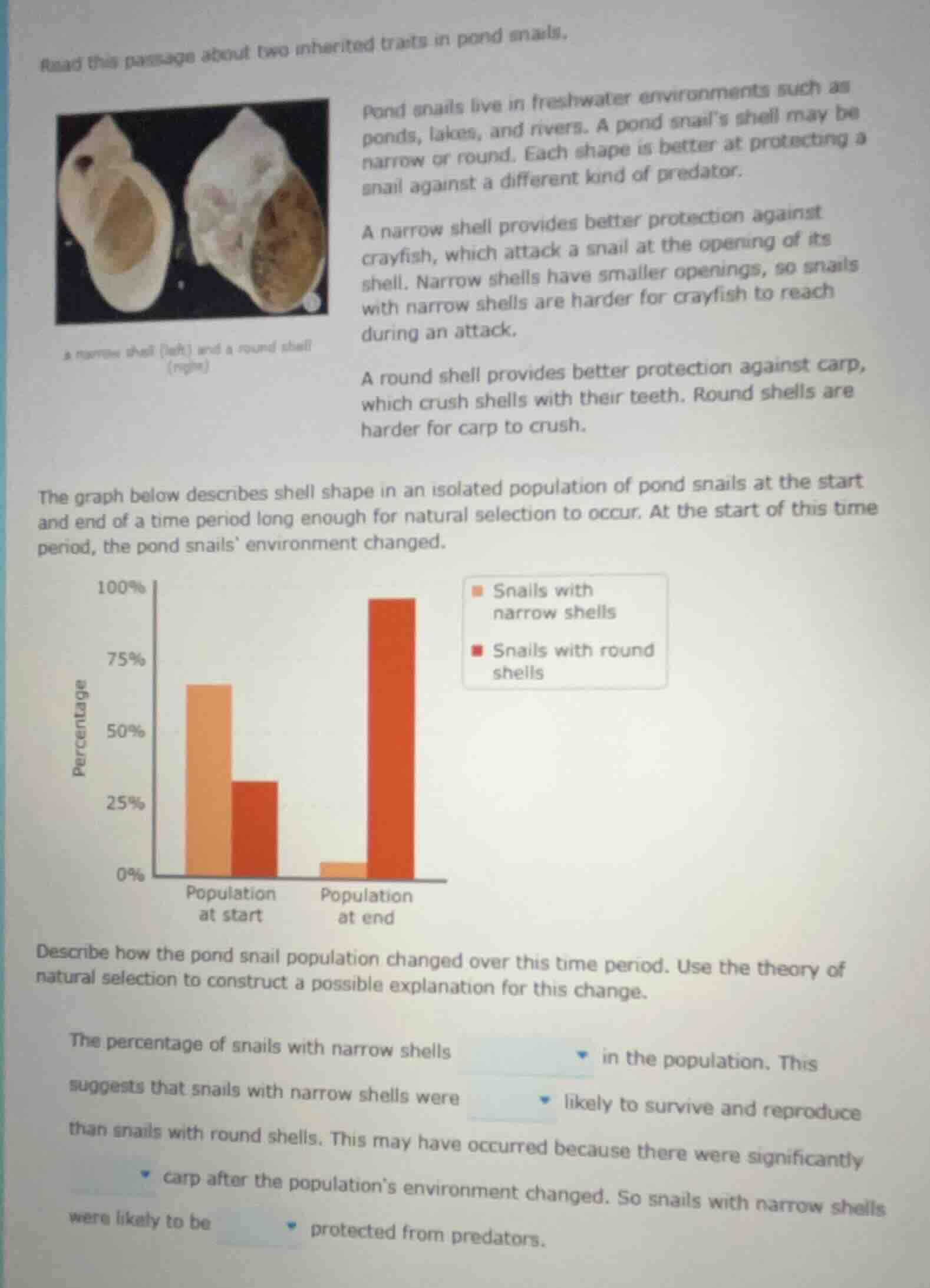
a narrow shell (left) and a round shell (right)
pond snails live in freshwater environments such as ponds, lakes, and rivers. a pond snails shell may be narrow or round. each shape is better at protecting a snail against a different kind of predator.
a narrow shell provides better protection against crayfish, which attack a snail at the opening of its shell. narrow shells have smaller openings, so snails with narrow shells are harder for crayfish to reach during an attack.
a round shell provides better protection against carp, which crush shells with their teeth. round shells are harder for carp to crush.
the graph below describes shell shape in an isolated population of pond snails at the start and end of a time period long enough for natural selection to occur. at the start of this time period, the pond snails environment changed.
describe how the pond snail population changed over this time period. use the theory of natural selection to construct a possible explanation for this change.
the percentage of snails with narrow shells $quad$ in the population. this suggests that snails with narrow shells were $quad$ likely to survive and reproduce than snails with round shells. this may have occurred because there were significantly $quad$ carp after the populations environment changed. so snails with narrow shells were likely to be $quad$ protected from predators.
- First, analyze the bar graph: the percentage of narrow-shelled snails drops from ~68% to a small single-digit percentage, while round-shelled snails rise from ~32% to nearly 100%.
- Apply natural selection principles: traits that improve survival/reproduction become more common. Since narrow-shelled snails declined, they had lower survival/reproduction success.
- Match to predator adaptations: Round shells protect against carp (shell-crushing predators). If carp became more common, round-shelled snails survived better, passing on their trait. Narrow shells are poor protection against carp, so these snails were less likely to survive.

Snap & solve any problem in the app
Get step-by-step solutions on Sovi AI
Photo-based solutions with guided steps
Explore more problems and detailed explanations
The percentage of snails with narrow shells decreased sharply in the population. This suggests that snails with narrow shells were less likely to survive and reproduce than snails with round shells. This may have occurred because there were significantly more carp after the population's environment changed. So snails with narrow shells were likely to be poorly protected from predators.