QUESTION IMAGE
Question
read the passage and answer the following question(s).
passage #822
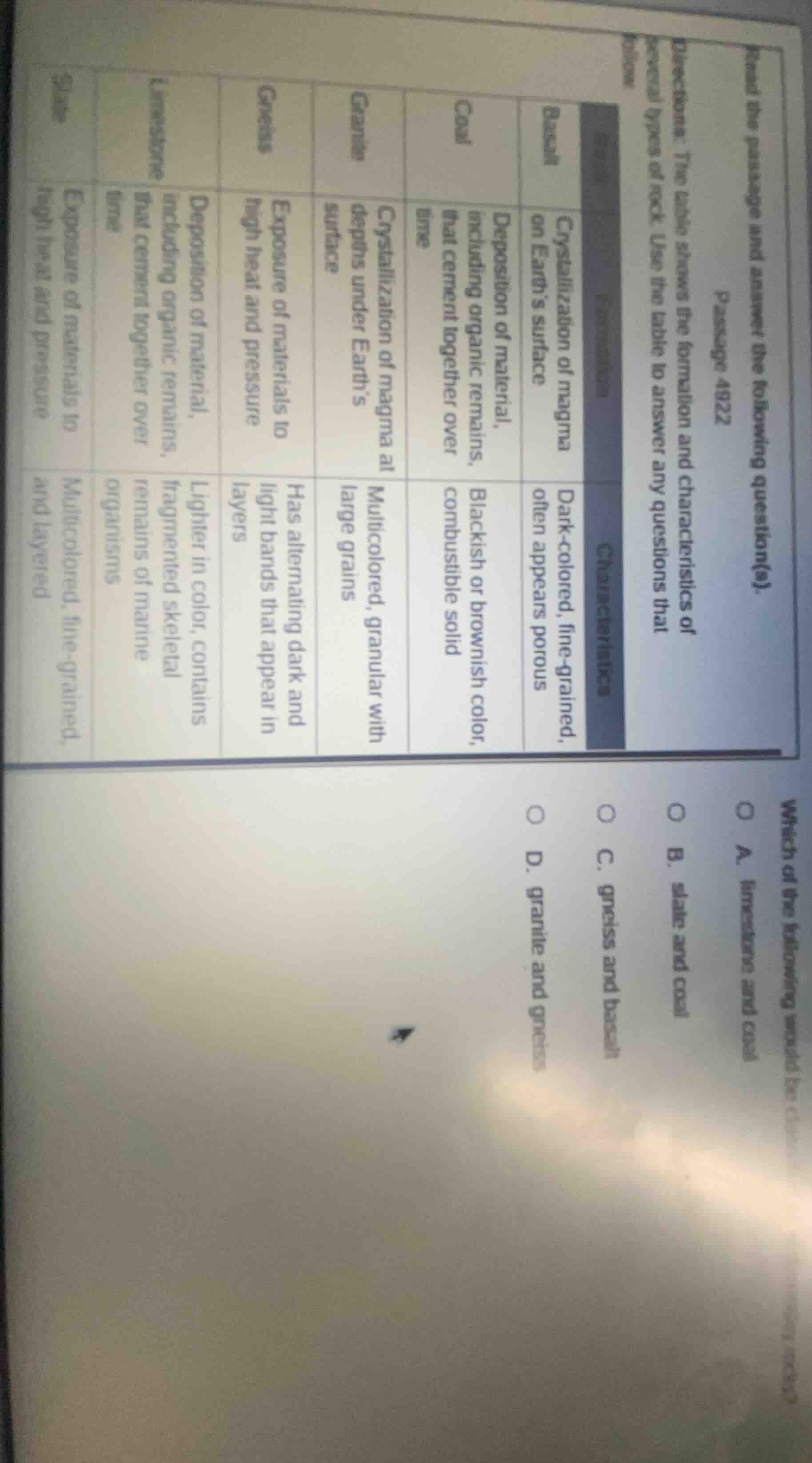
directions: the table shows the formation and characteristics of several types of rock. use the table to answer any questions that follow.
| rock type | formation | characteristics |
|---|---|---|
| coal | deposition of material, including organic remains, that cement together over time | blackish or brownish color, combustible solid |
| granite | crystallization of magma at depths under earth’s surface | multicolored, granular with large grains |
| gneiss | exposure of materials to high heat and pressure | has alternating dark and light bands that appear in layers |
| limestone | deposition of material, including organic remains, that cement together over time | lighter in color, contains fragmented skeletal remains of marine organisms |
| shale | exposure of materials to light heat and pressure | multicolored, fine - grained, and layered |
which of the following would be...
a. limestone and coal
b. shale and coal
c. gneiss and basalt
d. granite and gneiss
Brief Explanations
To solve this, we analyze each rock type:
- Limestone and Coal: Limestone forms from deposition of marine organisms (matches limestone's characteristics: "contains fragmented skeletal remains of marine organisms"). Coal forms from deposition of organic material over time (matches coal's: "Deposition of material, including organic remains, that cement together over time" and "blackish or brownish, combustible solid").
- Slate and Coal: Slate is a metamorphic rock (formed by heat/pressure), but coal's formation is sedimentary, and slate's characteristics don't match coal.
- Gneiss and Basalt: Gneiss is metamorphic (heat/pressure, alternating bands), basalt is extrusive igneous (fine - grained, dark), their formations don't match the pair.
- Granite and Gneiss: Granite is intrusive igneous (formed deep, large grains), gneiss is metamorphic, their formations don't match the pair.
So limestone and coal (option A) match their respective formation and characteristics.

Snap & solve any problem in the app
Get step-by-step solutions on Sovi AI
Photo-based solutions with guided steps
Explore more problems and detailed explanations
A. limestone and coal