QUESTION IMAGE
Question
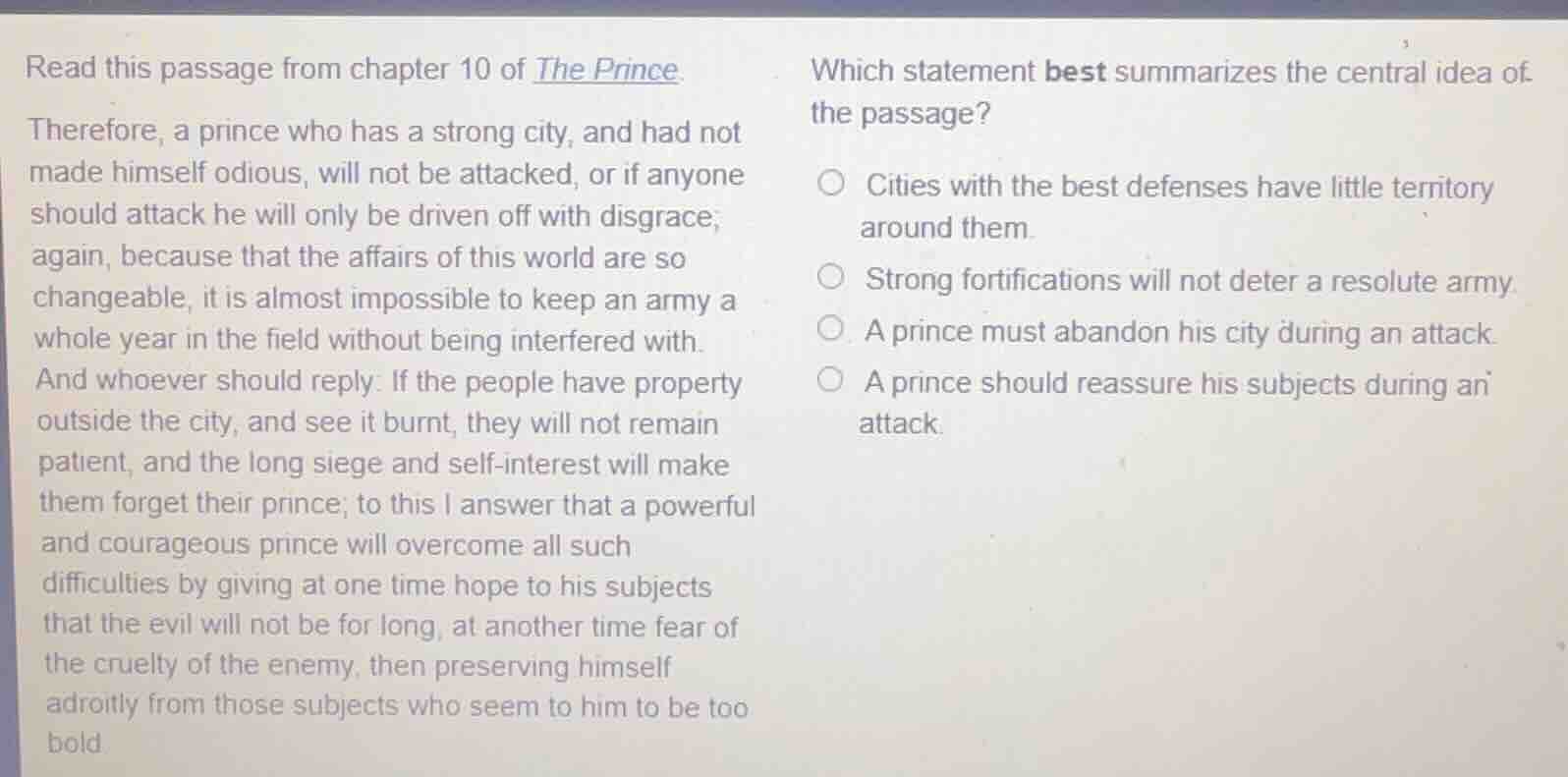
read this passage from chapter 10 of the prince. therefore, a prince who has a strong city, and had not made himself odious, will not be attacked, or if anyone should attack he will only be driven off with disgrace; again, because that the affairs of this world are so changeable, it is almost impossible to keep an army a whole year in the field without being interfered with. and whoever should reply: if the people have property outside the city, and see it burnt, they will not remain patient, and the long siege and self - interest will make them forget their prince; to this i answer that a powerful and courageous prince will overcome all such difficulties by giving at one time hope to his subjects that the evil will not be for long, at another time fear of the cruelty of the enemy, then preserving himself adroitly from those subjects who seem to him to be too bold. which statement best summarizes the central idea of the passage? ○ cities with the best defenses have little territory around them. ○ strong fortifications will not deter a resolute army. ○ a prince must abandon his city during an attack. ○ a prince should reassure his subjects during an attack.
The passage states a prince with a strong city and no public hatred won't be attacked; if attacked, attackers will fail. It addresses a counterargument about subjects' unrest, noting a strong prince can manage this by giving subjects hope, fear of the enemy, and controlling overly bold subjects. The other options don't match: the first is unmentioned, the second contradicts the passage's claim about strong cities deterring attacks, the third is opposite to the passage's focus on holding the city.

Snap & solve any problem in the app
Get step-by-step solutions on Sovi AI
Photo-based solutions with guided steps
Explore more problems and detailed explanations
A prince should reassure his subjects during an attack.