QUESTION IMAGE
Question
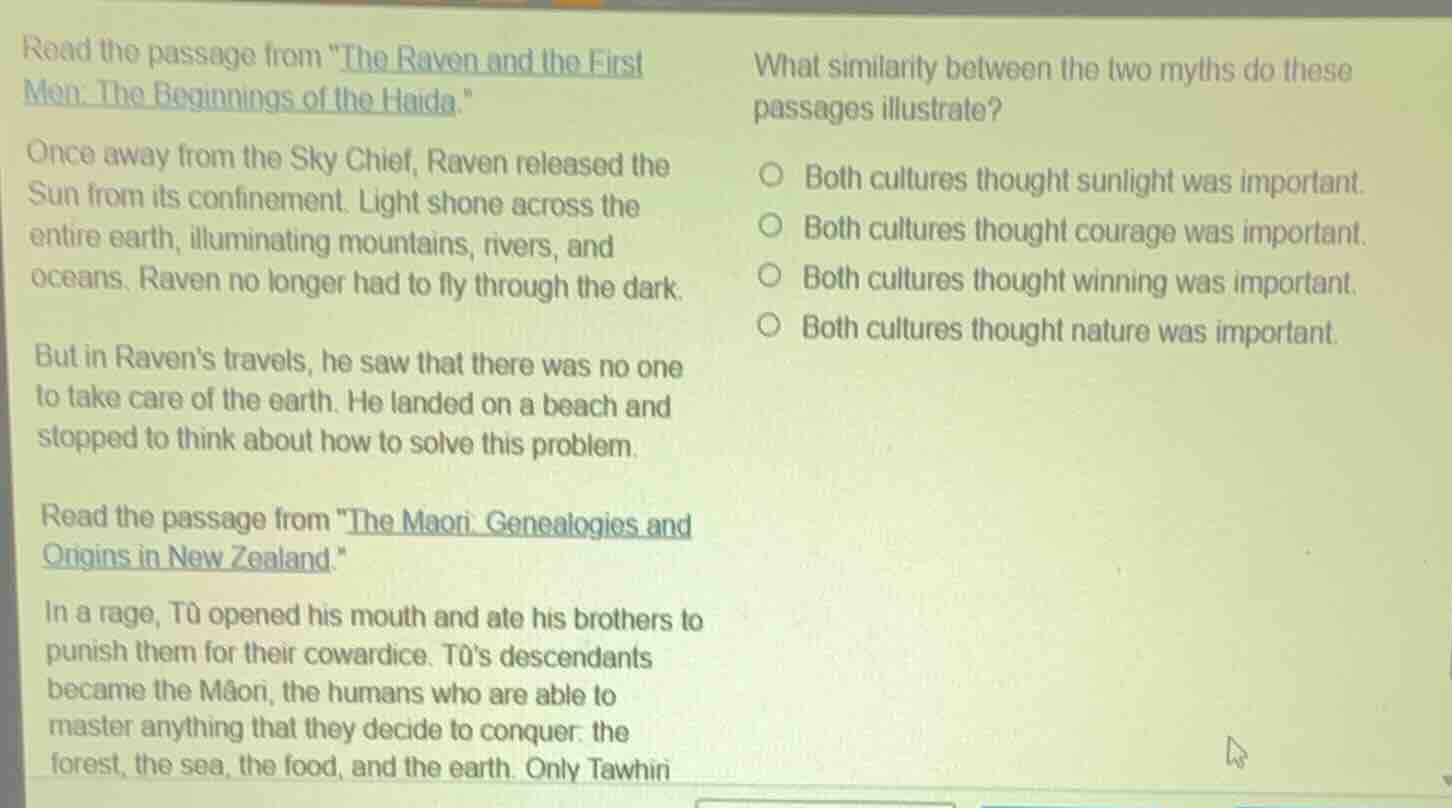
read the passage from \the raven and the first men: the beginnings of the haida.\
once away from the sky chief, raven released the sun from its confinement. light shone across the entire earth, illuminating mountains, rivers, and oceans. raven no longer had to fly through the dark.
but in raven’s travels, he saw that there was no one to take care of the earth. he landed on a beach and stopped to think about how to solve this problem.
read the passage from \the maori: genealogies and origins in new zealand.\
in a rage, tû opened his mouth and ate his brothers to punish them for their cowardice. tû’s descendants became the mâori, the humans who are able to master anything that they decide to conquer: the forest, the sea, the food, and the earth. only tawhiri
what similarity between the two myths do these passages illustrate?
○ both cultures thought sunlight was important.
○ both cultures thought courage was important.
○ both cultures thought winning was important.
○ both cultures thought nature was important.
- Analyze the first myth (Haida): Raven releases the Sun, and later is concerned about caring for the earth (mountains, rivers, oceans, earth are part of nature).
- Analyze the second myth (Maori): Tū's descendants master the forest, sea, food, and earth (these are natural elements).
- Evaluate options:
- Option A: The Haida myth involves sunlight, but the Maori myth does not focus on sunlight. Eliminate.
- Option B: The Maori myth has Tū punishing cowardice, but the Haida myth does not emphasize courage. Eliminate.
- Option C: Neither myth focuses on "winning" in a general sense. Eliminate.
- Option D: Both myths show concern for or mastery of natural elements (earth, mountains, rivers, oceans, forest, sea), so both cultures think nature is important.

Snap & solve any problem in the app
Get step-by-step solutions on Sovi AI
Photo-based solutions with guided steps
Explore more problems and detailed explanations
D. Both cultures thought nature was important.