QUESTION IMAGE
Question
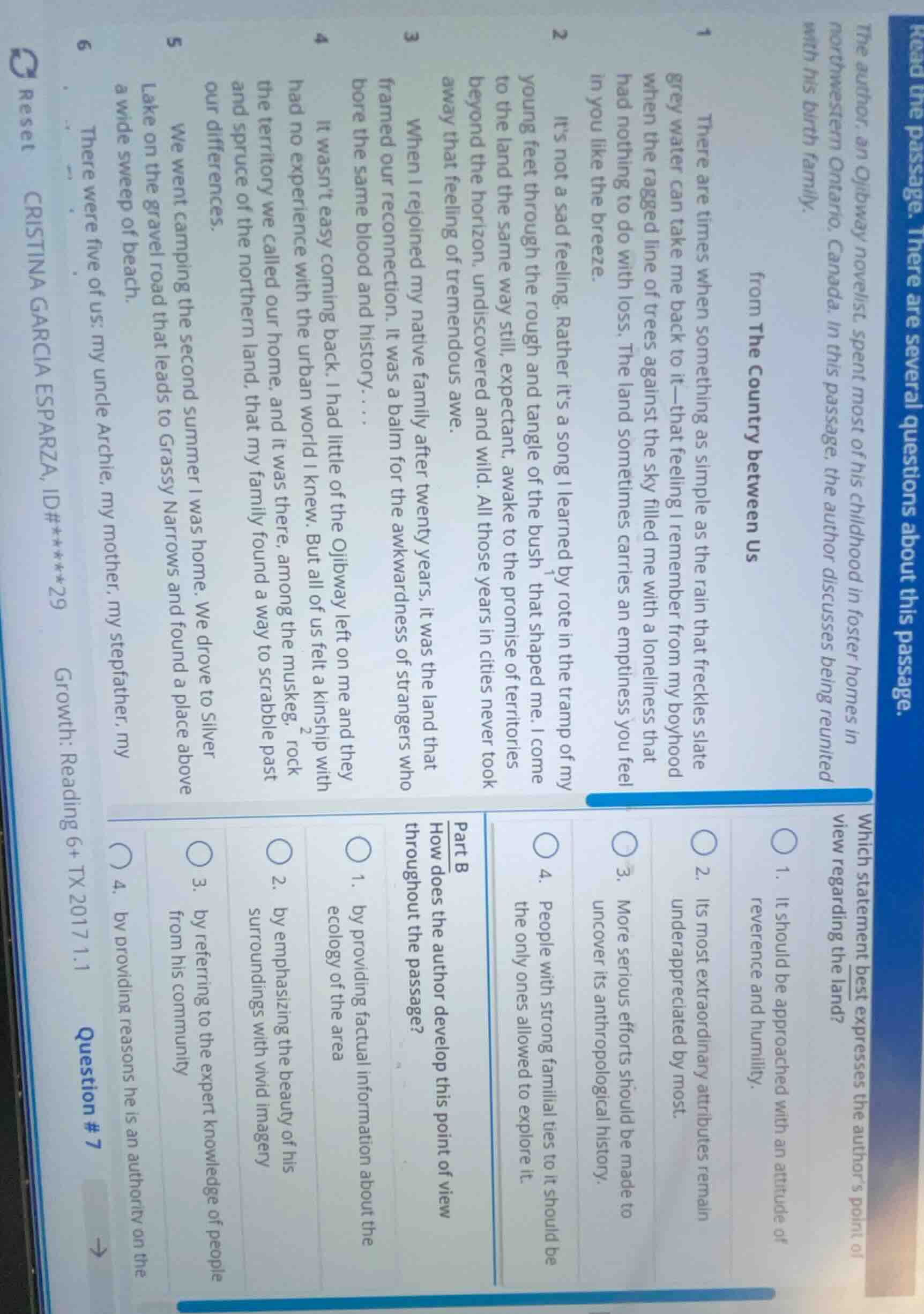
read the passage. there are several questions about this passage.
the author, an ojibway novelist, spent most of his childhood in foster homes in northwestern ontario, canada. in this passage, the author discusses being reunited with his birth family.
from the country between us
there are times when something as simple as the rain that freckles slate grey water can take me back to it—that feeling i remember from my boyhood when the ragged line of trees against the sky filled me with a loneliness that had nothing to do with loss. the land sometimes carries an emptiness you feel in you like the breeze.
it’s not a sad feeling. rather it’s a song i learned by rote in the tramp of my young feet through the rough and tangle of the bush that shaped me. i come to the land the same way still, expectant, awake to the promise of territories beyond the horizon, undiscovered and wild. all those years in cities never took away that feeling of tremendous awe.
when i rejoined my native family after twenty years, it was the land that framed our reconnection. it was a balm for the awkwardness of strangers who bore the same blood and history. . . .
it wasn’t easy coming back. i had little of the ojibway left on me and they had no experience with the urban world i knew. but all of us felt a kinship with the territory we called our home, and it was there, among the muskeg, rock and spruce of the northern land, that my family found a way to scrabble past our differences.
we went camping the second summer i was home. we drove to silver lake on the gravel road that leads to grassy narrows and found a place above a wide sweep of beach.
there were five of us: my uncle archie, my mother, my stepfather, my...
which statement best expresses the author’s point of view regarding the land?
- it should be approached with an attitude of reverence and humility.
- its most extraordinary attributes remain underappreciated by most.
- more serious efforts should be made to uncover its anthropological history.
- people with strong familial ties to it should be the only ones allowed to explore it.
part b
how does the author develop this point of view throughout the passage?
- by providing factual information about the ecology of the area
- by emphasizing the beauty of his surroundings with vivid imagery
- by referring to the expert knowledge of people from his community
- by providing reasons he is an authority on the
For Part A (author's view of the land): The passage describes the land as a source of reconnection, comfort, and awe, with the author feeling a deep, personal kinship to it. Option 1 aligns with this, as the author expresses wonder and a humble, respectful attitude (e.g., feeling awe, seeing the land as a balm for disconnection).
For Part B (how the author develops their view): The author uses sensory and descriptive language like "ragged line of trees," "grey water," "tremendous awe," and vivid scenes of the land shaping him, which is vivid imagery to emphasize the beauty and personal meaning of his surroundings. This matches Option 2.

Snap & solve any problem in the app
Get step-by-step solutions on Sovi AI
Photo-based solutions with guided steps
Explore more problems and detailed explanations
Part A: 1. It should be approached with an attitude of reverence and humility.
Part B: 2. by emphasizing the beauty of his surroundings with vivid imagery