QUESTION IMAGE
Question
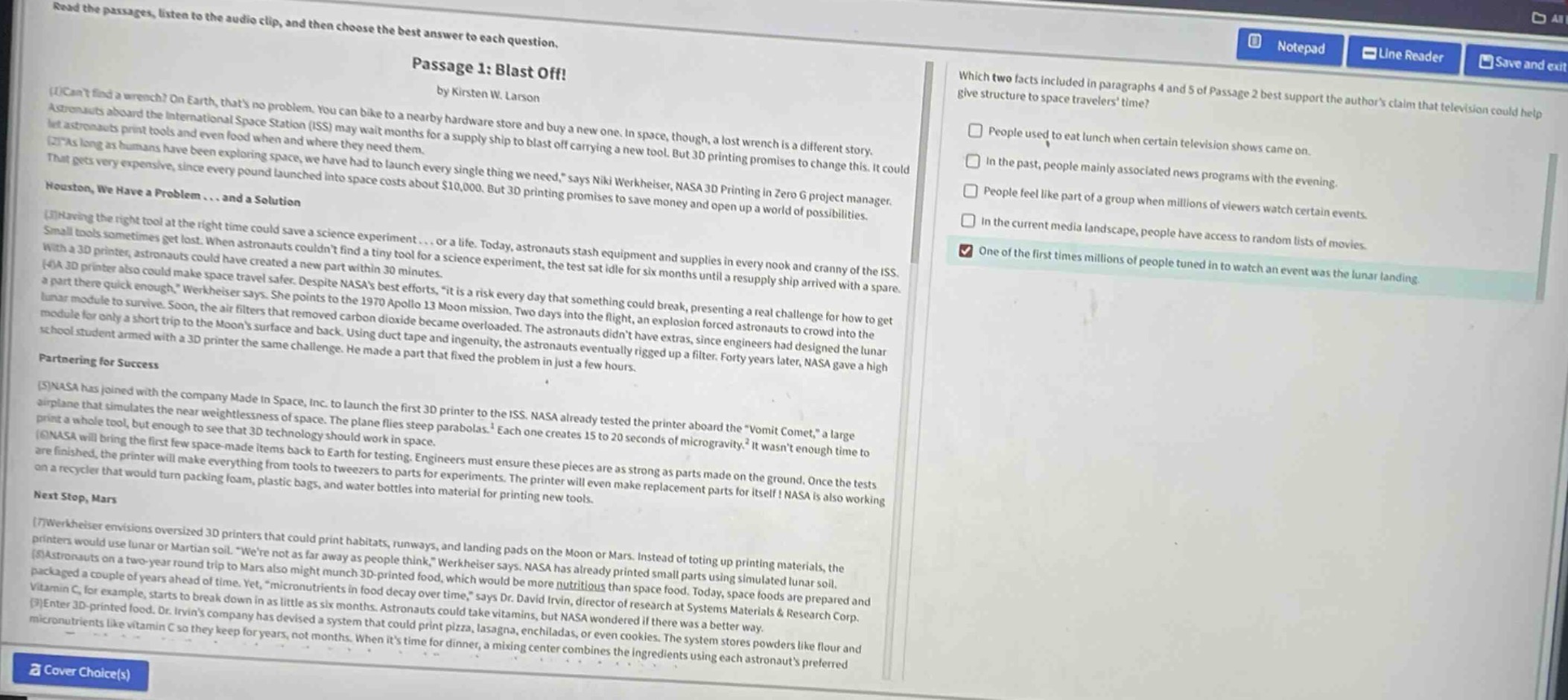
read the passages, listen to the audio clip, and then choose the best answer to each question.
passage 1: blast off!
by kirsten w. larson
(1)can’t find a wrench? on earth, that’s no problem. you can bike to a nearby hardware store and buy a new one. in space, though, a lost wrench is a different story. astronauts aboard the international space station (iss) may wait months for a supply ship to blast off carrying a new tool. but 3d printing promises to change this. it could let astronauts print tools and even food when and where they need them.
(2)“as long as humans have been exploring space, we have had to launch every single thing we need,” says niki werkheiser, nasa 3d printing in zero g project manager. that gets very expensive, since every pound launched into space costs about $10,000. but 3d printing promises to save money and open up a world of possibilities.
houston, we have a problem... and a solution
(3)having the right tool at the right time could save a science experiment... or a life. today, astronauts stash equipment and supplies in every nook and cranny of the iss. small tools sometimes get lost. when astronauts couldn’t find a tiny tool for a science experiment, the test sat idle for six months until a resupply ship arrived with a spare. with a 3d printer, astronauts could have created a new part within 30 minutes.
(4)a 3d printer also could make space travel safer. despite nasa’s best efforts, “it is a risk every day that something could break, presenting a real challenge for how to get a part there quick enough,” werkheiser says. she points to the 1970 apollo 13 moon mission. two days into the flight, an explosion forced astronauts to crowd into the lunar module to survive. soon, the air filters that removed carbon dioxide became overloaded. the astronauts didn’t have extras, since engineers had designed the lunar module for only a short trip to the moon’s surface and back. using duct tape and ingenuity, the astronauts eventually rigged up a filter. forty years later, nasa gave a high school student armed with a 3d printer the same challenge. he made a part that fixed the problem in just a few hours.
partnering for success
(5)nasa has joined with the company made in space, inc. to launch the first 3d printer to the iss. nasa already tested the printer aboard the “vomit comet,” a large airplane that simulates the near weightlessness of space. the plane flies steep parabolas.¹ each one creates 15 to 20 seconds of microgravity.² it wasn’t enough time to print a whole tool, but enough to see that 3d technology should work in space.
(6)nasa will bring the first few space - made items back to earth for testing. engineers must ensure these pieces are as strong as parts made on the ground. once the tests are finished, the printer will make everything from tools to tweezers to parts for experiments. the printer will even make replacement parts for itself! nasa is also working on a recycler that would turn packing foam, plastic bags, and water bottles into material for printing new tools.
next stop, mars
(7)werkheiser envisions oversized 3d printers that could print habitats, runways, and landing pads on the moon or mars. instead of toting up printing materials, the printers would use lunar or martian soil. “we’re not as far away as people think,” werkheiser says. nasa has already printed small parts using simulated lunar soil.
(8)astronauts on a two - year round trip to mars also might munch 3d - printed food, which would be more nutritious than space food. today, space foods are prepared and packaged a couple of years ahead of time. yet, “micronutrients in food decay over time,” says dr. david irvin, director of research at systems materials & research corp. vitamin c, for example, starts to break down in as little as six months. astronauts could take vitamins, but nasa wondered if there was a better way.
(9)enter 3d - printed food. dr. irvin’s company has devised a system that could print pizza, lasagna, enchiladas, or even cookies. the system stores powders like flour and micronutrients like vitamin c so they keep for years, not months. when it’s time for dinner, a mixing center combines the ingredients using each astronaut’s preferred
which two facts included in paragraphs 4 and 5 of passage 2 best support the author’s claim that television could help give structure to space travelers’ time?
- people used to eat lunch when certain television shows came on.
- in the past, people mainly associated news programs with the evening.
- people feel like part of a group when millions of viewers watch certain events.
- in the current media landscape, people have access to random lists of movies.
- one of the first times millions of people tuned in to watch an event was the lunar landing.
To solve this, we analyze each option to see if it supports how TV gives structure to space travelers' time (by creating routines or shared timing):
- Option 1: "People used to eat lunch when certain television shows came on."
This shows TV created a routine (eating lunch at show time), so it supports structure (space travelers could use TV to structure meals/tasks).
- Option 2: "In the past, people mainly associated news programs with the evening."
This is about news timing, not how TV structures daily time (e.g., routines), so it’s not relevant.
- Option 3: "People feel like part of a group when millions of viewers watch certain events."
This is about social connection, not time structure, so it’s not relevant.
- Option 4: "In the current media landscape, people have access to random lists of movies."
Random access doesn’t create structure; it’s about choice, so it’s not relevant.
- Option 5: "One of the first times millions of people tuned in to watch an event was the lunar landing."
This is about a historic event, not daily time structure for space travelers, so it’s not relevant.
So the correct answer is the first option.

Snap & solve any problem in the app
Get step-by-step solutions on Sovi AI
Photo-based solutions with guided steps
Explore more problems and detailed explanations
A. People used to eat lunch when certain television shows came on.