QUESTION IMAGE
Question
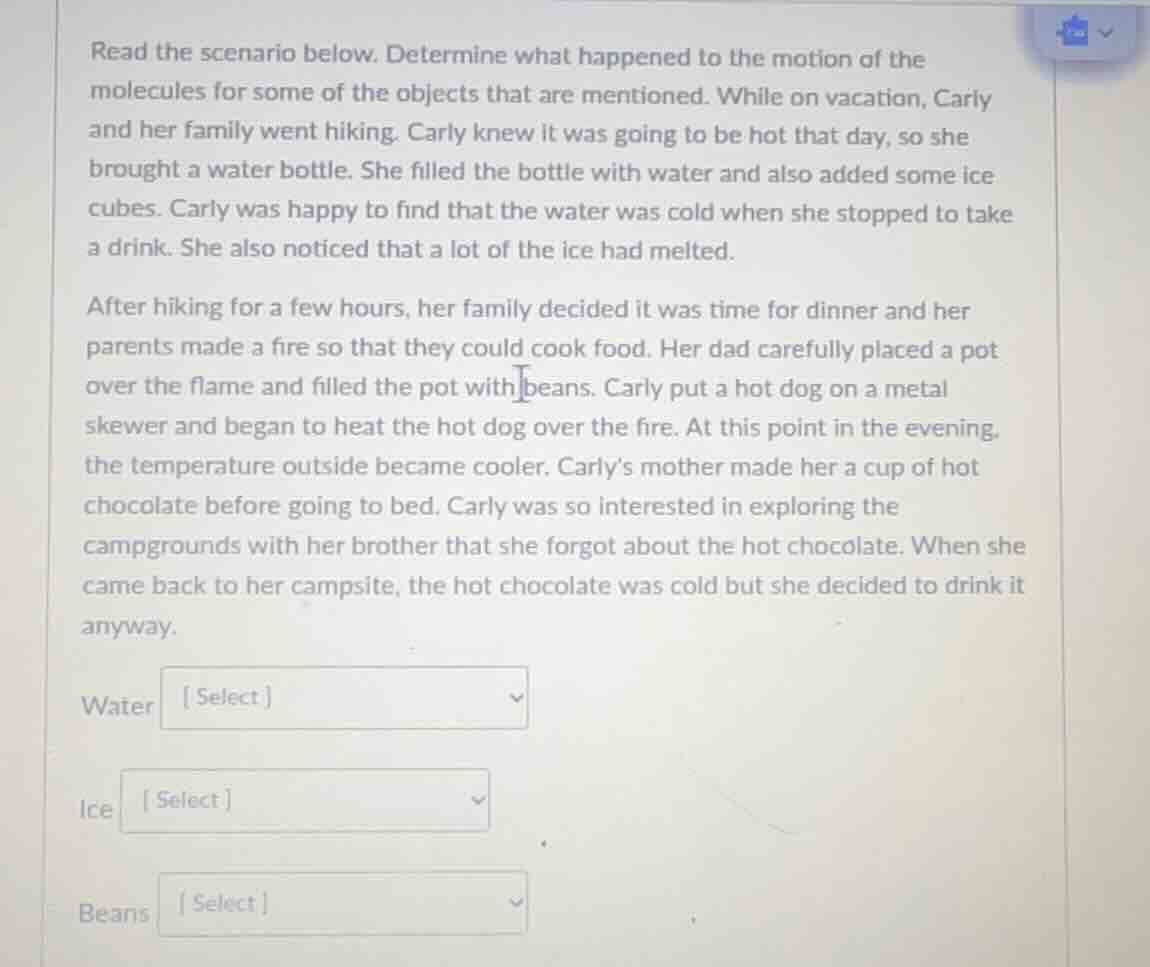
read the scenario below. determine what happened to the motion of the molecules for some of the objects that are mentioned. while on vacation, carly and her family went hiking. carly knew it was going to be hot that day, so she brought a water bottle. she filled the bottle with water and also added some ice cubes. carly was happy to find that the water was cold when she stopped to take a drink. she also noticed that a lot of the ice had melted. after hiking for a few hours, her family decided it was time for dinner and her parents made a fire so that they could cook food. her dad carefully placed a pot over the flame and filled the pot with beans. carly put a hot dog on a metal skewer and began to heat the hot dog over the fire. at this point in the evening, the temperature outside became cooler. carlys mother made her a cup of hot chocolate before going to bed. carly was so interested in exploring the campgrounds with her brother that she forgot about the hot chocolate. when she came back to her campsite, the hot chocolate was cold but she decided to drink it anyway. water select ice select beans select
To solve this, we analyze the molecular motion based on temperature changes (kinetic theory: higher temp → faster molecular motion, lower temp → slower; phase changes involve energy transfer affecting motion):
Water (in the bottle initially with ice):
The ice melts (endothermic, absorbs heat from water), so the water’s temperature decreases. By kinetic theory, as temperature drops, molecular motion slows down (since kinetic energy of molecules is proportional to temperature).
Ice (in the bottle):
Ice melts because it absorbs heat from the warmer water (and surroundings). Melting is a phase change from solid to liquid. In solids, molecules vibrate in fixed positions; in liquids, they move more freely. So, as ice melts (absorbs heat, temperature remains at 0°C during melting but energy increases molecular motion), molecular motion increases (from restricted vibration in solid to more free movement in liquid).
Beans (in the pot over the fire):
The fire heats the pot, transferring heat to the beans. Heating increases the beans’ temperature. By kinetic theory, higher temperature means molecular motion speeds up (molecules gain kinetic energy, move faster).
Final Answers:
- Water: Molecular motion slowed down
- Ice: Molecular motion increased
- Beans: Molecular motion sped up
(Note: If the dropdowns have options like "slowed down", "increased", "sped up" (or similar phrasing), these would match. Adjust based on exact dropdown choices, but the reasoning above guides the selection.)

Snap & solve any problem in the app
Get step-by-step solutions on Sovi AI
Photo-based solutions with guided steps
Explore more problems and detailed explanations
To solve this, we analyze the molecular motion based on temperature changes (kinetic theory: higher temp → faster molecular motion, lower temp → slower; phase changes involve energy transfer affecting motion):
Water (in the bottle initially with ice):
The ice melts (endothermic, absorbs heat from water), so the water’s temperature decreases. By kinetic theory, as temperature drops, molecular motion slows down (since kinetic energy of molecules is proportional to temperature).
Ice (in the bottle):
Ice melts because it absorbs heat from the warmer water (and surroundings). Melting is a phase change from solid to liquid. In solids, molecules vibrate in fixed positions; in liquids, they move more freely. So, as ice melts (absorbs heat, temperature remains at 0°C during melting but energy increases molecular motion), molecular motion increases (from restricted vibration in solid to more free movement in liquid).
Beans (in the pot over the fire):
The fire heats the pot, transferring heat to the beans. Heating increases the beans’ temperature. By kinetic theory, higher temperature means molecular motion speeds up (molecules gain kinetic energy, move faster).
Final Answers:
- Water: Molecular motion slowed down
- Ice: Molecular motion increased
- Beans: Molecular motion sped up
(Note: If the dropdowns have options like "slowed down", "increased", "sped up" (or similar phrasing), these would match. Adjust based on exact dropdown choices, but the reasoning above guides the selection.)