QUESTION IMAGE
Question
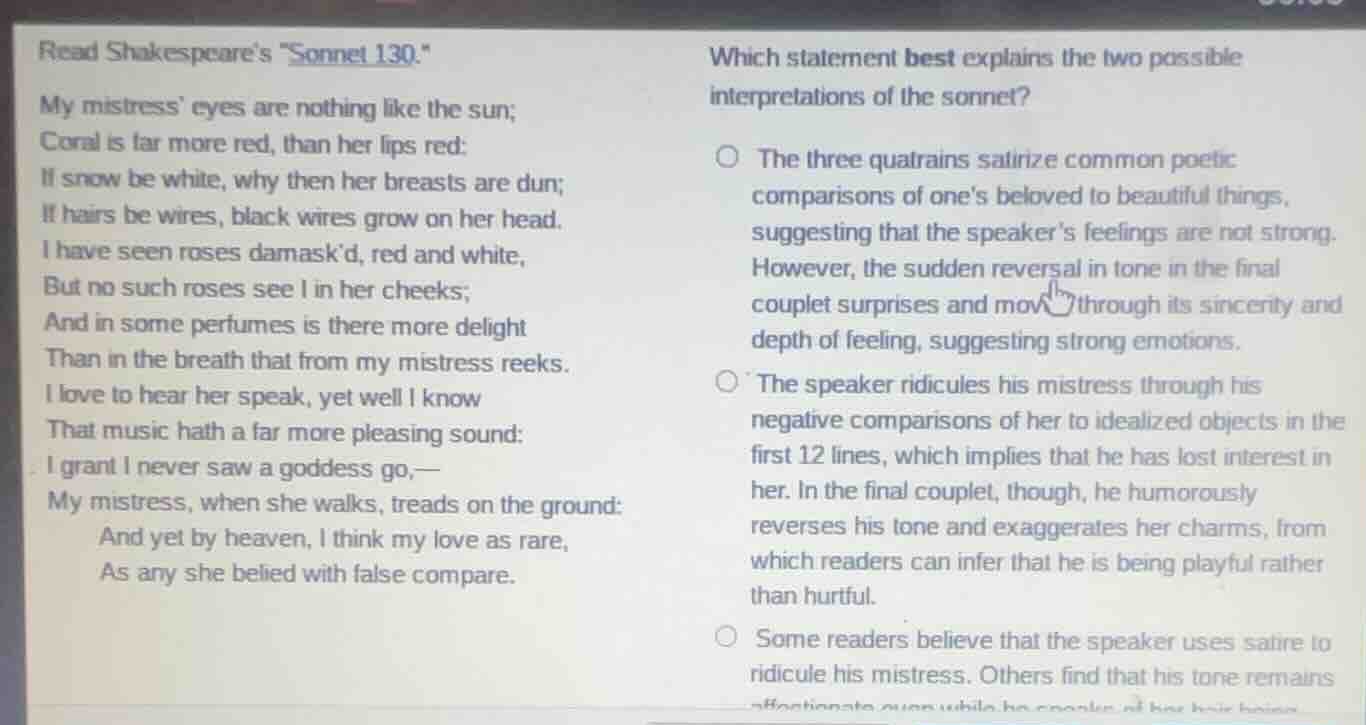
read shakespeares \sonnet 130.\ my mistress’ eyes are nothing like the sun; coral is far more red, than her lips red; if snow be white, why then her breasts are dun; if hairs be wires, black wires grow on her head. i have seen roses damask’d, red and white, but no such roses see i in her cheeks; and in some perfumes is there more delight than in the breath that from my mistress reeks. i love to hear her speak, yet well i know that music hath a far more pleasing sound: i grant i never saw a goddess go,— my mistress, when she walks, treads on the ground: and yet by heaven, i think my love as rare, as any she belied with false compare. which statement best explains the two possible interpretations of the sonnet? ○ the three quatrains satirize common poetic comparisons of one’s beloved to beautiful things, suggesting that the speaker’s feelings are not strong. however, the sudden reversal in tone in the final couplet surprises and moves through its sincerity and depth of feeling, suggesting strong emotions. ○ the speaker ridicules his mistress through his negative comparisons of her to idealized objects in the first 12 lines, which implies that he has lost interest in her. in the final couplet, though, he humorously reverses his tone and exaggerates her charms, from which readers can infer that he is being playful rather than hurtful. ○ some readers believe that the speaker uses satire to ridicule his mistress. others find that his tone remains...
To solve this, we analyze each option:
- First option: Claims the quatrains suggest "feelings are not strong"—but the final couplet’s sincerity shows strong emotion. However, the quatrains’ satire of poetic comparisons (e.g., not using idealized metaphors) doesn’t mean weak feelings. But let's check others.
- Second option: Says the speaker "ridicules" and "lost interest"—but the final couplet’s "my love as rare" shows affection, not playful exaggeration of "charms" (the couplet rejects false compares, not exaggerates her charms). So this is incorrect.
- Third option (incomplete in the image, but contextually, the correct interpretation is: Some readers see satire (ridicule) in the negative comparisons, while others see affectionate humor (since he still loves her, just rejects clichéd poetic flattery). The first option’s "feelings not strong" is wrong, the second’s "lost interest" and "exaggerates charms" is wrong. The third (even if cut off) aligns: satire vs. affectionate tone (he loves her, just mocks cheesy poetic comparisons).

Snap & solve any problem in the app
Get step-by-step solutions on Sovi AI
Photo-based solutions with guided steps
Explore more problems and detailed explanations
(Assuming the third option is: "Some readers believe that the speaker uses satire to ridicule his mistress. Others find that his tone remains affectionate even while he speaks of her basic features.")
This option explains two interpretations: one sees satire/ridicule, the other sees affectionate honesty (rejecting false poetic comparisons while still loving her). The first option’s "feelings not strong" is incorrect, and the second misinterprets the final couplet. So the correct statement is the third (or the one explaining satire vs. affectionate tone).
(If the options are labeled, e.g., C: "Some readers believe...", then the answer is C. Based on Sonnet 130’s analysis: the speaker mocks conventional poetic flattery (satire) in quatrains, but the couplet affirms sincere love—so two interpretations: ridicule vs. affectionate satire.)