QUESTION IMAGE
Question
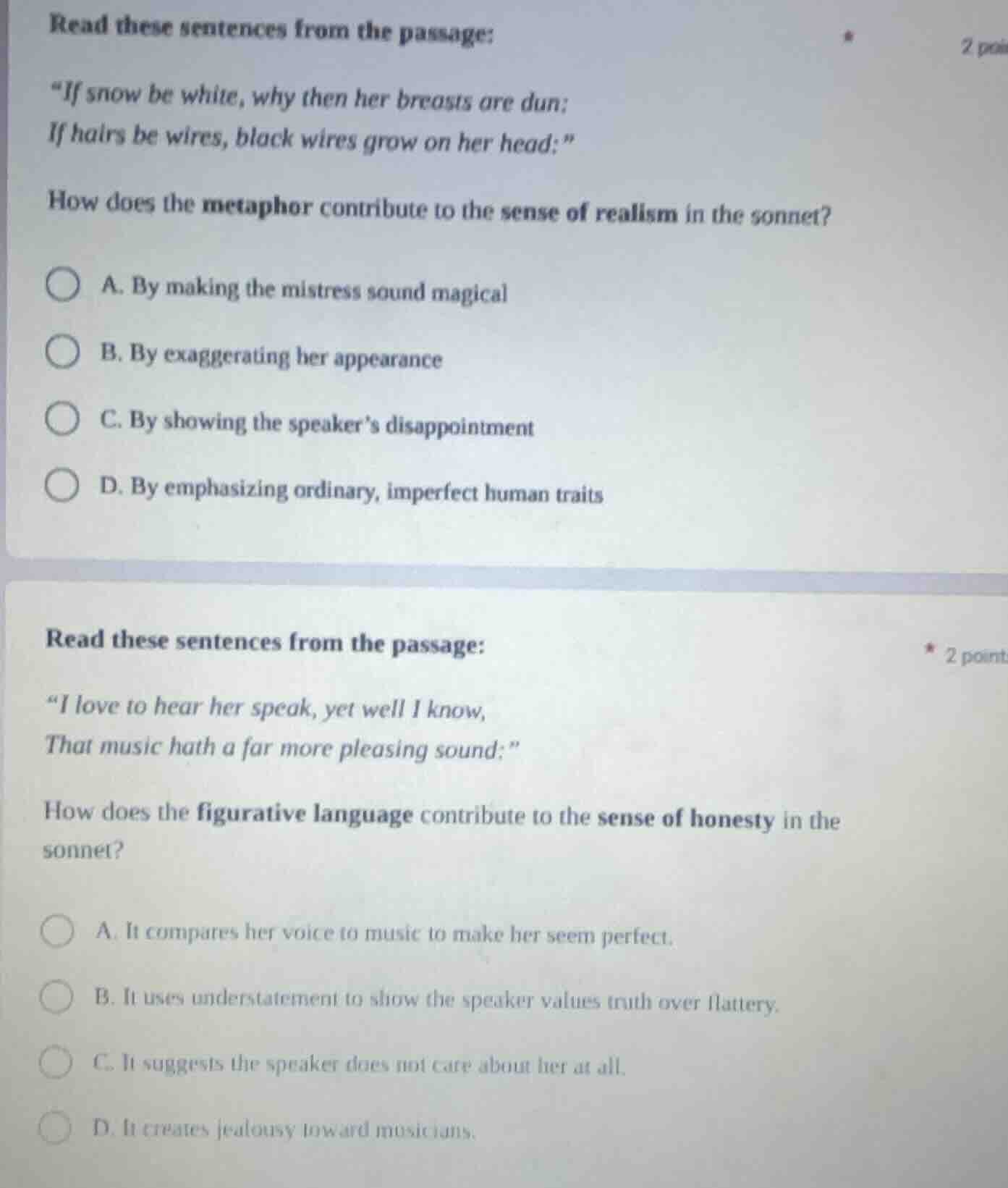
read these sentences from the passage:
\if snow be white, why then her breasts are dun;
if hairs be wires, black wires grow on her head:\
how does the metaphor contribute to the sense of realism in the sonnet?
a. by making the mistress sound magical
b. by exaggerating her appearance
c. by showing the speaker’s disappointment
d. by emphasizing ordinary, imperfect human traits
read these sentences from the passage:
\i love to hear her speak, yet well i know,
that music hath a far more pleasing sound:\
how does the figurative language contribute to the sense of honesty in the sonnet?
a. it compares her voice to music to make her seem perfect.
b. it uses understatement to show the speaker values truth over flattery.
c. it suggests the speaker does not care about her at all.
d. it creates jealousy toward musicians.
First Question:
- Option A: Making the mistress sound magical goes against realism, so A is wrong.
- Option B: Exaggerating appearance is more about hyperbole or idealization, not realism, so B is wrong.
- Option C: The metaphors here are about describing her, not showing disappointment directly, so C is wrong.
- Option D: Comparing her breasts to non - white (dun) and hair to black wires emphasizes that she has ordinary, imperfect traits, which fits realism's focus on real - life imperfections.
- Option A: The line says music is more pleasing, so it's not making her seem perfect, A is wrong.
- Option B: The speaker honestly says her voice isn't as pleasing as music, using understatement (not over - praising) to show valuing truth over flattery, which fits honesty.
- Option C: The speaker says "I love to hear her speak", so he does care, C is wrong.
- Option D: There's no jealousy toward musicians, the comparison is about her voice and music, D is wrong.

Snap & solve any problem in the app
Get step-by-step solutions on Sovi AI
Photo-based solutions with guided steps
Explore more problems and detailed explanations
D. By emphasizing ordinary, imperfect human traits