QUESTION IMAGE
Question
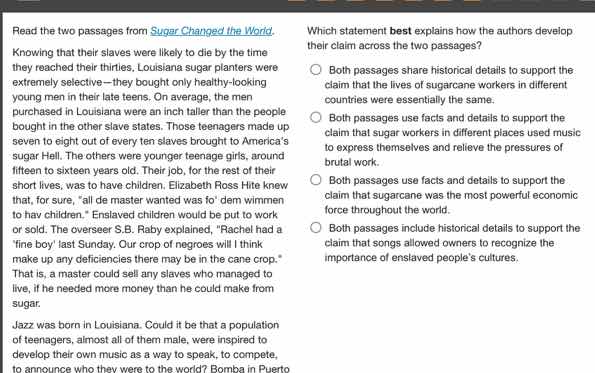
read the two passages from sugar changed the world. knowing that their slaves were likely to die by the time they reached their thirties, louisiana sugar planters were extremely selective—they bought only healthy-looking young men in their late teens. on average, the men purchased in louisiana were an inch taller than the people bought in the other slave states. those teenagers made up seven to eight out of every ten slaves brought to america’s sugar hell. the others were younger teenage girls, around fifteen to sixteen years old. their job, for the rest of their short lives, was to have children. elizabeth ross hite knew that, for sure, “all de master wanted... was dem women to hav children.” enslaved children would be put to work or sold. the overseer s.r. raby explained, “i rachel had a fine boy last sunday, our crop of negros will fetch a mate up any deficiencies there may be in the cane crop.” that is, a master could sell any slaves who managed to live, if he needed more money than he could make from sugar. jazz was born in louisiana. could it be that a population of teenagers, almost all of them male, were inspired to develop their own music as a way to speak? bomba, in puerto rico, to announce who they were to the world? to combat... which statement best explains how the authors develop their claim across the two passages? both passages share historical details to support the claim that the lives of sugarcane workers in different countries were essentially the same. both passages use facts and details to support the claim that sugar workers in different places used music to express themselves and relieve the pressures of brutal work. both passages use facts and details to support the claim that sugarcane was the most powerful economic force throughout the world. both passages include historical details to support the claim that songs allowed owners to recognize the importance of enslaved people’s cultures.
To solve this, we analyze each option:
- Option A: The passages don't focus on comparing workers' lives across countries as the main claim. Eliminate A.
- Option B: The first passage has historical details about slave - buying (e.g., age of slaves, what masters wanted), and the second passage has details about how slaves (sugarcane workers) used music (Jazz) to express themselves. Both use facts and details to support the idea that sugarcane workers (slaves) used music to express and relieve pressure. This matches.
- Option C: The passages aren't centered around sugar being the most powerful economic force. Eliminate C.
- Option D: The passages don't suggest songs were for owners to recognize enslaved cultures; rather, music was for the slaves' self - expression. Eliminate D.

Snap & solve any problem in the app
Get step-by-step solutions on Sovi AI
Photo-based solutions with guided steps
Explore more problems and detailed explanations
B. Both passages use facts and details to support the claim that sugarcane workers in different places used music to express themselves and relieve the pressures of brutal work.