QUESTION IMAGE
Question
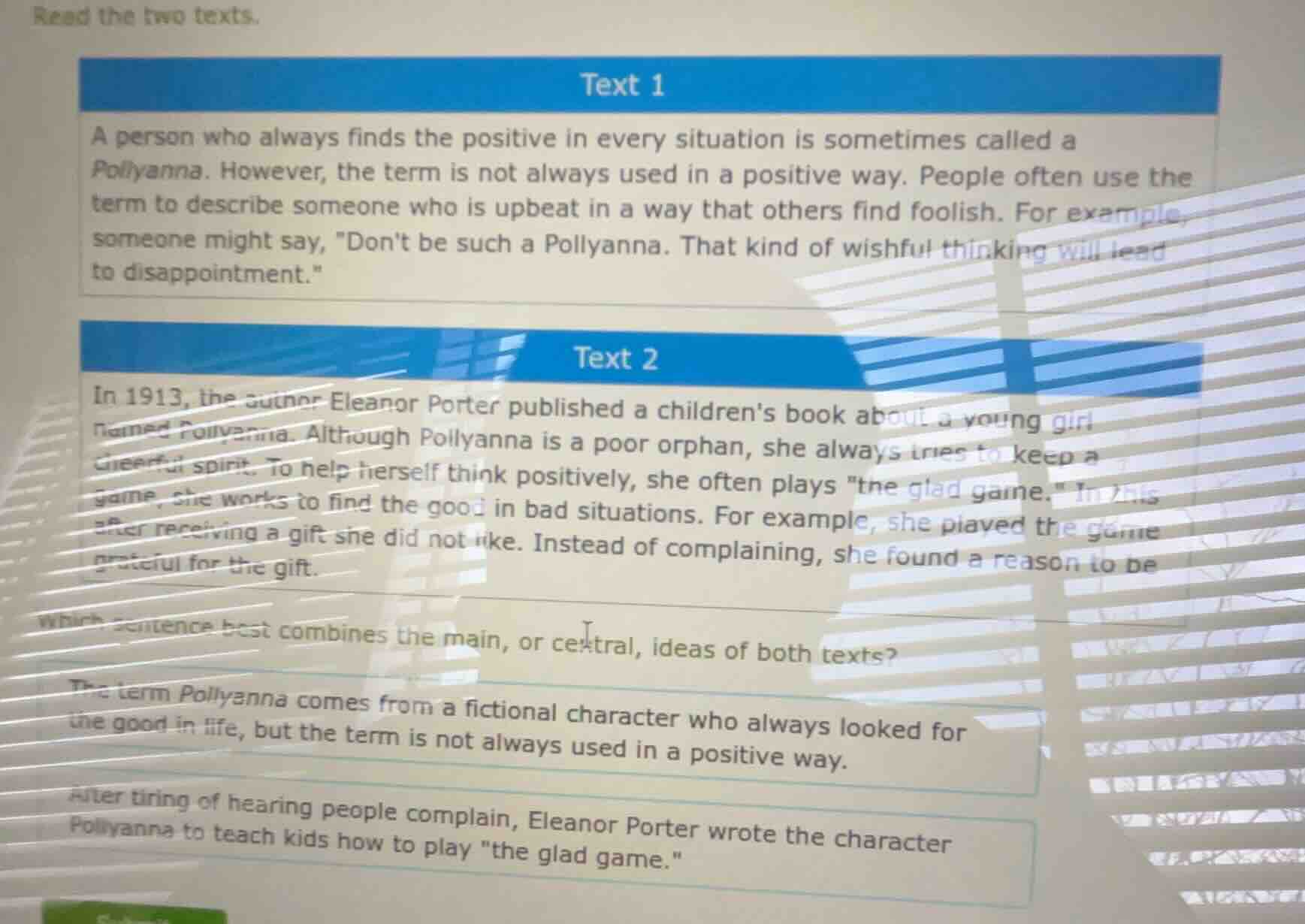
read the two texts.
text 1
a person who always finds the positive in every situation is sometimes called a pollyanna. however, the term is not always used in a positive way. people often use the term to describe someone who is upbeat in a way that others find foolish. for example, someone might say, \dont be such a pollyanna. that kind of wishful thinking will lead to disappointment.\
text 2
in 1913, the author eleanor porter published a childrens book about a young girl named pollyanna. although pollyanna is a poor orphan, she always tries to keep a cheerful spirit. to help herself think positively, she often plays \the glad game.\ in this game, she works to find the good in bad situations. for example, she played the game after receiving a gift she did not like. instead of complaining, she found a reason to be grateful for the gift.
which sentence best combines the main, or central, ideas of both texts?
the term pollyanna comes from a fictional character who always looked for the good in life, but the term is not always used in a positive way.
after tiring of hearing people complain, eleanor porter wrote the character pollyanna to teach kids how to play \the glad game.\
Text 1 explains that the term "Pollyanna" refers to someone who finds positives, but it is not always used positively. Text 2 introduces the fictional origin of the term: a 1913 children's book character who intentionally looks for good in all situations. The first option combines both the origin of the term from the fictional character and the mixed (not always positive) modern usage, which covers the main ideas of both texts. The second option only focuses on a detail from Text 2 and does not address the content of Text 1.

Snap & solve any problem in the app
Get step-by-step solutions on Sovi AI
Photo-based solutions with guided steps
Explore more problems and detailed explanations
The term Pollyanna comes from a fictional character who always looked for the good in life, but the term is not always used in a positive way.