QUESTION IMAGE
Question
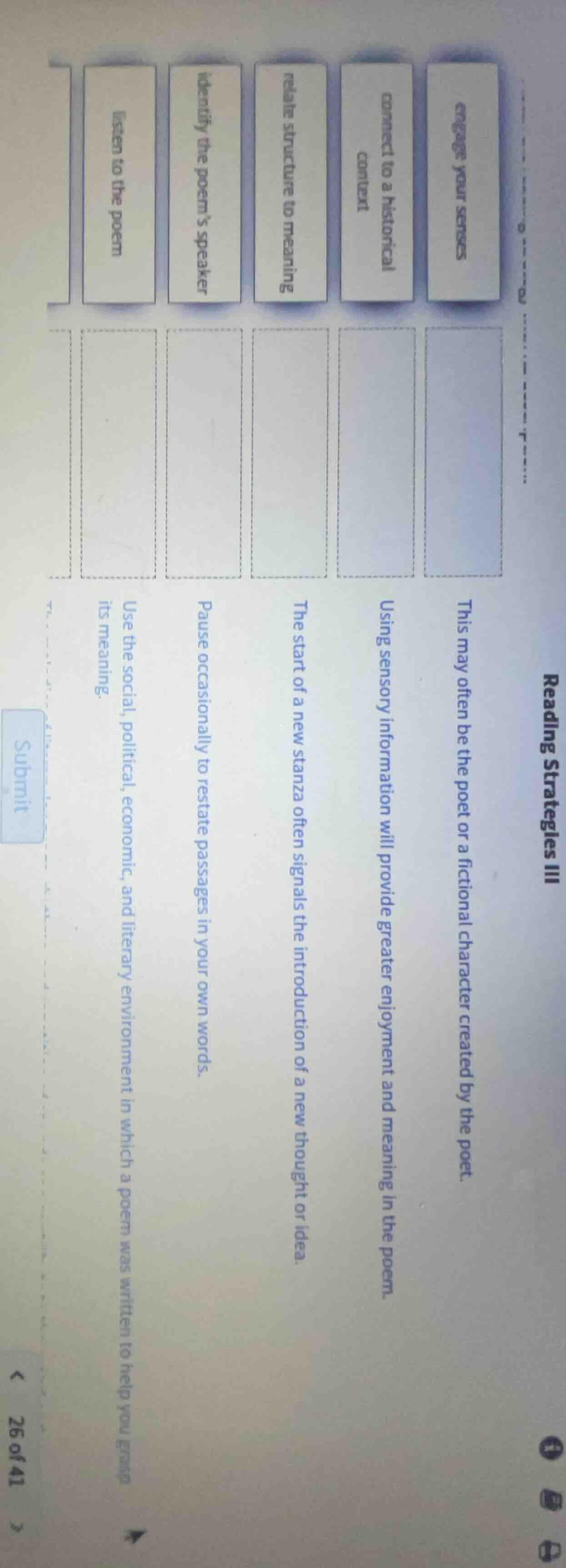
reading strategies iii
engage your senses
this may often be the poet or a fictional character created by the poet.
connect to a historical context
using sensory information will provide greater enjoyment and meaning in the poem.
relate structure to meaning
the start of a new stanza often signals the introduction of a new thought or idea.
identify the poem’s speaker
pause occasionally to restate passages in your own words.
listen to the poem
use the social, political, economic, and literary environment in which a poem was written to help you grasp its meaning.
submit
26 of 41
Each strategy is matched to its corresponding descriptive explanation by aligning the core action of the strategy with the detailed practice described:
- "engage your senses" links to using sensory details for deeper understanding.
- "connect to a historical context" ties to using the poem's social/political background.
- "relate structure to meaning" matches stanza structure signaling new ideas.
- "identify the poem's speaker" corresponds to recognizing the poem's narrative voice.
- "listen to the poem" aligns with actively processing text by restating passages.

Snap & solve any problem in the app
Get step-by-step solutions on Sovi AI
Photo-based solutions with guided steps
Explore more problems and detailed explanations
- engage your senses → Using sensory information will provide greater enjoyment and meaning in the poem.
- connect to a historical context → Use the social, political, economic, and literary environment in which a poem was written to help you grasp its meaning.
- relate structure to meaning → The start of a new stanza often signals the introduction of a new thought or idea.
- identify the poem's speaker → This may often be the poet or a fictional character created by the poet.
- listen to the poem → Pause occasionally to restate passages in your own words.