QUESTION IMAGE
Question
rear-end collisions
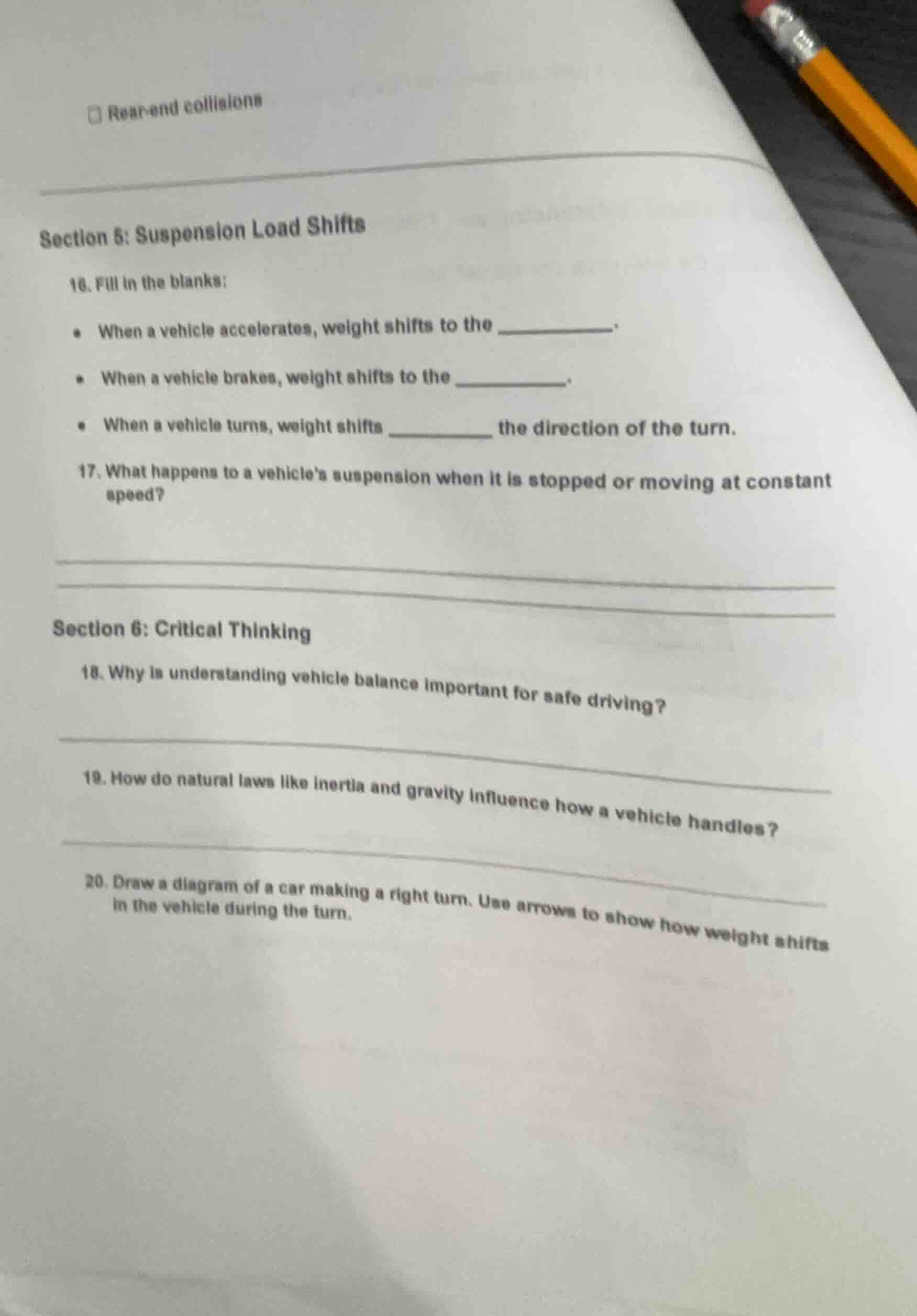
section 5: suspension load shifts
- fill in the blanks:
- when a vehicle accelerates, weight shifts to the ______.
- when a vehicle brakes, weight shifts to the ______.
- when a vehicle turns, weight shifts ______ the direction of the turn.
- what happens to a vehicles suspension when it is stopped or moving at constant speed?
section 6: critical thinking
- why is understanding vehicle balance important for safe driving?
- how do natural laws like inertia and gravity influence how a vehicle handles?
- draw a diagram of a car making a right turn. use arrows to show how weight shifts in the vehicle during the turn.
Question 16 (Fill in the blanks)
Step 1: Analyze vehicle acceleration
When a vehicle accelerates, due to inertia (the tendency of an object to resist changes in its state of motion), the weight of the vehicle shifts to the rear.
So the first blank: rear.
Step 2: Analyze vehicle braking
When a vehicle brakes, the inertia of the vehicle causes the weight to shift forward (towards the direction opposite to the motion, which is the front of the vehicle as it slows down).
So the second blank: front.
Step 3: Analyze vehicle turning
When a vehicle turns, due to the centripetal force and inertia, the weight shifts opposite to the direction of the turn (for example, when turning right, weight shifts left and vice - versa).
So the third blank: opposite to.
Question 17
When a vehicle is stopped or moving at a constant speed, according to Newton's first law (the law of inertia), there is no net force causing a change in the state of motion in the horizontal direction. In the vertical direction, the weight of the vehicle is balanced by the normal force from the ground on the suspension. So the suspension carries the weight of the vehicle evenly, and there is no additional load shift. The suspension is in a relatively stable state, supporting the vehicle's weight without the dynamic load shifts that occur during acceleration, braking, or turning.
Question 18
Understanding vehicle balance is important for safe driving because:
- Tire Traction: Proper vehicle balance affects the traction of the tires on the road. If the weight is not balanced during maneuvers like turning, braking, or accelerating, the tires may lose traction, leading to skidding or loss of control.
- Handling and Stability: A balanced vehicle is more stable and easier to handle. For example, during a turn, if the weight shift is not properly understood, the vehicle may roll over or veer off the intended path.
- Braking Efficiency: When braking, proper weight distribution (which is related to vehicle balance) ensures that the brakes can work effectively. If the weight is shifted too much to the front, the rear brakes may not be utilized properly, and if shifted too much to the rear, the front brakes may be over - stressed.
- Suspension and Component Longevity: Unbalanced loads on the suspension can cause excessive wear and tear on suspension components, tires, and other related parts. By understanding vehicle balance, a driver can operate the vehicle in a way that minimizes this wear, ensuring the vehicle remains in good working condition for a longer time.
Question 19

Snap & solve any problem in the app
Get step-by-step solutions on Sovi AI
Photo-based solutions with guided steps
Explore more problems and detailed explanations
s:
16.
- When a vehicle accelerates, weight shifts to the $\boldsymbol{\text{rear}}$.
- When a vehicle brakes, weight shifts to the $\boldsymbol{\text{front}}$.
- When a vehicle turns, weight shifts $\boldsymbol{\text{opposite to}}$ the direction of the turn.
- When a vehicle is stopped or moving at constant speed, the suspension carries the vehicle's weight evenly, with no dynamic load shifts (as there is no net force causing a change in motion state, and weight is balanced by normal force from the ground).
- Understanding vehicle balance is important for safe driving as it affects tire traction, handling/stability, braking efficiency, and suspension/component longevity.
- Inertia causes weight shifts during acceleration (rear), braking (front), and turning (opposite to turn direction), affecting traction and stability. Gravity provides weight for tire friction (needed for turning/ braking) and affects roll - over risk (via center of gravity).
- (Diagram description as above: Car turning right, weight shift arrows to the left, centripetal force arrow to the right - center, inertia force arrow to the left - outside.)