QUESTION IMAGE
Question
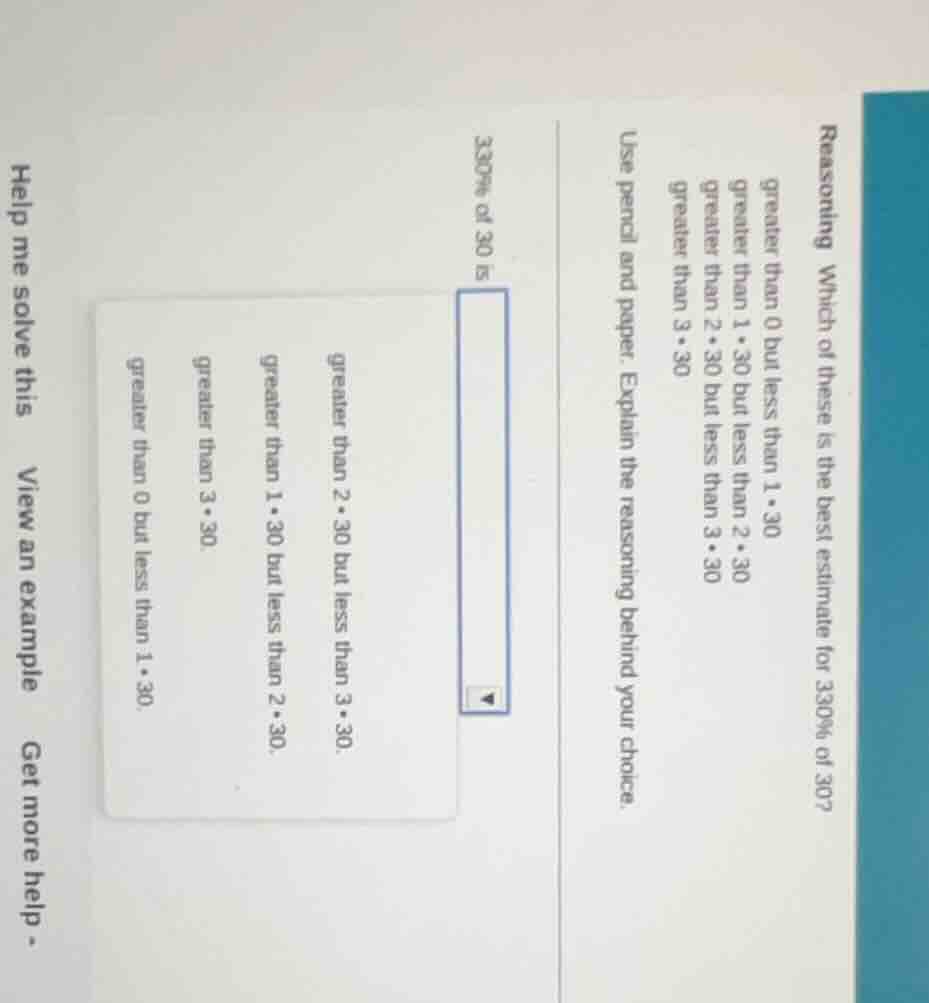
reasoning which of these is the best estimate for 330% of 30?
greater than 0 but less than 1·30
greater than 1·30 but less than 2·30
greater than 2·30 but less than 3·30
greater than 3·30
use pencil and paper. explain the reasoning behind your choice.
330% of 30 is
greater than 2·30 but less than 3·30.
greater than 1·30 but less than 2·30.
greater than 3·30.
greater than 0 but less than 1·30.
help me solve this
view an example
get more help ·
Step1: Convert percentage to decimal
To find a percentage of a number, we first convert the percentage to a decimal. Recall that to convert a percentage to a decimal, we divide by 100. So, \(330\%=\frac{330}{100} = 3.3\).
Step2: Calculate \(330\%\) of \(30\)
Now, we find \(330\%\) of \(30\) by multiplying the decimal form of the percentage by \(30\). So, \(3.3\times30 = 99\).
Step3: Analyze the ranges
- Calculate \(1\times30 = 30\), \(2\times30=60\), \(3\times30 = 90\), \(3.3\times30=99\)
- Now, check the ranges:
- \(2\times30 = 60\) and \(3\times30=90\). But \(99>90\), so not in "greater than \(2\cdot30\) but less than \(3\cdot30\)".
- \(1\times30 = 30\) and \(2\times30 = 60\). But \(99>60\), so not in "greater than \(1\cdot30\) but less than \(2\cdot30\)".
- \(3\times30=90\) and \(3.3\times30 = 99\), and \(99>90\) (which is \(3\cdot30\)) and we can also see the next range (but since \(3.3>3\), \(3.3\times30\) is greater than \(3\cdot30\) but let's check the options again. Wait, maybe I miscalculated the options. Wait the options are:
- greater than \(0\) but less than \(1\cdot30\) (i.e., \(0 < x<30\)): \(99\) is not here.
- greater than \(1\cdot30\) but less than \(2\cdot30\) (i.e., \(30 < x<60\)): \(99\) is not here.
- greater than \(2\cdot30\) but less than \(3\cdot30\) (i.e., \(60 < x<90\)): \(99\) is not here.
- greater than \(3\cdot30\) (i.e., \(x > 90\)): Since \(3.3\times30=99>90 = 3\times30\), so the correct option is "greater than \(3\cdot30\)". Wait, but maybe the options were misread. Wait the original options:
- greater than \(0\) but less than \(1\cdot30\)
- greater than \(1\cdot30\) but less than \(2\cdot30\)
- greater than \(2\cdot30\) but less than \(3\cdot30\)
- greater than \(3\cdot30\)
So since \(330\% = 3.3\), \(3.3\times30=99\), and \(3\times30 = 90\), so \(99>90\), so the value is greater than \(3\cdot30\). Also, calculating \(330\%\) of \(30\): \(330\% \times30=\frac{330}{100}\times30 = 99\).

Snap & solve any problem in the app
Get step-by-step solutions on Sovi AI
Photo-based solutions with guided steps
Explore more problems and detailed explanations
First, convert \(330\%\) to a decimal: \(330\%=\frac{330}{100} = 3.3\). Then calculate \(3.3\times30=99\). Now, \(3\times30 = 90\). Since \(99>90\), the value \(330\%\) of \(30\) (which is \(99\)) is greater than \(3\cdot30\). And the value of \(330\%\) of \(30\) is \(99\).
For the estimation part, since \(330\% = 3.3\), which is greater than \(3\), so \(3.3\times30\) is greater than \(3\times30\). So the best estimate is the option "greater than \(3\cdot30\)". And the value of \(330\%\) of \(30\) is \(99\).