QUESTION IMAGE
Question
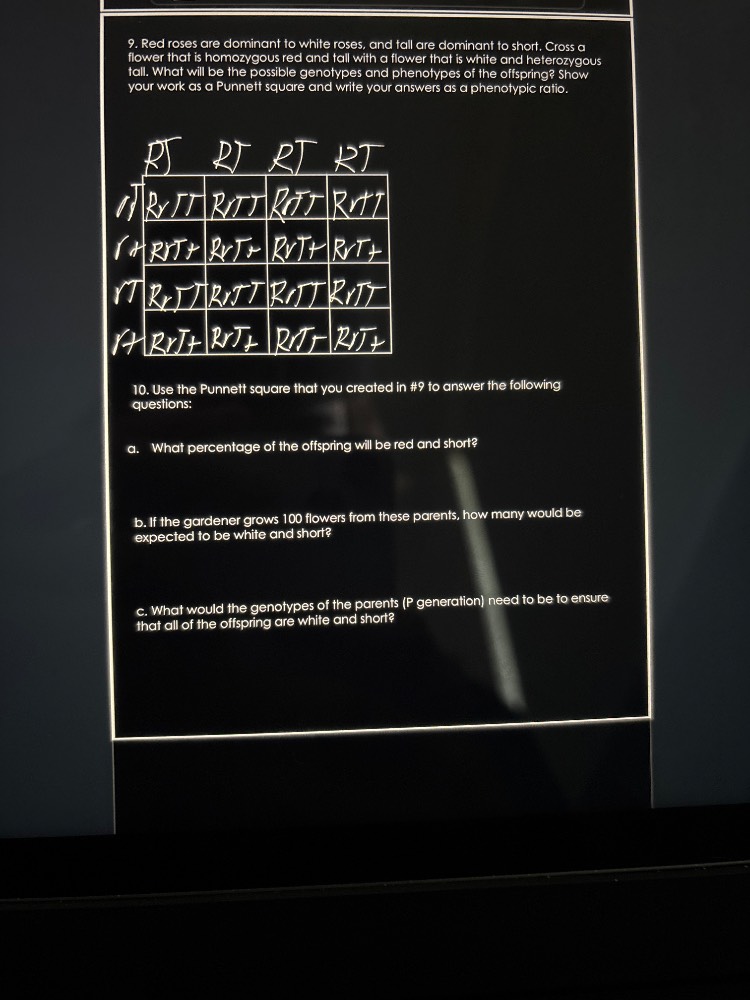
- red roses are dominant to white roses, and tall are dominant to short. cross a flower that is homozygous red and tall with a flower that is white and heterozygous tall. what will be the possible genotypes and phenotypes of the offspring? show your work as a punnett square and write your answers as a phenotypic ratio.
- use the punnett square that you created in #9 to answer the following questions:
a. what percentage of the offspring will be red and short?
b. if the gardener grows 100 flowers from these parents, how many would be expected to be white and short?
c. what would the genotypes of the parents (p generation) need to be to ensure that all of the offspring are white and short?
First, correct the parent genotypes and Punnett square for question 9:
- Parent 1 (homozygous red and tall): Genotype = $RRTT$, gametes = $RT, RT, RT, RT$
- Parent 2 (white and heterozygous tall): Genotype = $rrTt$, gametes = $rT, rt, rT, rt$
Step1: Build correct Punnett square
| $RT$ | $RT$ | $RT$ | $RT$ | |
|---|---|---|---|---|
| $rt$ | $RrTt$ | $RrTt$ | $RrTt$ | $RrTt$ |
| $rT$ | $RrTT$ | $RrTT$ | $RrTT$ | $RrTT$ |
| $rt$ | $RrTt$ | $RrTt$ | $RrTt$ | $RrTt$ |
---
For 10a:
Step1: Identify red & short genotypes
Red ($R_-$) and short ($tt$) requires $R\_tt$. No offspring have this genotype.
Step2: Calculate percentage
$\frac{0}{16} \times 100\% = 0\%$
For 10b:
Step1: Identify white & short genotypes
White ($rr$) and short ($tt$) requires $rrtt$. No offspring have this genotype.
Step2: Calculate expected number
$100 \times 0\% = 0$
For 10c:
Step1: Define target offspring genotype
All offspring must be $rrtt$ (white, short).
Step2: Determine parent genotypes
Offspring get one allele from each parent. To only produce $rrtt$, both parents must only pass $r$ (for color) and $t$ (for height). So parents must be $rrtt$ x $rrtt$.

Snap & solve any problem in the app
Get step-by-step solutions on Sovi AI
Photo-based solutions with guided steps
Explore more problems and detailed explanations
a. 0%
b. 0
c. Both parents must be homozygous white and short, with genotypes $rrtt$ and $rrtt$