QUESTION IMAGE
Question
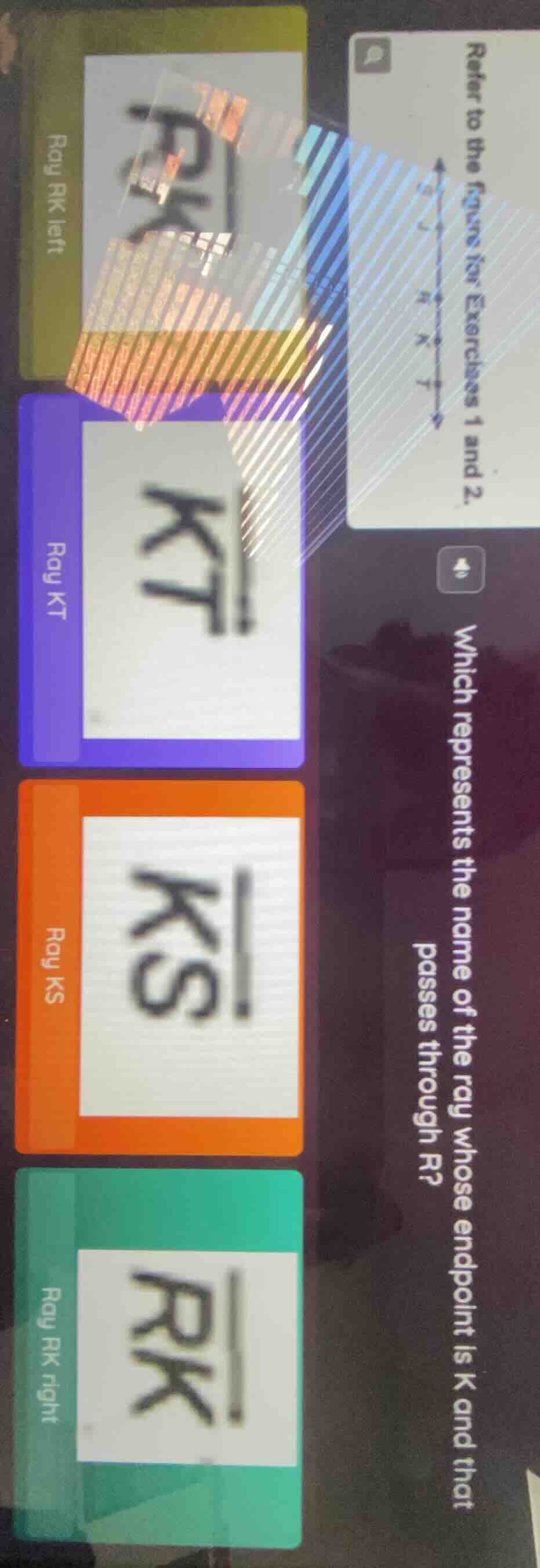
refer to the figure for exercises 1 and 2.
which represents the name of the ray whose endpoint is k and that passes through r?
ray rk left
ray kt
ray ks
ray rk right
To determine the ray with endpoint \( K \) passing through \( R \), we recall the definition of a ray: a ray is named with its endpoint first, followed by another point it passes through.
- A ray is denoted as \( \overrightarrow{KL} \) where \( K \) is the endpoint and \( L \) is a point on the ray (extending from \( K \) through \( L \)).
- For a ray with endpoint \( K \) passing through \( R \), the notation should start with \( K \) and include \( R \) (or another point in the direction of \( R \)).
Looking at the options (interpreting the blurry text, likely the correct ray is labeled with \( K \) as the endpoint and \( R \) (or a point like \( R \)) in the direction). Assuming the correct option is the one where the ray is named with \( K \) first and then the point through \( R \) (e.g., if one of the options is \( \overrightarrow{KR} \) or similar with \( K \) as endpoint and passing through \( R \)).

Snap & solve any problem in the app
Get step-by-step solutions on Sovi AI
Photo-based solutions with guided steps
Explore more problems and detailed explanations
(Assuming the correct option is, for example, the one labeled "Ray RK left" or similar with \( K \) as endpoint and passing through \( R \); since the image is blurry, but based on ray naming rules, the ray with endpoint \( K \) through \( R \) is named \( \overrightarrow{KR} \) (or the option where \( K \) is first and the ray extends through \( R \)). If the options include a ray labeled with \( K \) as endpoint and \( R \) in the direction, that is the answer. For example, if one option is "Ray KT" (but adjusted for \( R \)), the correct one is the ray starting at \( K \) and going through \( R \), so the answer would be the option with \( K \) as endpoint and \( R \) (or a point like \( R \)) in the ray’s name.)
(Note: Due to image blur, the exact option depends on the labels, but the key is the ray’s name starts with \( K \) (endpoint) and includes the point through \( R \).)