QUESTION IMAGE
Question
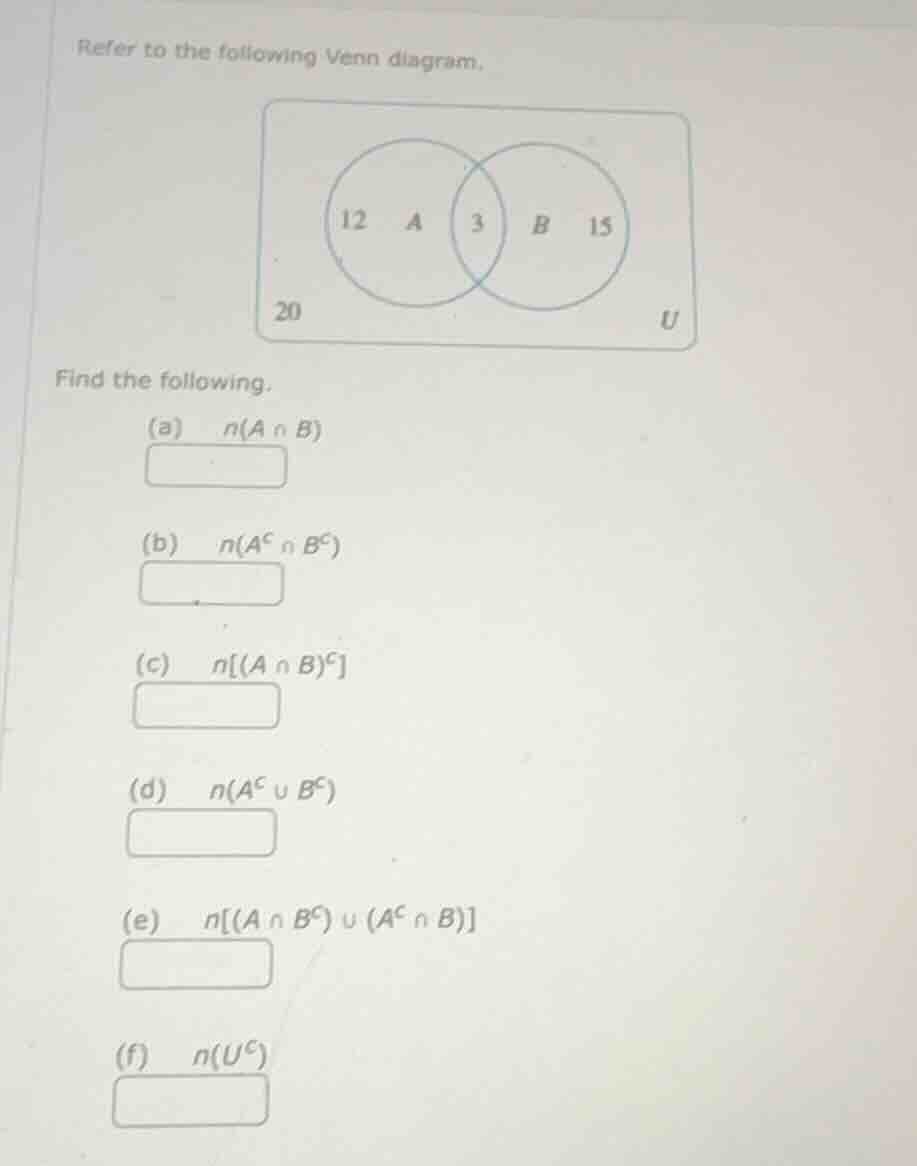
refer to the following venn diagram.
find the following.
(a) \\( n(a \cap b) \\)
(b) \\( n(a^c \cap b^c) \\)
(c) \\( n(a \cap b)^c \\)
(d) \\( n(a^c \cup b^c) \\)
(e) \\( n(a \cap b^c) \cup (a^c \cap b) \\)
(f) \\( n(u^c) \\)
Step1: Identify $n(A \cap B)$
The overlap of A and B is 3, so $n(A \cap B) = 3$.
Step2: Identify $n(A^c \cap B^c)$
This is the region outside both A and B, which is 20, so $n(A^c \cap B^c) = 20$.
Step3: Calculate $n[(A \cap B)^c]$
This is total elements minus $n(A \cap B)$. First find total $n(U)=12+3+15+20=50$. Then $n[(A \cap B)^c] = 50 - 3 = 47$.
Step4: Calculate $n(A^c \cup B^c)$
By De Morgan's law, $A^c \cup B^c = (A \cap B)^c$, so $n(A^c \cup B^c) = 47$.
Step5: Calculate $n[(A \cap B^c) \cup (A^c \cap B)]$
This is the non-overlapping parts of A and B: $12 + 15 = 27$.
Step6: Calculate $n(U^c)$
The complement of the universal set has no elements, so $n(U^c) = 0$.

Snap & solve any problem in the app
Get step-by-step solutions on Sovi AI
Photo-based solutions with guided steps
Explore more problems and detailed explanations
(a) 3
(b) 20
(c) 47
(d) 47
(e) 27
(f) 0