QUESTION IMAGE
Question
reflections
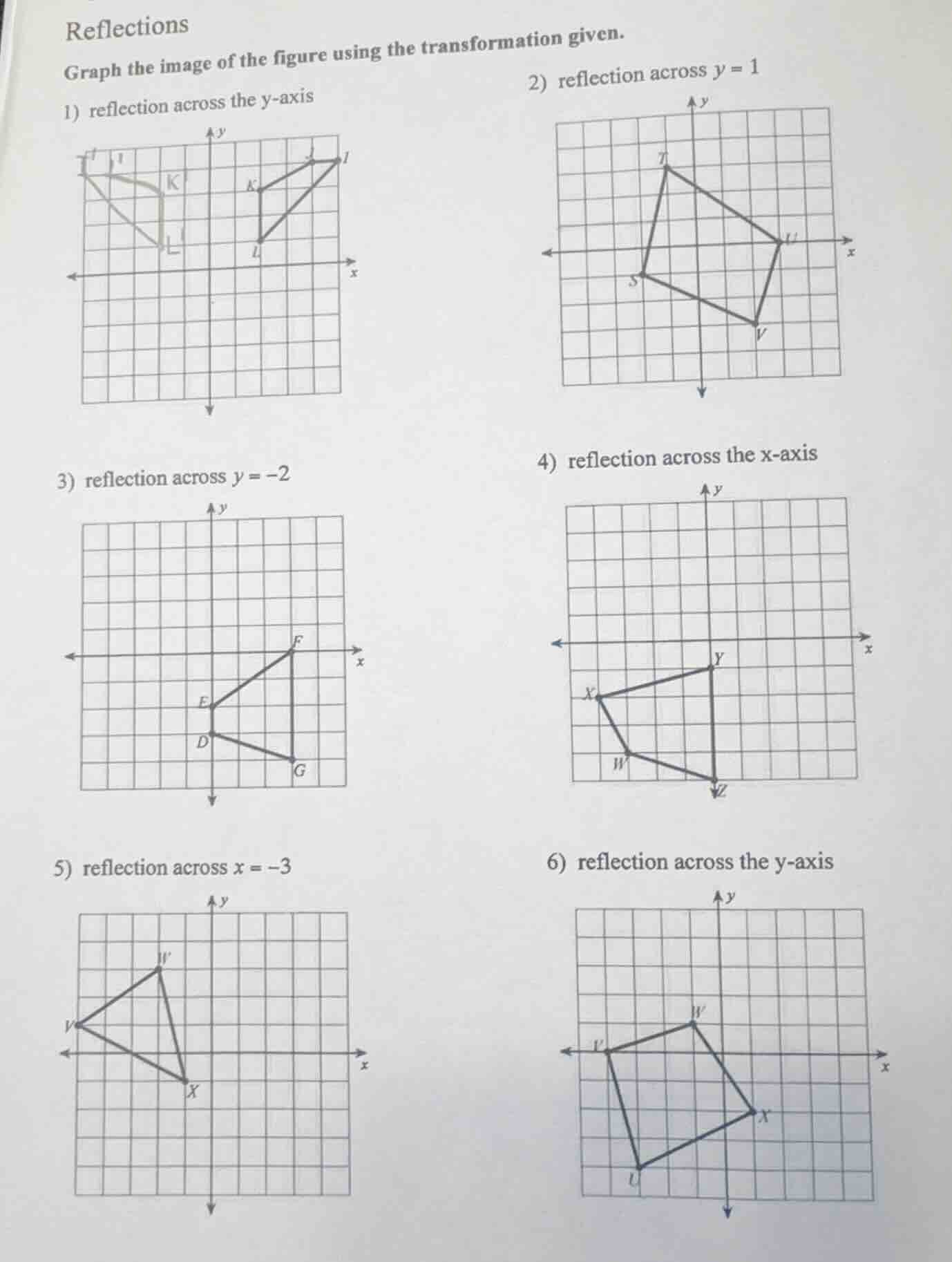
graph the image of the figure using the transformation given.
- reflection across the y - axis
- reflection across ( y = 1 )
- reflection across ( y=-2 )
- reflection across the x - axis
- reflection across ( x = - 3 )
- reflection across the y - axis
To solve these reflection problems, we'll take problem 1 (reflection across the \( y \)-axis) as an example to show the step - by - step process. The same logic can be applied to the other problems with different reflection lines/axes.
Step 1: Recall the rule for reflection across the \( y \)-axis
When a point \((x,y)\) is reflected across the \( y \)-axis, the \( x \)-coordinate changes its sign while the \( y \)-coordinate remains the same. The transformation rule is \((x,y)\to(-x,y)\).
Step 2: Identify the coordinates of the original figure's vertices
Let's assume the original figure (the non - gray one) has vertices, for example, let's say vertex \( K \) has coordinates \((a,b)\), vertex \( L \) has coordinates \((c,d)\), vertex \( J \) has coordinates \((e,f)\), and vertex \( I \) has coordinates \((g,h)\) (we can find the actual coordinates from the grid).
Step 3: Apply the reflection rule to each vertex
- For vertex \( K(a,b) \), after reflection across the \( y \)-axis, its image \( K' \) will have coordinates \((-a,b)\).
- For vertex \( L(c,d) \), after reflection across the \( y \)-axis, its image \( L' \) will have coordinates \((-c,d)\).
- For vertex \( J(e,f) \), after reflection across the \( y \)-axis, its image \( J' \) will have coordinates \((-e,f)\).
- For vertex \( I(g,h) \), after reflection across the \( y \)-axis, its image \( I' \) will have coordinates \((-g,h)\).
Step 4: Plot the reflected vertices and draw the image
Once we have the coordinates of the reflected vertices \( K' \), \( L' \), \( J' \), and \( I' \), we plot these points on the same coordinate grid and then connect them in the same order as the original figure to get the reflected image (the gray figure in the given diagram for problem 1 follows this process).
For the other problems:
Problem 2: Reflection across \( y = 1 \)
- Step 1: Recall the reflection rule across a horizontal line \( y = k \)
The distance between a point \((x,y)\) and the line \( y = k \) is \(|y - k|\). The reflected point \((x,y')\) will be such that the distance from \((x,y')\) to \( y = k \) is also \(|y - k|\), and \( y'=2k - y\).
- Step 2: Identify vertices of the original figure
Let the vertices of the original figure (with vertices \( T \), \( U \), \( V \), \( S \)) have coordinates \((x_1,y_1)\), \((x_2,y_2)\), \((x_3,y_3)\), \((x_4,y_4)\) respectively.
- Step 3: Apply the reflection formula
For a vertex \((x,y)\), the reflected \( y \)-coordinate is \( y' = 2\times1 - y=2 - y \), and the \( x \)-coordinate remains the same. So the reflected vertices will be \((x_1,2 - y_1)\), \((x_2,2 - y_2)\), \((x_3,2 - y_3)\), \((x_4,2 - y_4)\).
- Step 4: Plot and draw
Plot these reflected vertices and draw the figure.
Problem 3: Reflection across \( y=-2 \)
- Step 1: Recall the reflection rule across \( y = k=-2 \)
The formula for reflection across \( y = k \) is \( y'=2k - y \). Here \( k=-2 \), so \( y'=2\times(-2)-y=-4 - y \), and \( x \)-coordinate remains the same.
- Step 2: Identify vertices
Let the vertices of the original figure (with vertices \( D \), \( E \), \( F \), \( G \)) have coordinates \((x_1,y_1)\), \((x_2,y_2)\), \((x_3,y_3)\), \((x_4,y_4)\).
- Step 3: Apply the formula
Reflected vertices will be \((x_1,-4 - y_1)\), \((x_2,-4 - y_2)\), \((x_3,-4 - y_3)\), \((x_4,-4 - y_4)\).
- Step 4: Plot and draw
Plot the reflected vertices and draw the figure.
Problem 4: Reflection across the \( x \)-axis
- Step 1: Recall the reflection rule across the \( x \)-axis
For a point \((x,y)\), when reflec…

Snap & solve any problem in the app
Get step-by-step solutions on Sovi AI
Photo-based solutions with guided steps
Explore more problems and detailed explanations
To solve these reflection problems, we'll take problem 1 (reflection across the \( y \)-axis) as an example to show the step - by - step process. The same logic can be applied to the other problems with different reflection lines/axes.
Step 1: Recall the rule for reflection across the \( y \)-axis
When a point \((x,y)\) is reflected across the \( y \)-axis, the \( x \)-coordinate changes its sign while the \( y \)-coordinate remains the same. The transformation rule is \((x,y)\to(-x,y)\).
Step 2: Identify the coordinates of the original figure's vertices
Let's assume the original figure (the non - gray one) has vertices, for example, let's say vertex \( K \) has coordinates \((a,b)\), vertex \( L \) has coordinates \((c,d)\), vertex \( J \) has coordinates \((e,f)\), and vertex \( I \) has coordinates \((g,h)\) (we can find the actual coordinates from the grid).
Step 3: Apply the reflection rule to each vertex
- For vertex \( K(a,b) \), after reflection across the \( y \)-axis, its image \( K' \) will have coordinates \((-a,b)\).
- For vertex \( L(c,d) \), after reflection across the \( y \)-axis, its image \( L' \) will have coordinates \((-c,d)\).
- For vertex \( J(e,f) \), after reflection across the \( y \)-axis, its image \( J' \) will have coordinates \((-e,f)\).
- For vertex \( I(g,h) \), after reflection across the \( y \)-axis, its image \( I' \) will have coordinates \((-g,h)\).
Step 4: Plot the reflected vertices and draw the image
Once we have the coordinates of the reflected vertices \( K' \), \( L' \), \( J' \), and \( I' \), we plot these points on the same coordinate grid and then connect them in the same order as the original figure to get the reflected image (the gray figure in the given diagram for problem 1 follows this process).
For the other problems:
Problem 2: Reflection across \( y = 1 \)
- Step 1: Recall the reflection rule across a horizontal line \( y = k \)
The distance between a point \((x,y)\) and the line \( y = k \) is \(|y - k|\). The reflected point \((x,y')\) will be such that the distance from \((x,y')\) to \( y = k \) is also \(|y - k|\), and \( y'=2k - y\).
- Step 2: Identify vertices of the original figure
Let the vertices of the original figure (with vertices \( T \), \( U \), \( V \), \( S \)) have coordinates \((x_1,y_1)\), \((x_2,y_2)\), \((x_3,y_3)\), \((x_4,y_4)\) respectively.
- Step 3: Apply the reflection formula
For a vertex \((x,y)\), the reflected \( y \)-coordinate is \( y' = 2\times1 - y=2 - y \), and the \( x \)-coordinate remains the same. So the reflected vertices will be \((x_1,2 - y_1)\), \((x_2,2 - y_2)\), \((x_3,2 - y_3)\), \((x_4,2 - y_4)\).
- Step 4: Plot and draw
Plot these reflected vertices and draw the figure.
Problem 3: Reflection across \( y=-2 \)
- Step 1: Recall the reflection rule across \( y = k=-2 \)
The formula for reflection across \( y = k \) is \( y'=2k - y \). Here \( k=-2 \), so \( y'=2\times(-2)-y=-4 - y \), and \( x \)-coordinate remains the same.
- Step 2: Identify vertices
Let the vertices of the original figure (with vertices \( D \), \( E \), \( F \), \( G \)) have coordinates \((x_1,y_1)\), \((x_2,y_2)\), \((x_3,y_3)\), \((x_4,y_4)\).
- Step 3: Apply the formula
Reflected vertices will be \((x_1,-4 - y_1)\), \((x_2,-4 - y_2)\), \((x_3,-4 - y_3)\), \((x_4,-4 - y_4)\).
- Step 4: Plot and draw
Plot the reflected vertices and draw the figure.
Problem 4: Reflection across the \( x \)-axis
- Step 1: Recall the reflection rule across the \( x \)-axis
For a point \((x,y)\), when reflected across the \( x \)-axis, the \( y \)-coordinate changes sign and the \( x \)-coordinate remains the same. So the transformation is \((x,y)\to(x, - y)\).
- Step 2: Identify vertices
Let the vertices of the original figure (with vertices \( X \), \( Y \), \( Z \), \( W \)) have coordinates \((x_1,y_1)\), \((x_2,y_2)\), \((x_3,y_3)\), \((x_4,y_4)\).
- Step 3: Apply the rule
Reflected vertices will be \((x_1,-y_1)\), \((x_2,-y_2)\), \((x_3,-y_3)\), \((x_4,-y_4)\).
- Step 4: Plot and draw
Plot these points and draw the reflected figure.
Problem 5: Reflection across \( x=-3 \)
- Step 1: Recall the reflection rule across a vertical line \( x = k \)
The distance between a point \((x,y)\) and the line \( x = k \) is \(|x - k|\). The reflected point \((x',y)\) will be such that the distance from \((x',y)\) to \( x = k \) is also \(|x - k|\), and \( x'=2k - x\). Here \( k = - 3 \), so \( x'=2\times(-3)-x=-6 - x \), and the \( y \)-coordinate remains the same.
- Step 2: Identify vertices
Let the vertices of the original figure (with vertices \( V \), \( W \), \( X \)) have coordinates \((x_1,y_1)\), \((x_2,y_2)\), \((x_3,y_3)\).
- Step 3: Apply the formula
Reflected vertices will be \((-6 - x_1,y_1)\), \((-6 - x_2,y_2)\), \((-6 - x_3,y_3)\).
- Step 4: Plot and draw
Plot these points and draw the reflected figure.
Problem 6: Reflection across the \( y \)-axis
- Step 1: Recall the reflection rule across the \( y \)-axis
For a point \((x,y)\), the reflection across the \( y \)-axis is \((x,y)\to(-x,y)\) (same as problem 1's rule).
- Step 2: Identify vertices
Let the vertices of the original figure (with vertices \( V \), \( W \), \( X \), \( U \)) have coordinates \((x_1,y_1)\), \((x_2,y_2)\), \((x_3,y_3)\), \((x_4,y_4)\).
- Step 3: Apply the rule
Reflected vertices will be \((-x_1,y_1)\), \((-x_2,y_2)\), \((-x_3,y_3)\), \((-x_4,y_4)\).
- Step 4: Plot and draw
Plot these points and draw the reflected figure.
The process of reflecting a figure involves identifying the vertices, applying the appropriate reflection rule (based on the axis or line of reflection) to each vertex, and then plotting and connecting the reflected vertices to form the image. The final answer is the set of reflected figures obtained by following these steps for each respective problem.