QUESTION IMAGE
Question
released staar® - determine the best answer to the questions below.
______7. the cellular process known as the sodium - potassium pump was discovered in the 1950s by jens christian skou, a danish scientist. this process is a form of active transport that moves three sodium ions to the outside of a cell for every two potassium ions that it moves into the cell. which of these best explains why energy is needed for active transport?
a. ions are negatively charged.
b. ions are attached to large proteins.
c. ions are trapped inside the plasma membrane.
d. ions are moved against the concentration gradient.
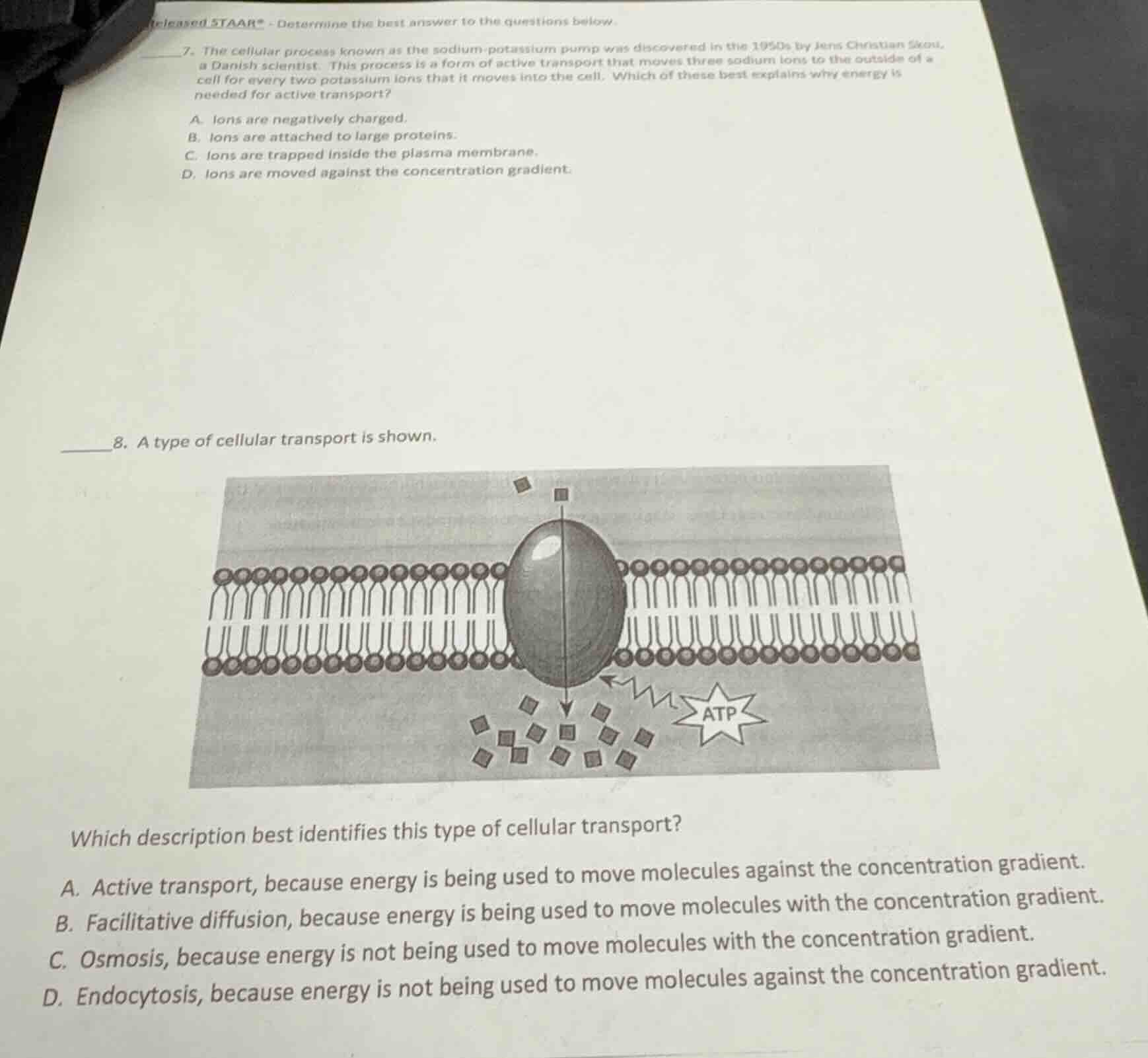
______8. a type of cellular transport is shown.
which description best identifies this type of cellular transport?
a. active transport, because energy is being used to move molecules against the concentration gradient.
b. facilitative diffusion, because energy is being used to move molecules with the concentration gradient.
c. osmosis, because energy is not being used to move molecules with the concentration gradient.
d. endocytosis, because energy is not being used to move molecules against the concentration gradient.
Question 7
To determine why energy is needed for active transport in the sodium - potassium pump:
- Option A: The charge of ions (negative) does not directly relate to the need for energy in active transport. Active transport is about movement against concentration gradients, not ion charge.
- Option B: Ions being attached to large proteins is not the reason energy is required for active transport. The key factor is the direction of ion movement relative to the concentration gradient.
- Option C: Ions are not "trapped" inside the plasma membrane in a way that explains the energy need for active transport. The plasma membrane is selectively permeable, and active transport is about moving against the natural flow of ions.
- Option D: Active transport, like the sodium - potassium pump, moves substances (ions in this case) against their concentration gradient (from an area of low concentration to high concentration). This process requires energy (in the form of ATP) because it is working against the natural tendency of substances to move down their concentration gradient (passive transport, which does not require energy). So this option correctly explains why energy is needed.
To identify the type of cellular transport:
- Option A: The diagram shows the use of ATP (energy) and the movement of molecules from an area of low concentration (top, fewer molecules) to high concentration (bottom, more molecules), which is against the concentration gradient. Active transport is defined as the movement of substances against their concentration gradient with the use of energy (ATP).
- Option B: Facilitative diffusion is a type of passive transport that moves substances with the concentration gradient and does not require energy. The diagram shows energy (ATP) being used, so this is incorrect.
- Option C: Osmosis is the movement of water across a semi - permeable membrane with the concentration gradient (from high water potential to low water potential) and does not require energy. The diagram shows a solute (the square molecules) being transported and energy being used, so this is not osmosis.
- Option D: Endocytosis is a process where the cell engulfs large particles or substances, and it is not the process shown in the diagram. Also, endocytosis does require energy, but the mechanism is different from what is depicted here.

Snap & solve any problem in the app
Get step-by-step solutions on Sovi AI
Photo-based solutions with guided steps
Explore more problems and detailed explanations
D. Ions are moved against the concentration gradient.