QUESTION IMAGE
Question
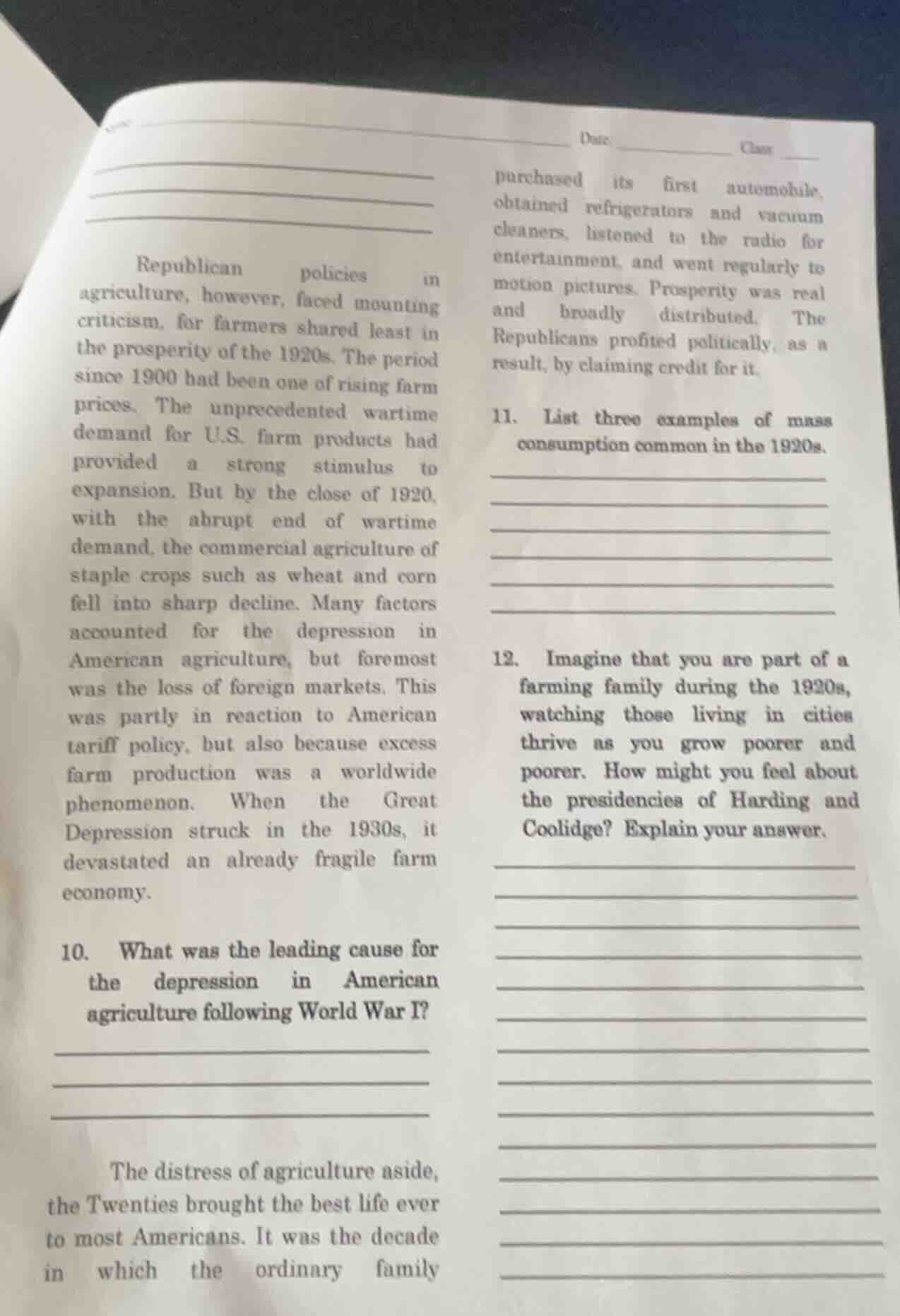
republican policies in agriculture, however, faced mounting criticism, for farmers shared least in the prosperity of the 1920s. the period since 1900 had been one of rising farm prices. the unprecedented wartime demand for u.s. farm products had provided a strong stimulus to expansion. but by the close of 1920, with the abrupt end of wartime demand, the commercial agriculture of staple crops such as wheat and corn fell into sharp decline. many factors accounted for the depression in american agriculture, but foremost was the loss of foreign markets. this was partly in reaction to american tariff policy, but also because excess farm production was a worldwide phenomenon. when the great depression struck in the 1930s, it devastated an already fragile farm economy.
- what was the leading cause for the depression in american agriculture following world war i?
the distress of agriculture aside, the twenties brought the best life ever to most americans. it was the decade in which the ordinary family purchased its first automobile, obtained refrigerators and vacuum cleaners, listened to the radio for entertainment, and went regularly to motion pictures. prosperity was real and broadly distributed. the republicans profited politically, as a result, by claiming credit for it.
- list three examples of mass consumption common in the 1920s.
- imagine that you are part of a farming family during the 1920s, watching those living in cities thrive as you grow poorer and poorer. how might you feel about the presidencies of harding and coolidge? explain your answer.
For Question 10:
The text explicitly states that the primary cause of the agricultural depression post-WWI was the loss of foreign markets, tied to U.S. tariff policy and global overproduction.
For Question 11:
The passage lists widespread consumer items and activities that defined 1920s mass consumption.
For Question 12:
Farmers benefited least from 1920s prosperity, while Republicans (Harding, Coolidge) took credit for urban/countrywide prosperity. This would foster resentment as farmers faced declining fortunes.

Snap & solve any problem in the app
Get step-by-step solutions on Sovi AI
Photo-based solutions with guided steps
Explore more problems and detailed explanations
- The leading cause was the loss of foreign markets for U.S. farm products, exacerbated by American tariff policy and global excess farm production.
- 1. Purchasing the first family automobile
- Buying household appliances like refrigerators and vacuum cleaners
- Regularly listening to the radio and going to motion pictures
- I would feel deeply resentful and betrayed. Harding and Coolidge's Republican administrations claimed credit for the 1920s prosperity, but my farming family was excluded from this economic success—we faced plummeting crop prices and a collapsing farm economy while city dwellers thrived. The policies of their administrations did nothing to address the crisis in agriculture, so I would view their claims of prosperity as ignoring the struggles of rural Americans like my family.