QUESTION IMAGE
Question
required information
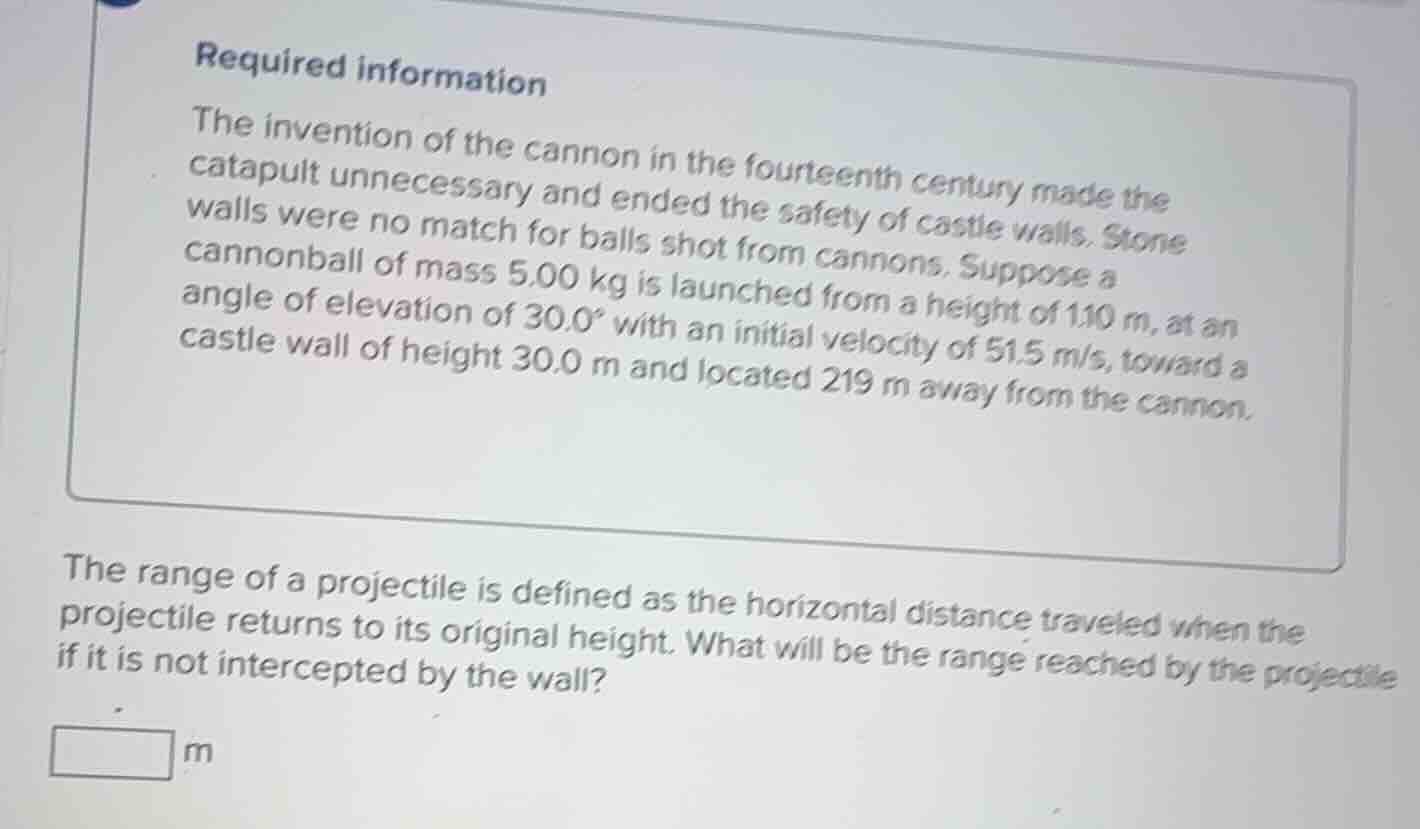
the invention of the cannon in the fourteenth century made the catapult unnecessary and ended the safety of castle walls. stone walls were no match for balls shot from cannons. suppose a cannonball of mass 5.00 kg is launched from a height of 1.10 m, at an angle of elevation of 30.0° with an initial velocity of 51.5 m/s, toward a castle wall of height 30.0 m and located 219 m away from the cannon.
the range of a projectile is defined as the horizontal distance traveled when the projectile returns to its original height. what will be the range reached by the projectile if it is not intercepted by the wall?
m
Step1: Find vertical initial velocity
$v_{0y} = v_0 \sin\theta = 51.5 \sin(30.0^\circ) = 25.75 \, \text{m/s}$
Step2: Find time to return to launch height
Use vertical displacement $\Delta y = 0$.
$\Delta y = v_{0y}t - \frac{1}{2}gt^2$
$0 = 25.75t - 4.9t^2$
$t(25.75 - 4.9t) = 0$
Take non-zero solution: $t = \frac{25.75}{4.9} \approx 5.255 \, \text{s}$
Step3: Find horizontal initial velocity
$v_{0x} = v_0 \cos\theta = 51.5 \cos(30.0^\circ) \approx 44.63 \, \text{m/s}$
Step4: Calculate horizontal range
$R = v_{0x} \times t$
$R \approx 44.63 \times 5.255$

Snap & solve any problem in the app
Get step-by-step solutions on Sovi AI
Photo-based solutions with guided steps
Explore more problems and detailed explanations
234.5 m (rounded to one decimal place, or 235 m if rounded to whole number)