QUESTION IMAGE
Question
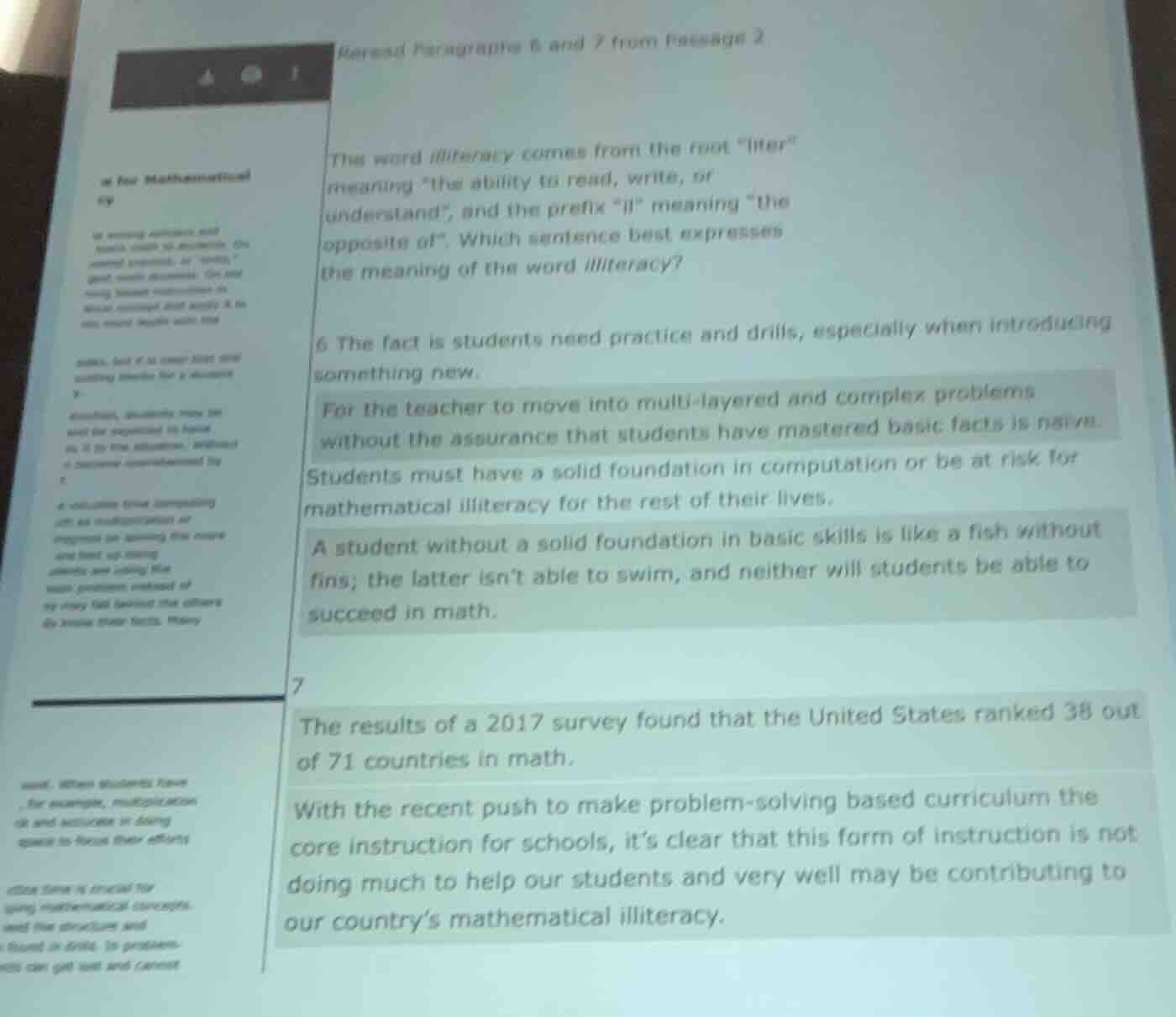
reread paragraphs 6 and 7 from passage 2
the word illiteracy comes from the root \liter\ meaning \the ability to read, write, or understand\, and the prefix \il\ meaning \the opposite of\. which sentence best expresses the meaning of the word illiteracy?
- the fact is students need practice and drills, especially when introducing something new.
for the teacher to move into multi - layered and complex problems without the assurance that students have mastered basic facts is naive.
students must have a solid foundation in computation or be at risk for mathematical illiteracy for the rest of their lives.
a student without a solid foundation in basic skills is like a fish without fins; the latter isnt able to swim, and neither will students be able to succeed in math.
7
the results of a 2017 survey found that the united states ranked 38 out of 71 countries in math.
with the recent push to make problem - solving based curriculum the core instruction for schools, its clear that this form of instruction is not doing much to help our students and very well may be contributing to our country’s mathematical illiteracy.
To determine the sentence that best expresses the meaning of "illiteracy" (in the context of mathematical illiteracy), we analyze the root and prefix: "liter" means "the ability to read, write, or understand" and "il-" means "the opposite of". So, "illiteracy" should relate to a lack of basic skills/understanding.
- Analyze each sentence:
- Paragraph 6 sentences: The sentence "Students must have a solid foundation in computation or be at risk for mathematical illiteracy for the rest of their lives" directly connects a lack of basic (computation) skills to "mathematical illiteracy", aligning with the prefix/root meaning (opposite of being able to understand/do math). The analogy ("A student without...") supports this but is illustrative, while the sentence about risk directly defines the consequence of lacking foundation as illiteracy.
- Paragraph 7 sentences: These discuss survey results and curriculum issues, not the definition of illiteracy.
To find the sentence expressing "illiteracy" (root "liter" = ability to understand, prefix "il-" = opposite), we analyze:
- "Students must have a solid foundation... or be at risk for mathematical illiteracy" links lacking basic (computation) skills to illiteracy (opposite of mathematical understanding/ability), matching the prefix - root meaning.
- Other sentences (e.g., about practice, survey, curriculum) do not define "illiteracy" but discuss related topics.

Snap & solve any problem in the app
Get step-by-step solutions on Sovi AI
Photo-based solutions with guided steps
Explore more problems and detailed explanations
Students must have a solid foundation in computation or be at risk for mathematical illiteracy for the rest of their lives.