QUESTION IMAGE
Question
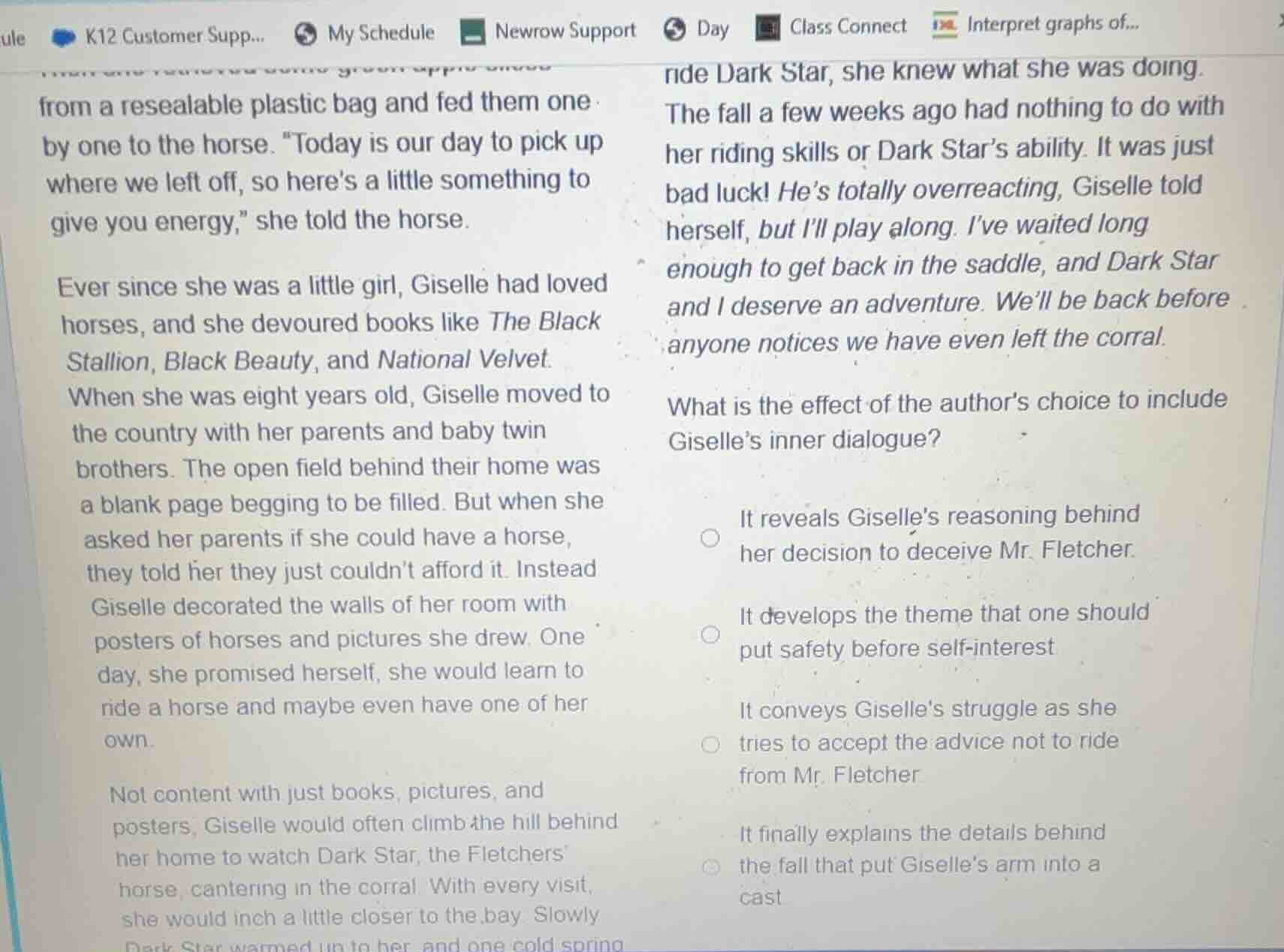
from a resealable plastic bag and fed them one by one to the horse. \today is our day to pick up where we left off, so heres a little something to give you energy,\ she told the horse.
ever since she was a little girl, giselle had loved horses, and she devoured books like the black stallion, black beauty, and national velvet. when she was eight years old, giselle moved to the country with her parents and baby twin brothers. the open field behind their home was a blank page begging to be filled. but when she asked her parents if she could have a horse, they told her they just couldnt afford it. instead giselle decorated the walls of her room with posters of horses and pictures she drew. one day, she promised herself, she would learn to ride a horse and maybe even have one of her own.
not content with just books, pictures, and posters, giselle would often climb the hill behind her home to watch dark star, the fletchers’ horse, cantering in the corral. with every visit, she would inch a little closer to the bay. slowly dark star warmed up to her, and one cold spring ride dark star, she knew what she was doing. the fall a few weeks ago had nothing to do with her riding skills or dark star’s ability. it was just bad luck! he’s totally overreacting, giselle told herself, but i’ll play along. i’ve waited long enough to get back in the saddle, and dark star and i deserve an adventure. we’ll be back before anyone notices we have even left the corral.
what is the effect of the author’s choice to include giselle’s inner dialogue?
- it reveals giselle’s reasoning behind her decision to deceive mr. fletcher.
- it develops the theme that one should put safety before self - interest
- it conveys giselles struggle as she tries to accept the advice not to ride from mr. fletcher
- it finally explains the details behind the fall that put giselle’s arm into a cast
To determine the effect of Giselle's inner dialogue, we analyze each option:
- Option 1: Giselle's inner dialogue (e.g., "He’s totally overreacting... I’ll play along... We’ll be back before anyone notices") shows her reasoning for deceiving Mr. Fletcher (by going riding despite his concerns) to fulfill her desire to ride.
- Option 2: The inner dialogue doesn't focus on safety vs. self - interest as a theme; it's about her desire to ride.
- Option 3: She isn't trying to accept the advice; she thinks he's overreacting and plans to ride anyway.
- Option 4: The inner dialogue doesn't explain the fall's details; it attributes the fall to bad luck but doesn't elaborate on the fall itself.

Snap & solve any problem in the app
Get step-by-step solutions on Sovi AI
Photo-based solutions with guided steps
Explore more problems and detailed explanations
A. It reveals Giselle’s reasoning behind her decision to deceive Mr. Fletcher.