QUESTION IMAGE
Question
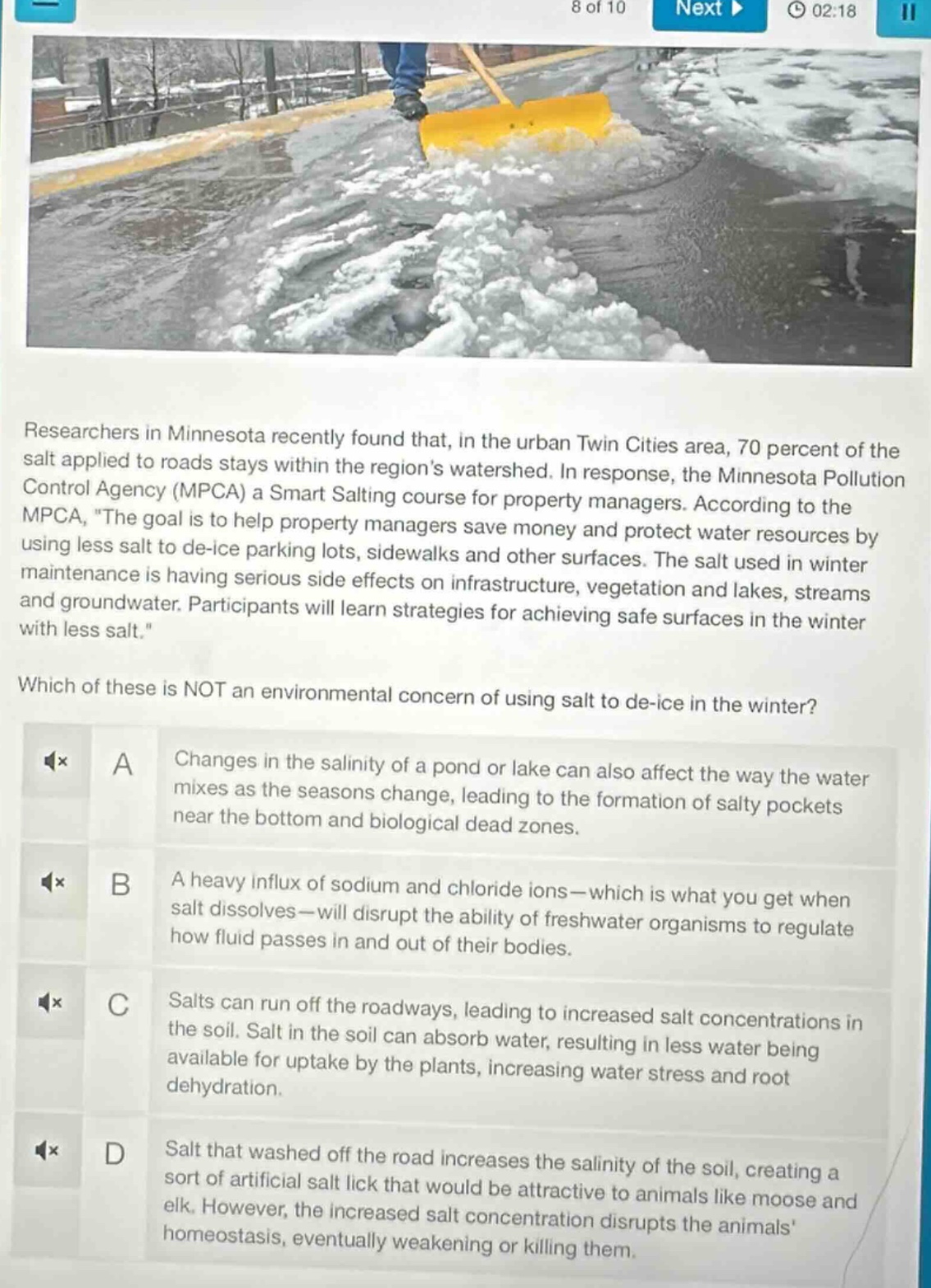
researchers in minnesota recently found that, in the urban twin cities area, 70 percent of the salt applied to roads stays within the regions watershed. in response, the minnesota pollution control agency (mpca) a smart salting course for property managers. according to the mpca, \the goal is to help property managers save money and protect water resources by using less salt to de - ice parking lots, sidewalks and other surfaces. the salt used in winter maintenance is having serious side effects on infrastructure, vegetation and lakes, streams and groundwater. participants will learn strategies for achieving safe surfaces in the winter with less salt.\
which of these is not an environmental concern of using salt to de - ice in the winter?
a changes in the salinity of a pond or lake can also affect the way the water mixes as the seasons change, leading to the formation of salty pockets near the bottom and biological dead zones.
b a heavy influx of sodium and chloride ions— which is what you get when salt dissolves— will disrupt the ability of freshwater organisms to regulate how fluid passes in and out of their bodies.
c salts can run off the roadways, leading to increased salt concentrations in the soil. salt in the soil can absorb water, resulting in less water being available for uptake by the plants, increasing water stress and root dehydration.
d salt that washed off the road increases the salinity of the soil, creating a sort of artificial salt lick that would be attractive to animals like moose and elk. however, the increased salt concentration disrupts the animals homeostasis, eventually weakening or killing them.
The passage lists environmental concerns of road salt: harm to vegetation, water resources (lakes, streams, groundwater), and infrastructure. Let's analyze each option:
- Option A: Describes salt creating dead zones in water bodies, an environmental water concern.
- Option B: Explains salt harming freshwater organisms, an environmental aquatic life concern.
- Option C: Details salt reducing plant water availability, an environmental vegetation concern.
- Option D: Focuses on salt attracting and harming large animals like moose/elk, which is a wildlife health issue not cited as an environmental concern in the provided text, and the core environmental concerns highlighted are tied to water, soil/vegetation, and infrastructure.

Snap & solve any problem in the app
Get step-by-step solutions on Sovi AI
Photo-based solutions with guided steps
Explore more problems and detailed explanations
D. Salt that washed off the road increases the salinity of the soil, creating a sort of artificial salt lick that would be attractive to animals like moose and elk. However, the increased salt concentration disrupts the animals' homeostasis, eventually weakening or killing them.