QUESTION IMAGE
Question
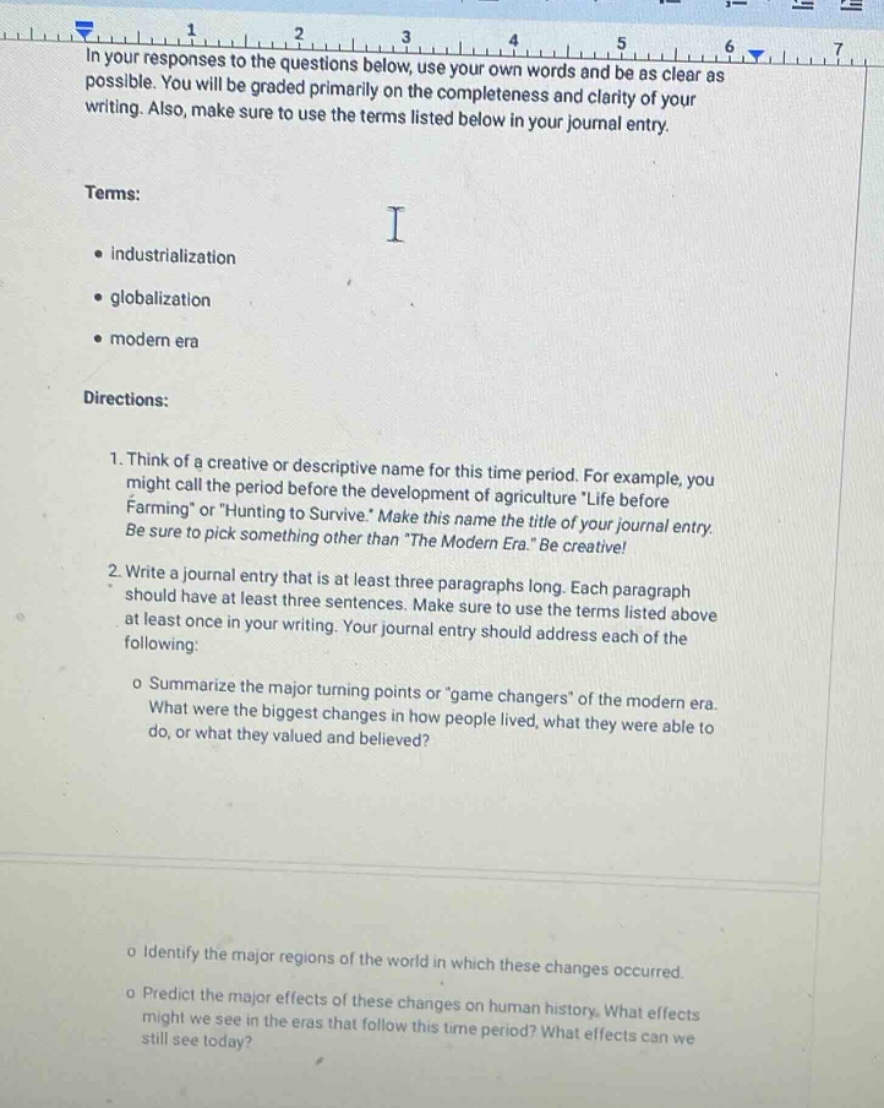
in your responses to the questions below, use your own words and be as clear as possible. you will be graded primarily on the completeness and clarity of your writing. also, make sure to use the terms listed below in your journal entry.
terms:
- industrialization
- globalization
- modern era
directions:
- think of a creative or descriptive name for this time period. for example, you might call the period before the development of agriculture \life before farming\ or \hunting to survive.\ make this name the title of your journal entry. be sure to pick something other than \the modern era.\ be creative!
- write a journal entry that is at least three paragraphs long. each paragraph should have at least three sentences. make sure to use the terms listed above at least once in your writing. your journal entry should address each of the following:
- summarize the major turning points or \game changers\ of the modern era. what were the biggest changes in how people lived, what they were able to do, or what they valued and believed?
- identify the major regions of the world in which these changes occurred.
- predict the major effects of these changes on human history. what effects might we see in the eras that follow this time period? what effects can we still see today?
Journal Entry Title: "The Age of Interconnected Progress"
Paragraph 1: Major Turning Points of the Modern Era
The modern era has been defined by transformative “game changers” that reshaped human life, values, and capabilities. Industrialization stands out as a cornerstone: it shifted societies from agrarian, manual labor–based economies to ones driven by machinery and factories, enabling mass production, urbanization, and new social classes. Concurrently, globalization emerged as nations and businesses began to interact on a global scale, breaking down geographic barriers through trade, technology, and cultural exchange. These changes redefined what people valued: efficiency, innovation, and global connectivity replaced more localized, traditional priorities. Daily life transformed as people moved to cities for factory jobs, gained access to new consumer goods, and embraced a faster-paced, technology-driven lifestyle.
Paragraph 2: Regions of Change
The changes of the modern era were not confined to a single region but spread across the globe, with distinct epicenters. Initially, industrialization took root in Western Europe and North America, where technological advancements like the steam engine and textile machinery fueled economic growth. Over time, globalization expanded these changes to regions like East Asia (e.g., Japan, South Korea) and parts of South America, as nations adopted industrial practices and engaged in global trade networks. Even regions with slower industrial adoption, such as parts of Africa and South Asia, felt the ripple effects of globalization through imported technologies, international aid, and cultural influences like Western media. This global reach meant that no continent remained untouched by the forces of industrialization and interconnectedness.
Paragraph 3: Lasting Effects on History and Today
The effects of industrialization and globalization in the modern era have echoed through subsequent eras and persist today. Historically, these changes spurred political movements (e.g., labor rights, decolonization) as people demanded better working conditions or self-governance in a more interconnected world. Economically, they laid the foundation for today’s global supply chains, where products are made, assembled, and sold across continents. Culturally, globalization has created a shared “global culture” while also sparking movements to preserve local traditions. Today, we still see the modern era’s legacy: rapid technological innovation (e.g., smartphones, AI) builds on industrialization’s emphasis on efficiency, and globalization continues to shape politics, economics, and daily life—from international climate agreements to the prevalence of multinational corporations. These changes have made the modern era a pivotal chapter in human history, with impacts that will likely endure for generations.

Snap & solve any problem in the app
Get step-by-step solutions on Sovi AI
Photo-based solutions with guided steps
Explore more problems and detailed explanations
Journal Entry Title: "The Age of Interconnected Progress"
Paragraph 1: Major Turning Points of the Modern Era
The modern era has been defined by transformative “game changers” that reshaped human life, values, and capabilities. Industrialization stands out as a cornerstone: it shifted societies from agrarian, manual labor–based economies to ones driven by machinery and factories, enabling mass production, urbanization, and new social classes. Concurrently, globalization emerged as nations and businesses began to interact on a global scale, breaking down geographic barriers through trade, technology, and cultural exchange. These changes redefined what people valued: efficiency, innovation, and global connectivity replaced more localized, traditional priorities. Daily life transformed as people moved to cities for factory jobs, gained access to new consumer goods, and embraced a faster-paced, technology-driven lifestyle.
Paragraph 2: Regions of Change
The changes of the modern era were not confined to a single region but spread across the globe, with distinct epicenters. Initially, industrialization took root in Western Europe and North America, where technological advancements like the steam engine and textile machinery fueled economic growth. Over time, globalization expanded these changes to regions like East Asia (e.g., Japan, South Korea) and parts of South America, as nations adopted industrial practices and engaged in global trade networks. Even regions with slower industrial adoption, such as parts of Africa and South Asia, felt the ripple effects of globalization through imported technologies, international aid, and cultural influences like Western media. This global reach meant that no continent remained untouched by the forces of industrialization and interconnectedness.
Paragraph 3: Lasting Effects on History and Today
The effects of industrialization and globalization in the modern era have echoed through subsequent eras and persist today. Historically, these changes spurred political movements (e.g., labor rights, decolonization) as people demanded better working conditions or self-governance in a more interconnected world. Economically, they laid the foundation for today’s global supply chains, where products are made, assembled, and sold across continents. Culturally, globalization has created a shared “global culture” while also sparking movements to preserve local traditions. Today, we still see the modern era’s legacy: rapid technological innovation (e.g., smartphones, AI) builds on industrialization’s emphasis on efficiency, and globalization continues to shape politics, economics, and daily life—from international climate agreements to the prevalence of multinational corporations. These changes have made the modern era a pivotal chapter in human history, with impacts that will likely endure for generations.