QUESTION IMAGE
Question
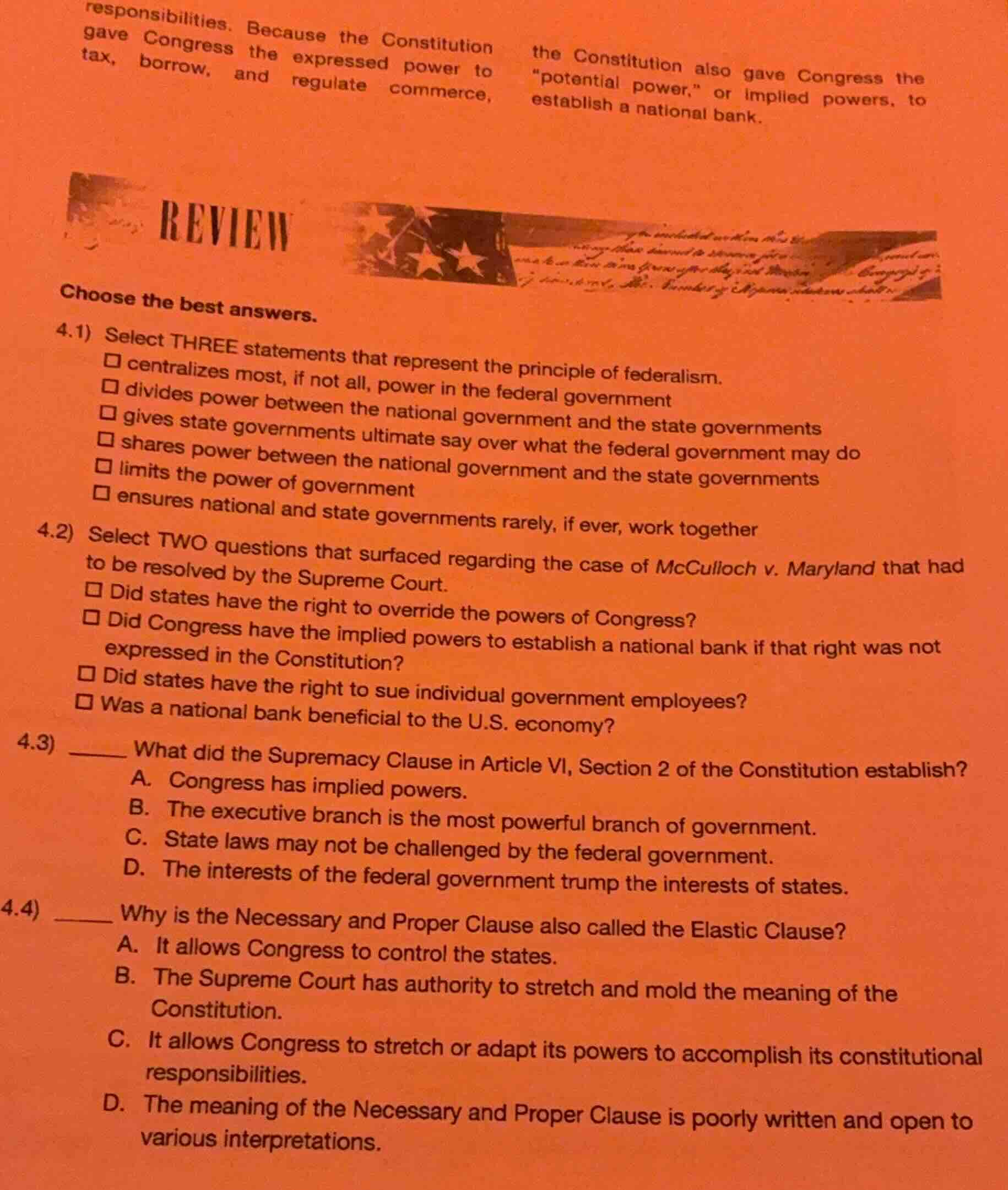
responsibilities. because the constitution gave congress the expressed power to tax, borrow, and regulate commerce, the constitution also gave congress the \potential power,\ or implied powers, to establish a national bank. review choose the best answers. 4.1) select three statements that represent the principle of federalism. □ centralizes most, if not all, power in the federal government □ divides power between the national government and the state governments □ gives state governments ultimate say over what the federal government may do □ shares power between the national government and the state governments □ limits the power of government □ ensures national and state governments rarely, if ever, work together 4.2) select two questions that surfaced regarding the case of mcculloch v. maryland that had to be resolved by the supreme court. □ did states have the right to override the powers of congress? □ did congress have the implied powers to establish a national bank if that right was not expressed in the constitution? □ did states have the right to sue individual government employees? □ was a national bank beneficial to the u.s. economy? 4.3) ____ what did the supremacy clause in article vi, section 2 of the constitution establish? a. congress has implied powers. b. the executive branch is the most powerful branch of government. c. state laws may not be challenged by the federal government. d. the interests of the federal government trump the interests of states. 4.4) ____ why is the necessary and proper clause also called the elastic clause? a. it allows congress to control the states. b. the supreme court has authority to stretch and mold the meaning of the constitution. c. it allows congress to stretch or adapt its powers to accomplish its constitutional responsibilities. d. the meaning of the necessary and proper clause is poorly written and open to various interpretations.
4.1) Federalism is defined as a system of government where power is split and shared between national and state governments. Centralizing power in the federal government, states having ultimate power, and claiming they rarely work together contradict this principle. Limiting government power is a broader constitutional principle, not specific to federalism.
4.2) McCulloch v. Maryland centered on Congress's implied powers to create a national bank and states' authority over federal institutions. The other questions are not relevant to the core issues of this case.
4.3) The Supremacy Clause establishes that federal law and authority take precedence over state interests when there is a conflict. The other options describe unrelated constitutional concepts.
4.4) The Necessary and Proper Clause is called the Elastic Clause because it lets Congress expand its powers beyond the explicit ones to carry out its constitutional duties, stretching to meet new needs.

Snap & solve any problem in the app
Get step-by-step solutions on Sovi AI
Photo-based solutions with guided steps
Explore more problems and detailed explanations
4.1)
- divides power between the national government and the state governments
- shares power between the national government and the state governments
4.2)
- Did states have the right to override the powers of Congress?
- Did Congress have the implied powers to establish a national bank if that right was not expressed in the Constitution?
4.3) D. The interests of the federal government trump the interests of states.
4.4) C. It allows Congress to stretch or adapt its powers to accomplish its constitutional responsibilities.