QUESTION IMAGE
Question
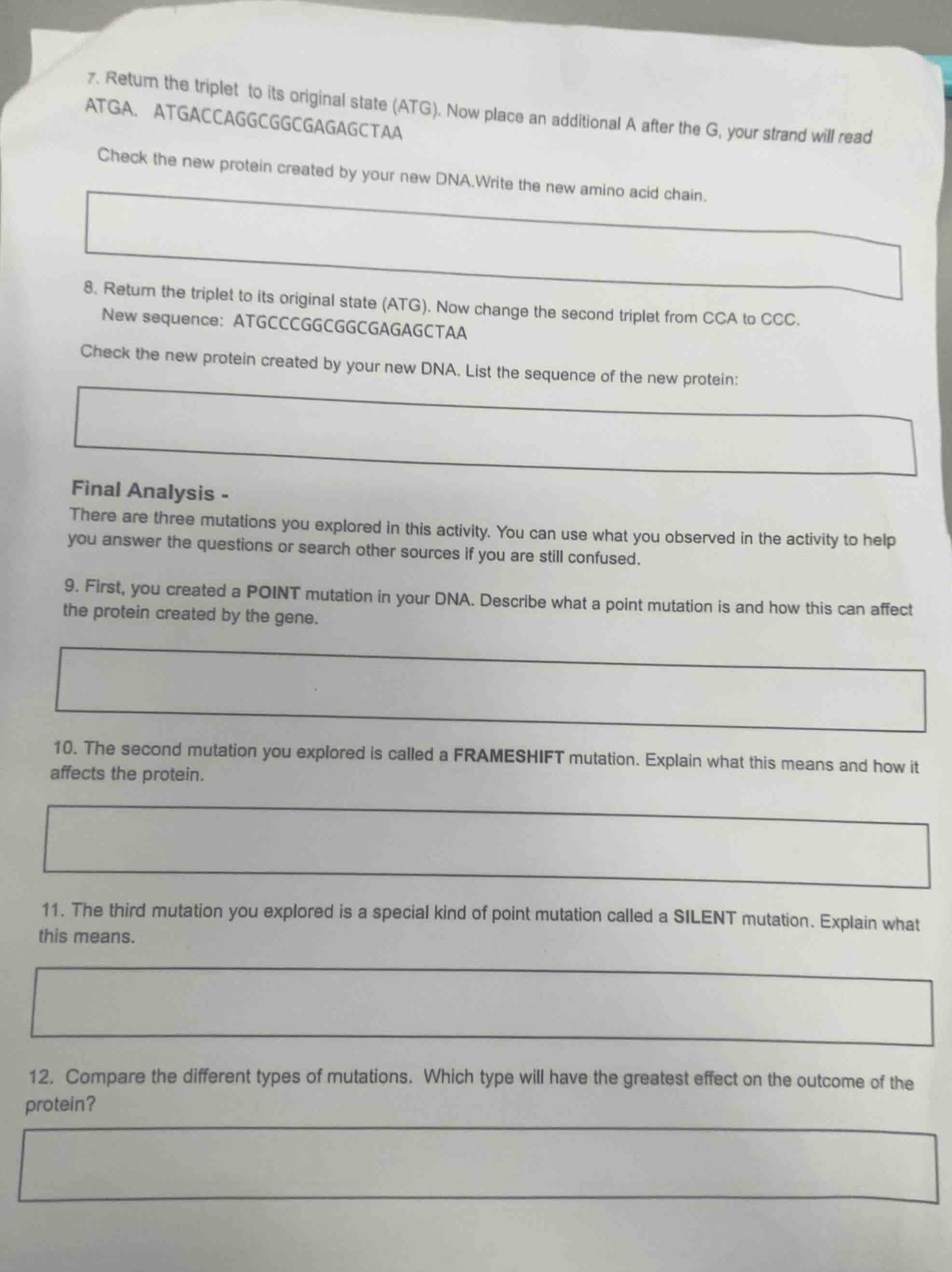
- return the triplet to its original state (atg). now place an additional a after the g, your strand will read atga. atgaccaggcggcgagagctaa
check the new protein created by your new dna.write the new amino acid chain.
- return the triplet to its original state (atg). now change the second triplet from cca to ccc.
new sequence: atgcccggcggcgagagctaa
check the new protein created by your new dna. list the sequence of the new protein:
final analysis -
there are three mutations you explored in this activity. you can use what you observed in the activity to help you answer the questions or search other sources if you are still confused.
- first, you created a point mutation in your dna. describe what a point mutation is and how this can affect the protein created by the gene.
- the second mutation you explored is called a frameshift mutation. explain what this means and how it affects the protein.
- the third mutation you explored is a special kind of point mutation called a silent mutation. explain what this means.
- compare the different types of mutations. which type will have the greatest effect on the outcome of the protein?
Step1: Transcribe DNA to mRNA (Q7)
DNA: ATGACCAGGCGGCGAGAGCTAA → mRNA: AUGACCAGGCGGCGAGAGCUAA
Step2: Split mRNA into codons (Q7)
Codons: AUG, ACC, AGG, CGG, CGA, GAG, CUA, AA
Step3: Translate codons to amino acids (Q7)
AUG=Methionine (Met), ACC=Threonine (Thr), AGG=Arginine (Arg), CGG=Arginine (Arg), CGA=Arginine (Arg), GAG=Glutamic Acid (Glu), CUA=Leucine (Leu); UAA=stop
Step4: Transcribe DNA to mRNA (Q8)
DNA: ATGCCCGGCGGCGAGAGCTAA → mRNA: AUGCCCGGCGGCGAGAGCUAA
Step5: Split mRNA into codons (Q8)
Codons: AUG, CCC, GGC, GGC, GAG, AGC, UAA
Step6: Translate codons to amino acids (Q8)
AUG=Methionine (Met), CCC=Proline (Pro), GGC=Glycine (Gly), GGC=Glycine (Gly), GAG=Glutamic Acid (Glu), AGC=Serine (Ser); UAA=stop
Step7: Define point mutation (Q9)
A single nucleotide change in DNA.
Step8: Define frameshift mutation (Q10)
Insertion/deletion of 1+ nucleotides, shifts codon reading frame.
Step9: Define silent mutation (Q11)
Point mutation that does not change the encoded amino acid.
Step10: Compare mutation effects (Q12)
Frameshift mutations alter all downstream amino acids, causing the most drastic change to the protein.

Snap & solve any problem in the app
Get step-by-step solutions on Sovi AI
Photo-based solutions with guided steps
Explore more problems and detailed explanations
- Methionine - Threonine - Arginine - Arginine - Arginine - Glutamic Acid - Leucine
- Methionine - Proline - Glycine - Glycine - Glutamic Acid - Serine
- A point mutation is a change in one single nucleotide base in a DNA sequence. It can change the encoded amino acid (altering protein structure/function), create a stop codon (truncating the protein), or have no effect (silent mutation).
- A frameshift mutation is caused by the insertion or deletion of one or more nucleotide bases that shifts the reading frame of the codons. This changes nearly all amino acids downstream of the mutation, often resulting in a nonfunctional or severely altered protein.
- A silent mutation is a type of point mutation where a single nucleotide change does not alter the amino acid that the codon codes for, due to the redundancy of the genetic code. The protein sequence and function remain unchanged.
- Frameshift mutations have the greatest effect on the protein. Unlike point mutations (which may only change one or no amino acids) or silent mutations (which have no effect), frameshift mutations change the entire reading frame, leading to a completely different, often nonfunctional, protein sequence from the mutation site onward.