QUESTION IMAGE
Question
- review questions & notes
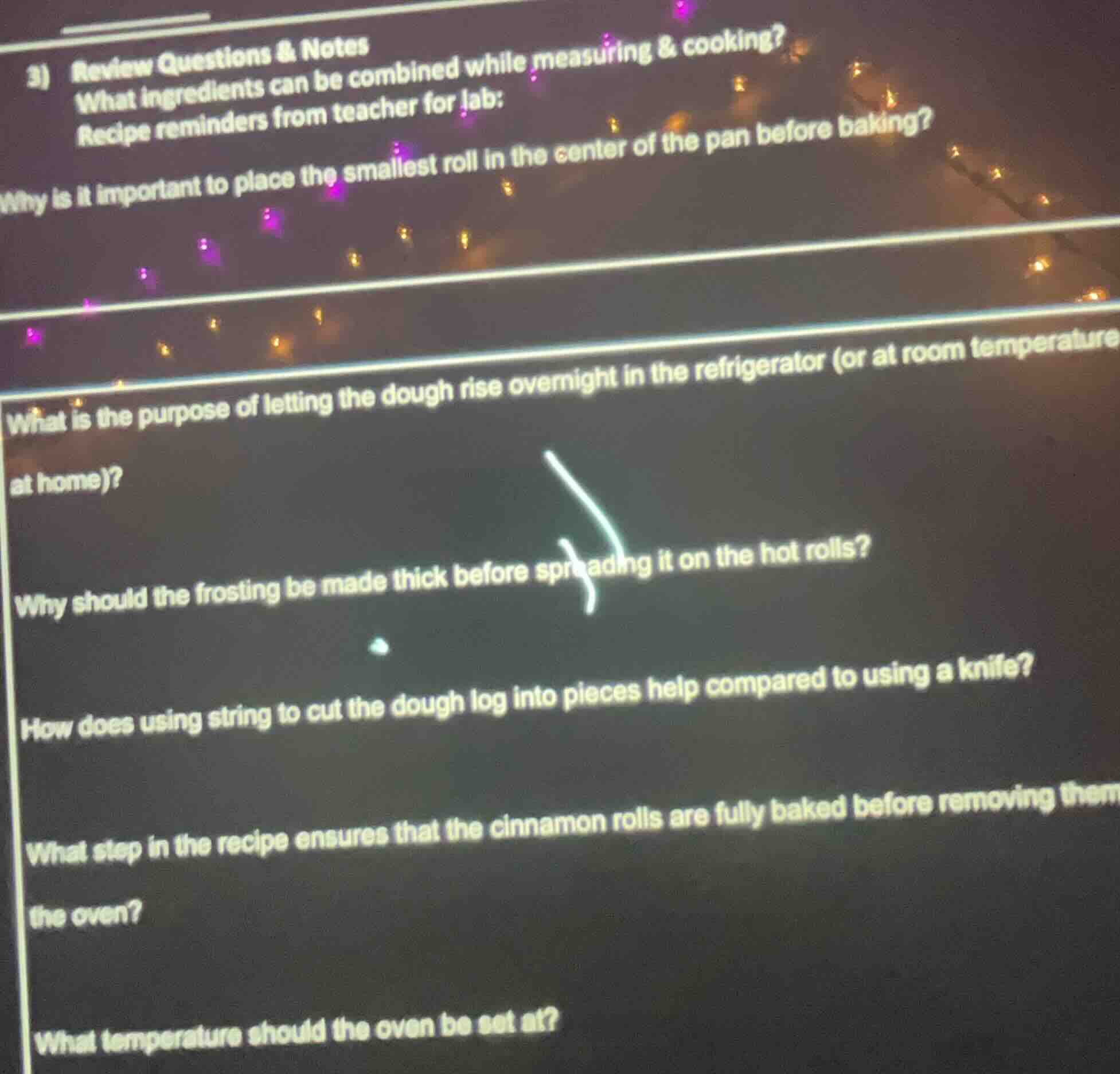
what ingredients can be combined while measuring & cooking?
recipe reminders from teacher for lab:
why is it important to place the smallest roll in the center of the pan before baking?
what is the purpose of letting the dough rise overnight in the refrigerator (or at room temperature at home)?
why should the frosting be made thick before spreading it on the hot rolls?
how does using string to cut the dough log into pieces help compared to using a knife?
what step in the recipe ensures that the cinnamon rolls are fully baked before removing them the oven?
what temperature should the oven be set at?
- Combining ingredients while measuring/cooking: Dry ingredients like flour, salt, and baking powder can be combined; wet ingredients like eggs, milk, oil can be combined first to streamline mixing.
- Smallest roll in pan center: Oven heat circulates most evenly at the edges, so the small roll (which bakes faster) in the cooler center ensures all rolls bake uniformly.
- Overnight dough rise: Slow cold rise develops deeper, more complex flavor; it also relaxes gluten for a softer texture, and makes prep easier by letting dough rise ahead of time.
- Thick frosting on hot rolls: The heat from rolls melts the thick frosting slightly, creating a smooth, evenly spread layer without it running off or becoming too thin/watery.
- String vs knife for dough: String cuts cleanly through dough without compressing it (unlike a knife, which can squish the layered dough structure), preserving the roll's light, fluffy texture after baking.
- Ensuring fully baked rolls: Inserting a toothpick or cake tester into the center of a roll; if it comes out clean (no wet dough), the rolls are fully baked.
- Oven temperature for cinnamon rolls: Standard is 350°F (175°C), a moderate temp that cooks through without burning the exterior.

Snap & solve any problem in the app
Get step-by-step solutions on Sovi AI
Photo-based solutions with guided steps
Explore more problems and detailed explanations
- Dry ingredients (flour, salt, leaveners) and wet ingredients (eggs, milk, oil) can be pre-combined separately.
- It ensures all rolls bake evenly, as the pan's center is cooler than edges.
- To develop deeper flavor, soften texture, and simplify prep timing.
- The heat melts it to a smooth, spreadable consistency without running off.
- It cuts dough cleanly without compressing its layered structure.
- Testing with a toothpick/tester that comes out clean from the roll's center.
- Typically 350°F (175°C).