QUESTION IMAGE
Question
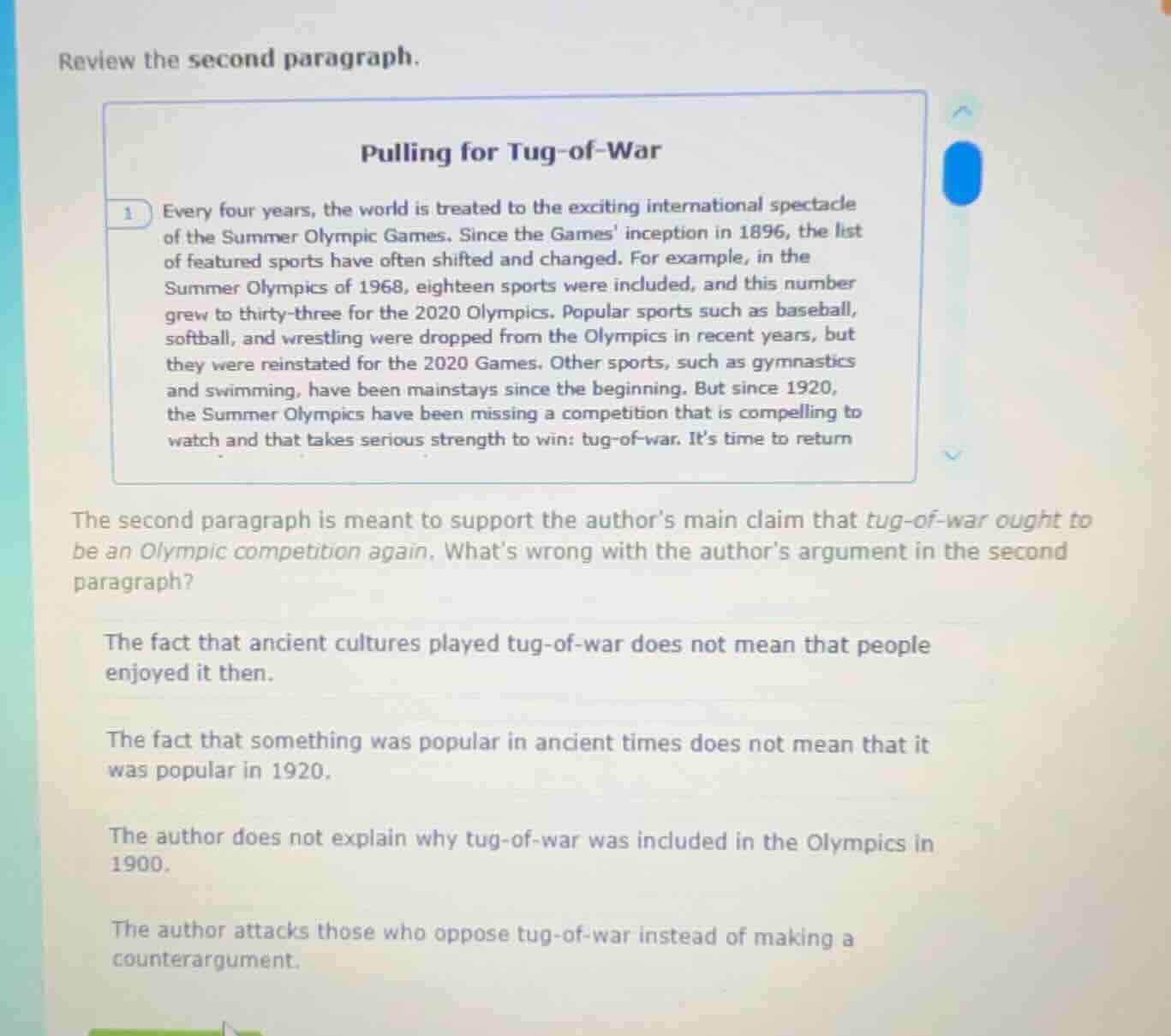
review the second paragraph.
pulling for tug-of-war
1 every four years, the world is treated to the exciting international spectacle of the summer olympic games. since the games inception in 1896, the list of featured sports have often shifted and changed. for example, in the summer olympics of 1968, eighteen sports were included, and this number grew to thirty-three for the 2020 olympics. popular sports such as baseball, softball, and wrestling were dropped from the olympics in recent years, but they were reinstated for the 2020 games. other sports, such as gymnastics and swimming, have been mainstays since the beginning. but since 1920, the summer olympics have been missing a competition that is compelling to watch and that takes serious strength to win: tug-of-war. its time to return
the second paragraph is meant to support the authors main claim that tug-of-war ought to be an olympic competition again. whats wrong with the authors argument in the second paragraph?
the fact that ancient cultures played tug-of-war does not mean that people enjoyed it then.
the fact that something was popular in ancient times does not mean that it was popular in 1920.
the author does not explain why tug-of-war was included in the olympics in 1900.
the author attacks those who oppose tug-of-war instead of making a counterargument.
To determine the flaw in the author's argument, we analyze each option:
- The first option is incorrect as the argument's flaw isn't about enjoyment in ancient times.
- The second option is correct. The author likely uses ancient popularity of tug - of - war to support its return, but popularity in ancient times doesn't imply it was popular in 1920 (when it was removed) or now, which is a flaw in the reasoning.
- The third option is incorrect as the argument's flaw isn't about explaining its 1900 inclusion.
- The fourth option is incorrect as the author doesn't attack opponents.

Snap & solve any problem in the app
Get step-by-step solutions on Sovi AI
Photo-based solutions with guided steps
Explore more problems and detailed explanations
The fact that something was popular in ancient times does not mean that it was popular in 1920.