QUESTION IMAGE
Question
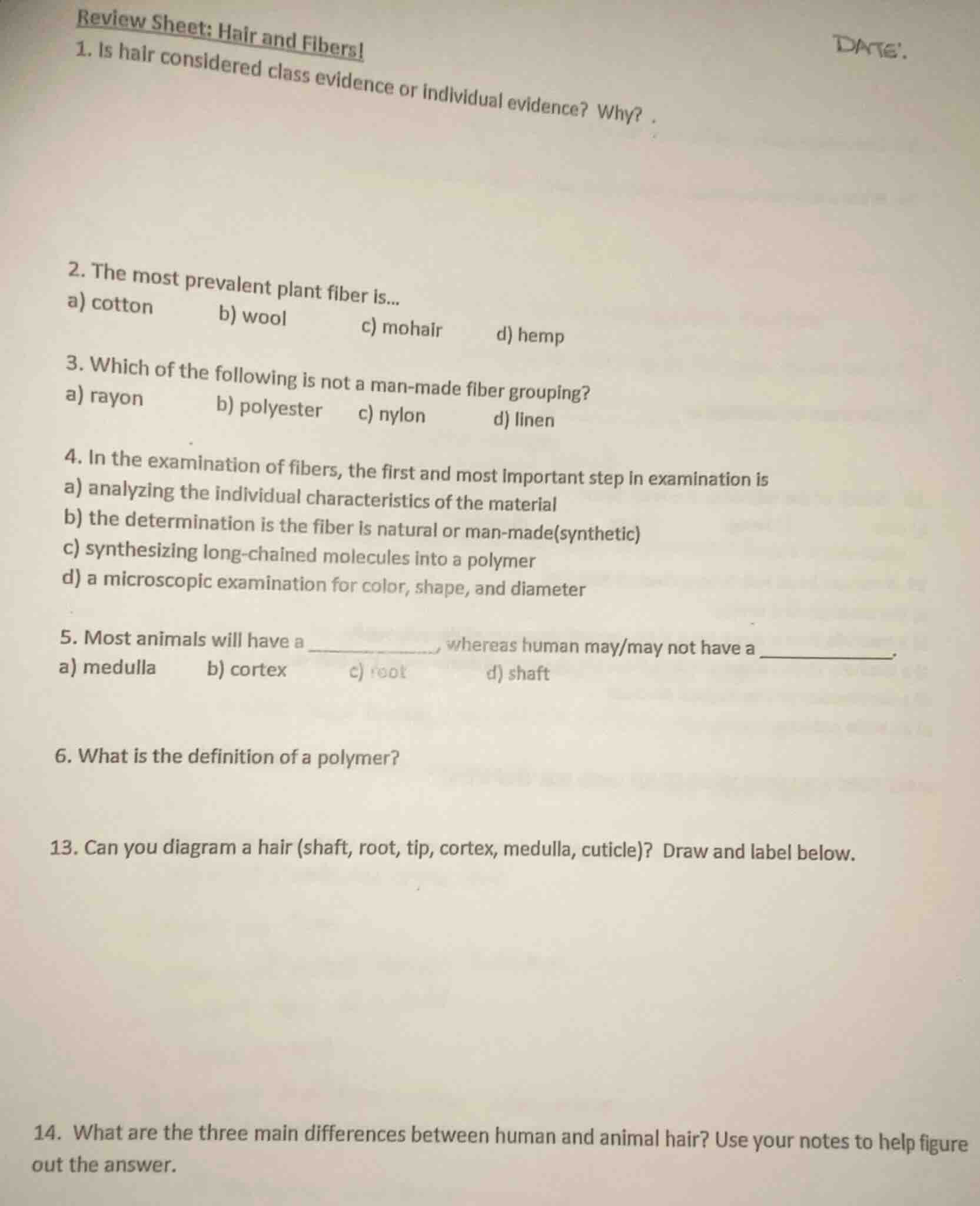
review sheet: hair and fibers!
- is hair considered class evidence or individual evidence? why?
- the most prevalent plant fiber is...
a) cotton b) wool c) mohair d) hemp
- which of the following is not a man - made fiber grouping?
a) rayon b) polyester c) nylon d) linen
- in the examination of fibers, the first and most important step in examination is
a) analyzing the individual characteristics of the material
b) the determination is the fiber is natural or man - made(synthetic)
c) synthesizing long - chained molecules into a polymer
d) a microscopic examination for color, shape, and diameter
- most animals will have a _____ whereas human may/may not have a _____.
a) medulla b) cortex c) root d) shaft
- what is the definition of a polymer?
- can you diagram a hair (shaft, root, tip, cortex, medulla, cuticle)? draw and label below.
- what are the three main differences between human and animal hair? use your notes to help figure out the answer.
Brief Explanations
- Hair is class evidence when only the shaft is found, as it can only be linked to a group of people with similar hair traits. It becomes individual evidence if the root (with DNA) is present, as DNA can match a specific person.
- Cotton is the most widely produced and used plant fiber globally. Wool and mohair are animal fibers, hemp is less prevalent than cotton.
- Linen is a natural plant fiber derived from flax, while rayon, polyester, and nylon are man-made/synthetic fibers.
- The first step in fiber analysis is identifying if it is natural or synthetic, as this dictates all subsequent testing and analysis pathways.
- Most animals have a prominent, continuous medulla, while human medullas are often fragmented or absent entirely.
- A polymer is a large molecule made of repeating smaller molecular units (monomers) linked together.
- A hair diagram has an outer cuticle (scaly protective layer), a middle cortex (contains pigment), an inner medulla (central core, may be absent in humans), a shaft (the visible part above skin), a root (embedded in skin, contains DNA if present), and a tip (the end of the shaft, often tapered).
- The key differences are: 1) Animal hair has a wider, more continuous medulla; human medulla is narrow/fragmented. 2) Animal hair has a more abrupt, distinct root shape (e.g., club-shaped for some); human roots are often more tapered. 3) Animal hair may have a distinct banded pattern in the cortex; human hair cortex pigment is more evenly distributed.

Snap & solve any problem in the app
Get step-by-step solutions on Sovi AI
Photo-based solutions with guided steps
Explore more problems and detailed explanations
- Hair is usually class evidence (when only the shaft is present) because it can only be associated with a group of individuals with similar hair characteristics. It can be individual evidence if the root (containing DNA) is attached, as DNA can be matched to a specific person.
- a) cotton
- d) linen
- b) the determination is the fiber is natural or man-made(synthetic)
- First blank: a) medulla; Second blank: a) medulla
- A polymer is a large macromolecule composed of many repeated smaller subunits called monomers, linked together by covalent bonds.
- (Diagram description):
- Draw a long, tapered strand (shaft) with a bulbous end (root) and a pointed end (tip).
- Label the outermost layer as Cuticle (scaly, overlapping cells).
- Label the thick middle layer as Cortex (contains color pigment).
- Label the central, thin (or absent) layer as Medulla.
- Label the bottom bulbous part as Root and the top pointed end as Tip.
- 1. Medulla structure: Animal hair has a wide, continuous medulla; human hair has a narrow, fragmented or absent medulla.
- Root shape: Animal hair roots are often distinct/abrupt (e.g., club-shaped); human roots are typically tapered.
- Cortex pigment: Animal hair may have banded cortex pigment; human hair cortex pigment is more evenly distributed.