QUESTION IMAGE
Question
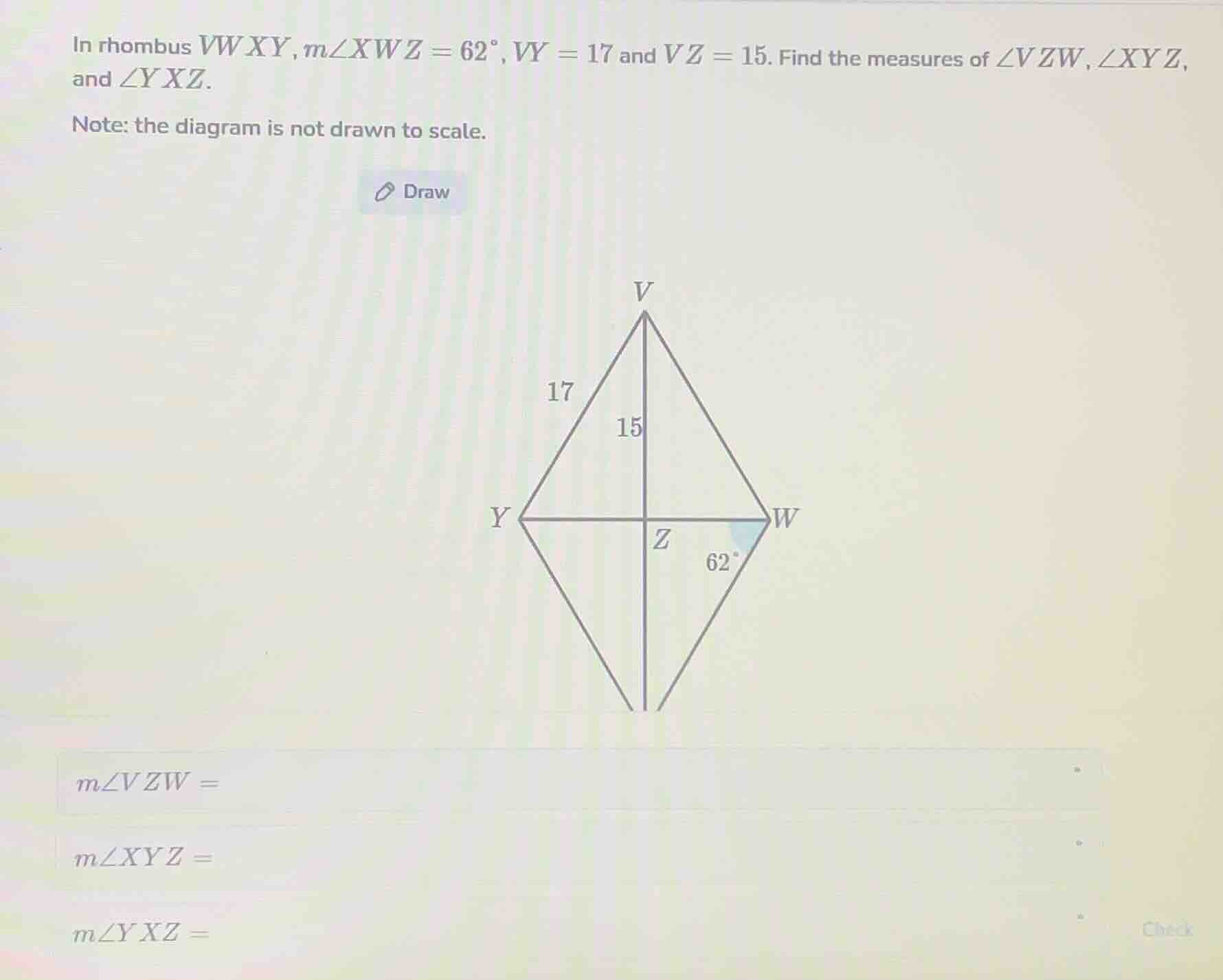
in rhombus vwxy, ( mangle xwz = 62^circ ), ( vy = 17 ) and ( vz = 15 ). find the measures of ( angle vzw ), ( angle xyz ), and ( angle yxz ).
note: the diagram is not drawn to scale.
draw
( mangle vzw = )
( mangle xyz = )
( mangle yxz = )
Step1: Find \( m\angle VZW \)
In a rhombus, the diagonals are perpendicular bisectors of each other, so \( \angle VZW = 90^\circ \) (since diagonals of a rhombus intersect at right angles).
Step2: Find \( m\angle XYZ \)
We know \( m\angle XWZ = 62^\circ \), and in a rhombus, adjacent angles are supplementary? Wait, no. Wait, triangle \( XWZ \) and the properties of the rhombus. Wait, the diagonals bisect the angles. Also, in triangle \( VWZ \), we can check if it's a right triangle. Wait, \( VY = 17 \), so \( VW = 17 \) (sides of rhombus are equal), \( VZ = 15 \). Wait, in triangle \( VZW \), \( VZ = 15 \), \( VW = 17 \), so by Pythagoras, \( ZW = \sqrt{17^2 - 15^2} = \sqrt{289 - 225} = \sqrt{64} = 8 \). But maybe that's not needed. Wait, \( \angle XWZ = 62^\circ \), and \( \angle XYZ \) is adjacent to \( \angle XWZ \)? Wait, no. Wait, in a rhombus, opposite angles are equal, and adjacent angles are supplementary. Wait, \( \angle XWZ \) is part of angle \( \angle XWY \)? Wait, no. Wait, the diagonal \( WY \) and \( VX \) intersect at \( Z \), right angles. So \( \angle VZW = 90^\circ \). Then, \( \angle XWZ = 62^\circ \), so angle \( \angle XWV = 62^\circ \), but the diagonal bisects the angle? Wait, no. Wait, in rhombus, diagonals bisect the angles. So angle \( \angle XWZ = 62^\circ \), and \( \angle XYZ \) is equal to \( 180^\circ - 2 \times 62^\circ \)? Wait, no. Wait, let's think again. The diagonals of a rhombus bisect the angles. So angle \( \angle XWZ = 62^\circ \), which is half of angle \( \angle XWY \)? No, wait, \( Z \) is the intersection of diagonals. So \( \angle XWZ = 62^\circ \), and \( \angle VZW = 90^\circ \), so in triangle \( XWZ \), angle at \( Z \) is \( 90^\circ \), angle at \( W \) is \( 62^\circ \), so angle at \( X \) is \( 28^\circ \)? Wait, no. Wait, \( \angle XWZ = 62^\circ \), \( \angle VZW = 90^\circ \), so \( \angle ZVW = 90^\circ - 62^\circ = 28^\circ \)? Wait, no, triangle \( VZW \): right-angled at \( Z \), so \( \angle VZW = 90^\circ \), \( \angle XWZ = 62^\circ \) (wait, maybe \( \angle XWZ \) is \( \angle W \) in triangle \( XWZ \)). Wait, maybe I messed up. Let's start over.
In rhombus \( VWXY \), diagonals \( VX \) and \( WY \) intersect at \( Z \), so:
- Diagonals are perpendicular: \( \angle VZW = 90^\circ \).
- Diagonals bisect the angles: So \( \angle XWZ = 62^\circ \) is half of angle \( \angle XWY \)? No, \( \angle XWZ \) is an angle in triangle \( XWZ \), which is right-angled at \( Z \). Wait, \( \angle XWZ = 62^\circ \), \( \angle XZW = 90^\circ \), so \( \angle WXZ = 180^\circ - 90^\circ - 62^\circ = 28^\circ \). Then, angle \( \angle YXZ \) is equal to \( \angle WXZ = 28^\circ \) (since diagonals bisect the angles, so \( \angle YXZ = \angle WXZ \)). Then, angle \( \angle XYZ \): in the rhombus, adjacent angles are supplementary. Wait, angle \( \angle XWZ \) is \( 62^\circ \), but angle \( \angle XWZ \) is part of angle \( \angle XWY \), which is \( 62^\circ \times 2 = 124^\circ \)? No, wait, no. Wait, \( \angle XWZ = 62^\circ \), and since diagonals are perpendicular, \( \angle VZW = 90^\circ \). Then, angle \( \angle XYZ \): in the rhombus, opposite angles are equal, and adjacent angles are supplementary. Wait, angle \( \angle XWZ \) is \( 62^\circ \), but angle \( \angle XYZ \) is adjacent to angle \( \angle WXY \). Wait, maybe I should use the fact that in triangle \( XWZ \), \( \angle XWZ = 62^\circ \), \( \angle XZW = 90^\circ \), so \( \angle WXZ = 28^\circ \). Then, angle \( \angle YXZ = 28^\circ \) (since diagonal bisects angle \( \angle YXW \)). Then, angle \( \a…

Snap & solve any problem in the app
Get step-by-step solutions on Sovi AI
Photo-based solutions with guided steps
Explore more problems and detailed explanations
\( m\angle VZW = \boxed{90^\circ} \)
\( m\angle XYZ = \boxed{124^\circ} \)
\( m\angle YXZ = \boxed{28^\circ} \)